
Dark Mode Light Mode
Chemistry, medicine, materials and the technology shaping tomorrow — the best science stories from trusted sources, every day.

Forgotten Particle Could Answer The Mystery of Why We Exist, Say Physicists

Forgotten Particle Could Answer The Mystery of Why We Exist, Say Physicists Forgotten Particle Could Answer The Mystery of Why We Exist, Say Physicists


The Big Bang should have been the start and the end of the Universe, as we understand it. 

In many ways, the cosmos likes balance, so it’s thought the Big Bang should have made matter and antimatter in equal amounts, leading them to destroy each other and leave only space and energy.

But an infinitesimal imbalance existed at some point in the early Universe that allowed matter to exist, which is important because humans and other stuff tend to be made of matter. 

Physicists now propose a new explanation for that imbalance, suggesting that our cosmic savior could have been something just as mysterious: an overlooked, hypothesized ‘ghost’ particle that could potentially solve multiple cosmological mysteries.

In a new study published in Physical Review Letters, physicists Rishav Roshan from the University of Southampton and Sudipta Show from the Indian Institute of Technology Kanpur used models and calculations to describe how this “sterile neutrino” could have allowed matter to exist.

The sterile neutrino is so called because it ignores the forces that act on ordinary matter, feeling only gravity and an extraordinarily weak pull from the Higgs.

“This decoupled heavy neutrino has long been dismissed as an irrelevant background detail in particle physics,” explains Roshan.

“However, it decays incredibly slowly. As the cosmos cooled after the Big Bang, the particle lived long enough that it temporarily took over the energy density of the Universe and triggered a matter-dominated period.”

And, if a super-heavy potential particle that only interacts with gravity brings to mind another cosmological conundrum (spoiler alert: dark matter), sterile neutrinos are a proposed culprit for at least some of the Universe’s ‘missing’ mass – though the ones in the running for that job are far lighter cousins of the monster in this study.

Yet the regular neutrinos known to exist (in three types) are themselves enigmatic, despite being everywhere all the time. Hundreds of billions may be passing through your body right now, thanks to their chargeless, nearly massless ghostlyness.

They also outnumber other particles with mass by 10 orders of magnitude, or 10 billion, CERN scientists say.

But why are they so puny? If you thought an electron was light, neutrinos are at least a million times lighter.

This riddle incorporates what’s known as Yukawa coupling, which gauges how particles like fermions interact with the Higgs field that gives them mass. Accordingly, electrons have low coupling, so they have low mass.

As physicist David Miller analogized in the 1990s, the Higgs field is like a cocktail party. The more famous an invitee is, the more they’re slowed down by other partygoers asking for a selfie. The Yukawa interaction is therefore akin to that person’s level of fame. 

In this context, one may surmise that regular neutrinos are phenomenally fame-less wallflowers. 

Every other Standard Model particle gets mass via the Higgs field, but the interaction would have to be stupendously small to explain regular neutrino masses. 
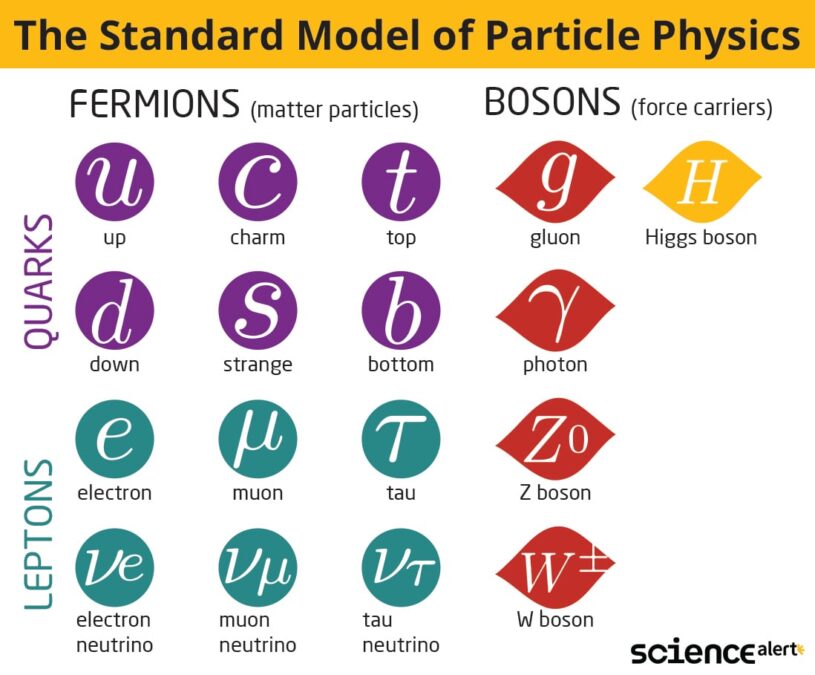
Some say the neutrinos at bottom may be joined by sterile neutrinos that could expand the Standard Model. (ScienceAlert)

So there’s another entertaining analogy, the “seesaw mechanism,” in which the regular neutrinos are so light because their undiscovered sterile neutrino counterparts (perhaps also three flavors) are so heavy. 

Boom, mystery number two potentially solved (?) via hypothetical ghosts. 

Enter the decoupled neutrino, the third, overlooked type of sterile neutrino that could inform the mystery of our existence. 

“The decoupled neutrino shifted the temperature in the early universe at which fundamental particles – like electrons and other leptons – interacted with their antiparticles with the help of the Standard Model Higgs boson,” Roshan explains.

“This temperature acts like a switch that shapes how the matter-antimatter imbalance was built up.”

So, by having an incredibly weak connection (being “decoupled”) from the seesaw mechanism, this sterile neutrino decayed more slowly than its other two sterile neutrino siblings, which more quickly decayed into leptons like electrons.

Intriguingly, these decays shortchanged the antimatter particles, creating ever so slightly more matter particles. 

By sticking around longer, the decoupled sterile neutrino temporarily upset the early Universe’s energy balance, shifting it toward a matter-dominant state that affected cosmic temperature and expansion – until said sterile neutrino decayed completely – so that the extra matter particles could survive and eventually form all the galaxies and raspberry-flavored gas clouds we see today.
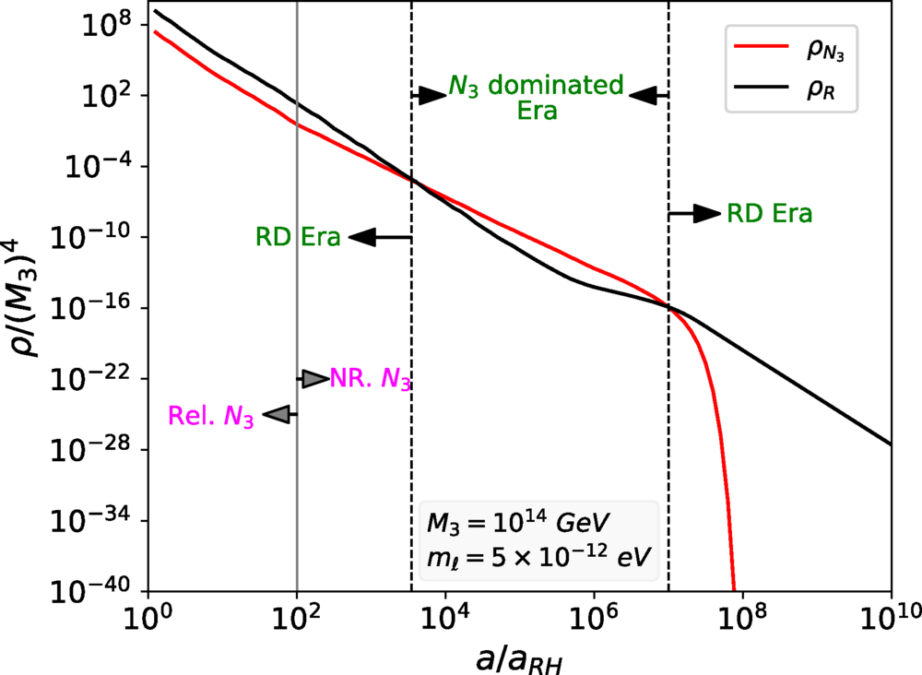
The red line that drops off sharply represents the decoupled neutrino in question. This image shows its heyday, during which it influenced early Universe evolution, before disappearing and allowing the resumption of radiation-dominated processes. (Roshan & Show, Phys. Rev. Lett., 2026)

A strange “sphaleron” process then occurred in the cooling quantum soup of the cosmos, converting part of that excess of leptons into a matching excess of quarks.

These quarks coagulated into protons and neutrons, to complement the electrons (leptons) that survived the conversion, the thinking goes.

Since this work calculates a lightest neutrino mass, it’s built to be falsifiable, and probing this mass using particle physics experiments could help pin down the ancient (non)-existence of the sterile neutrinos. 

Overall, this research “offers us a new explanation for how matter won,” Show says. 

“The dramatic shift in the early expansion of the cosmos leaves distinct but detectable imprints of changes, for example on primordial gravitational waves.”

Therefore, the neglected but slow-decaying (and now extinct) sterile neutrino as described here may be detectable through its former influence on the literal ripples in spacetime that have been propagating since the beginning of everything.

But tuning into the hum of the birth of the Universe is tricky, requiring next-generation observatories like LISA, a gigantic triangle of space-lasers, formed by a trio of spacecraft 2.5 million kilometers apart, smashing through space in Earth’s wake.

In other words, since the sterile neutrino potentially responsible for our existence is long gone, and today’s normal neutrinos are so phantasmal, we may all be the products of the ghost of a ghost. 

As Show concludes: 

“These gravitational wave signatures open up new avenues for us to unravel the evolution of the early universe after the Big Bang.”

The research has been published in Physical Review Letters.

This article was fact-checked by Rebecca Dyer and edited by Rebecca Dyer. While we pride ourselves on our process, we are only human. If you spot a mistake, please let us know.


Source link

Previous Post
Energy Department awards m to advance particle accelerators 

Energy Department awards $15m to advance particle accelerators 

Next Post
Covalent organic frameworks could clean up water pollution and generate ‘green’ ammonia | Research

Covalent organic frameworks could clean up water pollution and generate ‘green’ ammonia | Research