



Viruses can cause cancer. It’s something that’s well-established now, but the discovery was initially dismissed by the scientific community. Now, a new review published in Genes & Cancer is telling the story of the man responsible: Francis Peyton Rous.
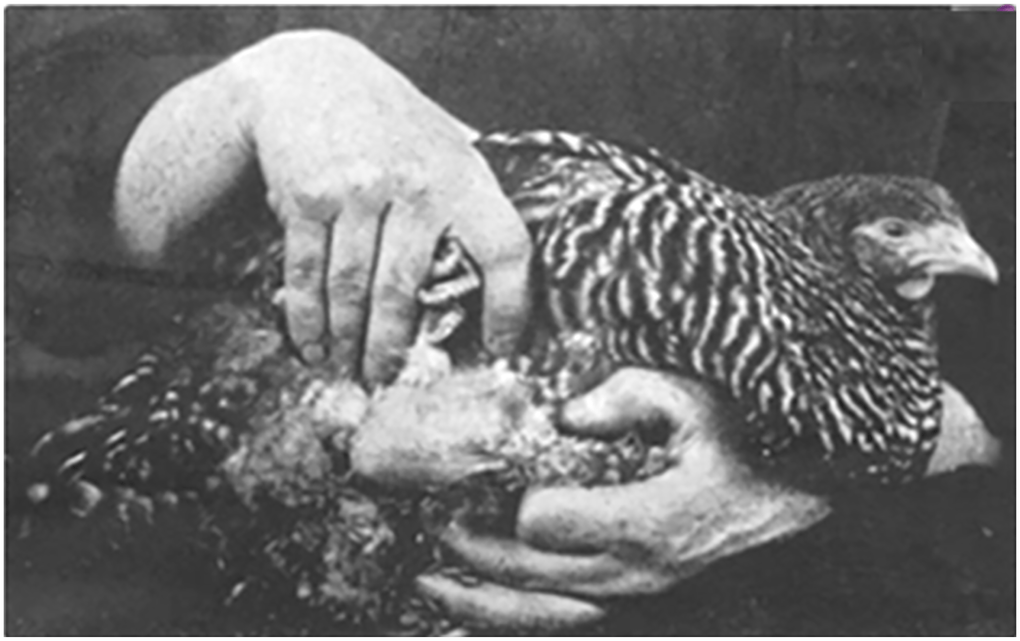
Rous was working at the Rockefeller Institute studying cancer in 1909 when a chicken farmer brought in a Barred Plymouth Rock hen with a large tumor on its breast. Unbeknownst to either of them (and especially the chicken), they would forever alter the field of cancer research.
Read more: “A Look at How Many Cancers Are Caused by Infections Worldwide”
After examining the tumor, Rous determined it was a spindle-cell sarcoma resulting from an aggressive connective tissue cancer. By transferring cells to other chickens, Rous demonstrated the cancer could be transmitted as well—but only among chickens closely related to the afflicted bird. He also found that with each transmission, the cancer grew more malignant.
To better understand what exactly was being passed on, Rous performed a simple experiment. He ground up the tumor tissue, extracted and filtered the fluid components, and injected cell-free solution into healthy birds. Curiously, these birds also developed tumors. Cancer, it seemed, was transmissible—and by something smaller than bacterium. The infectious agent in question was a virus, but without the molecular techniques and technology to investigate further, Rous pegged the carcinogenic culprit as a “minute parasitic organism.” (Viruses had only been discovered a couple decades prior, and weren’t well understood.)
The discovery would later prove to be “one of the foundational paradigm-shifts in 20th-century oncology,” as the researchers wrote, but it wouldn’t be properly recognized for decades. Instead, Rous’s findings were either questioned, downplayed, or discarded as inconsequential to human physiology. Cancer, it was believed, resulted from abnormalities in the cells.
It would take more than half a century for Rous’s discoveries to receive their appropriate acclaim. In the 1950s, advances in both virology and cell culture techniques revealed the transformational properties of the Rous-sarcoma virus. Not long after, the virus helped shed light on the genetic machinery of cancer, demonstrating how proto-oncogenes can turn into oncogenes, causing unchecked cell growth.
Rous received the Nobel Prize in Physiology or Medicine in 1966. Since then, scientists have identified a slew of viruses capable of causing cancer in humans, including human papilloma virus, Epstein–Barr virus, hepatitis B, and many more.
“What began with the investigation of a tumor-bearing chicken at the Rockefeller Institute therefore contributed to a chain of discoveries that profoundly changed our understanding of cancer biology and its molecular basis,” the researchers concluded.
Enjoying Nautilus? Subscribe to our free newsletter.
Lead Image: Rockefeller Archive Center


