

Dark Mode Light Mode
Chemistry, medicine, materials and the technology shaping tomorrow — the best science stories from trusted sources, every day.

Nitrogen radical cations overturn assumptions by mimicking Lewis acid catalysts | Research

Nitrogen radical cations overturn assumptions by mimicking Lewis acid catalysts | Research Nitrogen radical cations overturn assumptions by mimicking Lewis acid catalysts | Research


Nitrogen radical cations can catalyse hydrosilylations, aldol reactions, Diels–Alder cycloadditions, olefin dimerisations and other transformations typically associated with Lewis acids, new research shows. The findings suggest that highly electrophilic open-shell species can sometimes activate substrates in ways that resemble conventional Lewis acids.

Lewis acids are among the most widely used catalysts in synthesis. Their ability to activate substrates has traditionally been associated with compounds that possess a formally vacant acceptor orbital, such as the borane B(C₆F₅)₃. But the new work suggests that this may not be a prerequisite for Lewis acid-like reactivity.

To investigate whether similar reactivity might arise from an entirely different class of compounds, Christopher Caputo at York University in Canada and Tomáš Slanina at the Institute of Organic Chemistry and Biochemistry in Prague, Czechia, turned their attention to triarylamminium radical cations, including the commercially available oxidant Magic Blue.

‘Once we started seeing some of these reactions work, we realised there was probably something more fundamental going on,’ says Caputo. ‘The challenge then became figuring out exactly what these radical cations were doing.’
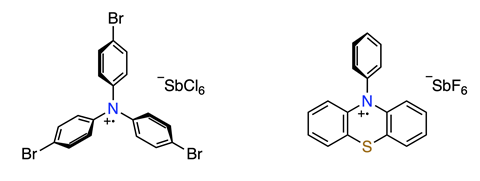
Two organic structures each with three carbon rings around a centre of Nitrogen. One has bromines on the end of each ring and SbCl6. The other has a sulfur link between two of the rings and a SbF6

Determining the origin of that reactivity required extensive mechanistic detective work. ‘We spent probably 60% of it trying to rule out mechanisms,’ says Caputo. The researchers systematically excluded pathways involving single-electron transfer, Brønsted acid catalysis, excited-state chemistry and Lewis acids such as SbCl₅ generated through decomposition of the counter-anion.

That detective work was complicated by the nature of the catalysts themselves. ‘The hardest thing in my opinion of the whole project is the fact that we’re working with radicals,’ says Taylor Cosby, a PhD student in the Caputo group, who co-led the work. Because the species are paramagnetic, many conventional mechanistic tools, including NMR spectroscopy, could not be readily applied, forcing the team to rely on alternative spectroscopic methods and carefully designed control experiments.

For postdoc Denisa Hidasová, who co-led the work from the Slanina group, the biggest challenge was overturning assumptions about how radical cations typically react. ‘This was a big challenge to rule out radical mechanisms,’ she says. Nitrogen radical cations are normally associated with single-electron processes, yet the team found they could promote transformations more commonly linked to electrophilic catalysts.
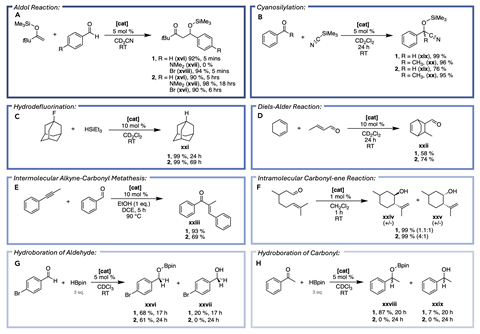
A series of chemical equations

Computational studies suggested the radical cations possess exceptionally high Lewis acidity. Lutz Greb, who develops Lewis acids and methods for evaluating Lewis acidity at Heidelberg University, Germany, highlights that the work brings ‘unconventional electronic structures, which have previously not been considered to be like typical Lewis acidic systems’ into focus. At the same time, he cautions against overinterpreting the Global Electrophilicity Index (GEI) data used in the study, because the metric’s scale was not designed to compare fundamentally different compounds, such as radical cations and classical Lewis acids.

Rebecca Melen, whose group at Cardiff University, UK, has extensive experience using Lewis acid catalysts in synthesis, shares that view. ‘I think you always need to be careful when comparing to other Lewis acid types,’ she says, although she notes that GEI has the advantage of being independent of any specific Lewis base probe. More broadly, she says the study highlights an alternative mode of substrate activation and provides ‘a different way of thinking about Lewis acidity and catalyst design’.


Source link

Previous Post
Advancing battery recycling targets through improved electrochemical performance of lithium-ion battery cells at full factory scale

Advancing battery recycling targets through improved electrochemical performance of lithium-ion battery cells at full factory scale

Next Post
“Medium Roast, Cream, No Plastic”: New Coffee Cup Coating Protects Against Microplastics

“Medium Roast, Cream, No Plastic”: New Coffee Cup Coating Protects Against Microplastics