


A binary potassium–iridium compound synthesised under high pressure has an unusual distribution of electronic charge.1 Although it is not the compound the researchers were seeking, they believe it could be the first member of a family of alkali metal–iridium compounds.
Exploring the limits of elements’ oxidation states can uncover new electronic structures and bonding patterns. Iridium is especially interesting because it can exist in a remarkably broad range of oxidation states, predominantly as cations, including +9 – the highest oxidation state of any element. Unlike neighbouring platinum and gold, which have well-established anionic chemistry, monoatomic iridium anions have remained experimentally elusive.
In 2016, computational work at the University of Houston in the US suggested that synthesising the compound K3Ir under high pressure would form an iridide (Ir3−) anion.2 Now, a team led by Douglas Fabini, who’s now at the Paul Scherrer Institute in Switzerland, and Danna Freedman, at Massachusetts Institute of Technology in the US, set out to create Ir3– using modern high-pressure synthetic and analytical techniques.
Hoping to synthesise K3Ir, the team heated and squeezed a potassium rich mixture of elemental potassium and iridium to 493K and almost 20GPa in a diamond anvil cell. It saw them create K5Ir, not K3Ir. A combination of x-ray diffraction, Raman spectroscopy and first-principles calculations helped establish its crystal structure as a BaSn5 type structure. And while it wasn’t quite what they were aiming for, K5Ir is the first reported example of contact between iridium and an alkali metal heavier than lithium.
It is also the alkali-richest alkali metal–transition metal compound reported and has an unusual electronic structure where a highly reduced iridium centre is stabilised by both oxidised and neutral potassium on different sites. ‘The numbers of negatively and positively charged electronic charge carriers are both small and somewhat balanced. This situation is not as extreme as in some semimetals like elemental bismuth, but it is nevertheless intriguing,’ says Fabini.
Weiwei Xie, an expert in high-pressure single crystal x-ray diffraction at Michigan State University in the US, describes the compound’s structure as ‘an approximate “anti-Zintl” phase’, in which the potassium-rich framework contains electronically distinct potassium sites, with some of the electrons delocalised in the interstitial regions between potassium atoms. ‘This challenges conventional ionic and Zintl-type bonding descriptions and provides an interesting example of how chemical bonding can evolve under high pressure,’ she says.
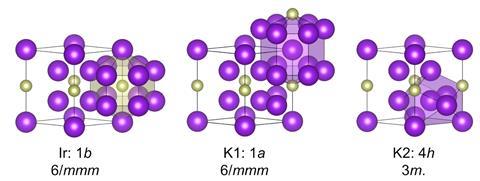
Estimated net atomic charge of iridium is −1.89 in K5Ir, which is less negative than in hypothetical K3Ir. But it exceeds those of Pt2− in Cs2Pt and Ir3− in putative Na3[Ir(CO)3]. Extended theoretical analysis predicts several other thermodynamically stable compounds in the K–Ir system, hinting at the possibility of discovering other exciting new iridide species.
Fabini sees K5Ir as a starting point for future discoveries in a barely explored region of chemical space. Looking ahead, Xie suggests that this research could open up possibilities for future applications in quantum and energy materials, while also emphasising the potential of high-pressure methods for accessing unusual electronic states and bonding environments.


