





A common solitary bee lines its nest with a plastic that rapidly decomposes in soil. The female cellophane or plasterer bee (Colletes inaequalis) builds nests for larvae to overwinter in, yet this polyethylene-like polyester degrades significantly within a year, new research reveals.
Around one third of plastic made globally is polyethylene (PE) and it may persist in the environment for decades, even centuries. ‘Nature seems to have solved the conundrum of practical plastics and biodegradability – which normally don’t go well together,’ says Jonathan Coote, a sustainable biomaterials researcher at Virginia Tech in the US.
Cellophane bees, often harbingers of spring in North America, can nest together in their thousands underground and return to the same locations for decades. ‘The nest lining looks and feels just like cellophane when it is new – crinkly and shiny and strong. Over time, it begins to fragment and crumble,’ notes Laura Russo, an entomologist at the University of Tennessee in Knoxville. Russo, Coote and colleagues were intrigued by a lack of accumulation of nest material.
They revealed the bee plastic to consist of unbroken chains of carbon–carbon bonds with an ester group every 18 to 22 carbons. The polyester is crosslinked and about 60% crystalline with PE-like orthorhombic packing. The polymer is semicrystalline and water-repellent, with properties similar to manmade PE.
The amount of polyester in bee nests fell from 73% to 40% by weight within four months in soil. Chemists have tried to make PE-like polyesters, featuring long aliphatic repeat units connected by ester groups, but their degradability is often poor. ‘Those materials are too hydrophobic. The crystals seem to sequester the esters away so that biology and water can’t act on them,’ says Coote. ‘Based on their chemical structure, the nest lining should behave like these synthetic analogues, yet they don’t.’
Conventional polyester analogues form many-layered crystals that organise themselves into large spherical structures that can be tens to hundreds of micrometres in diameter. X-ray scattering analysis revealed scant evidence of higher order crystal organisation in the bee polyester, possibly due to cross-linking, which the researchers at Virgina Tech viewed as offering a possible explanation. ‘The crystallinity is broken up and disordered into small nano-crystallites, which expose a greater surface area and leave those esters more vulnerable,’ Coote says.
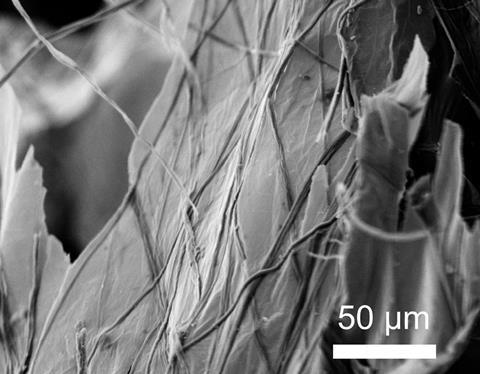
There was evidence of enzymes breaking down polyesters in bee nests. ‘We now have a natural model to work backwards from and we want to narrow down what is the silver bullet here for biodegradability – is it the crystal structure, the crystal organisation or enzymatic activity?’ asks Coote.
The bee polymer originates as macrocyclic lactone monomers – rings of carbon and oxygen – from a gland adjacent to the stinger, but these compounds can be difficult to polymerise. ‘You can see layers laid down as the nest is being constructed – it is almost like 3D printing, it is so fast,’ says Coote. ‘Figuring out what enzyme is facilitating that polymerisation would be really valuable.’
Taylor Nelson, an environmental chemist at the University of Konstanz in Germany, says the study doesn’t mean ‘we should now have bee farms for producing bioplastics, but certainly we could take lessons from the enzymatic process of polymerisation and depolymerisation’. ‘Enzymes could be useful catalysts for recycling plastics,’ he points out. ‘If you want an enzyme for polyethylene-like polyesters, maybe somewhere where bees are already degrading them is a good place to look.’


