
Dark Mode Light Mode
Here’s Why It’s So Hard to Boost a Satellite
Scientists Measure Gravitational Pull Between The Smallest Objects Yet in Quest For Quantum Gravity
Chemistry, medicine, materials and the technology shaping tomorrow — the best science stories from trusted sources, every day.

Scientists Measure Gravitational Pull Between The Smallest Objects Yet in Quest For Quantum Gravity

Scientists Measure Gravitational Pull Between The Smallest Objects Yet in Quest For Quantum Gravity Scientists Measure Gravitational Pull Between The Smallest Objects Yet in Quest For Quantum Gravity


We’re used to thinking of gravity in the context of large masses – the whirl of planets, the inexorable pull of a black hole.

But everything with mass, no matter how small, exerts a gravitational pull on everything else.

There is, however, an expected frontier where the classical dynamics described so elegantly by general relativity must somehow reconcile with the beautiful chaos of quantum mechanics.

How do we find this frontier? By attempting to measure gravitational interactions on smaller and smaller scales, always refining the techniques so that one day, hopefully, we can glimpse what lies therein.

And now, physicists led by Shan-Qing Yang of Sun Yat-sen University in China have announced a new milestone – a measurement of the gravitational attraction between the smallest pair of masses yet, two silicon wafers each weighing a mere 7.6 milligrams.

It is, they write in a paper published in Nature Communications, “a significant step toward bridging the classical and quantum regimes of gravitation.”

General relativity and quantum theory are two different ways of mathematically describing the behavior of the Universe on different scales.

Relativity describes gravity as the curvature of a continuous fabric of spacetime, while quantum mechanics describes the behavior of matter and energy using the mathematics of probability.

Both theories are marvelously successful in their respective realms, but their mathematical frameworks don’t fit neatly together, leaving physicists without a complete description of how gravity behaves when quantum effects come into play.

To find a door into this regime, physicists in recent years have turned to an experiment made famous by 18th-century English scientist Henry Cavendish, which could isolate the gravitational attraction between relatively small masses from Earth’s overwhelming pull.

YouTube Thumbnail

frameborder=”0″ allow=”accelerometer; autoplay; clipboard-write; encrypted-media; gyroscope; picture-in-picture; web-share” referrerpolicy=”strict-origin-when-cross-origin” allowfullscreen>

The Cavendish experiment consisted of a torsion balance, with lead weights attached at each end of a horizontally suspended rod, and larger lead weights positioned nearby.

The attraction between the nearby weights and those on the rod caused the rod to rotate, twisting the wire on which it was suspended, allowing Cavendish to measure the gravitational attraction based on how much the wire twisted.

In 2021, a team of physicists described what was at the time the lightest demonstration of Cavendish yet – a measurement of the gravitational attraction between two tiny gold spheres, each weighing around 92 milligrams.

And, in their paper, they laid down a challenge to push the envelope even further.

Yang and his colleagues apparently accepted.

Their version of the Cavendish experiment came with some special flair.

Using a technique called deep silicon etching, the researchers fashioned a miniature torsion balance, with a tiny silicon wafer weighing just 7.6 milligrams at one end of a suspended rod, and a counterweight at the other.
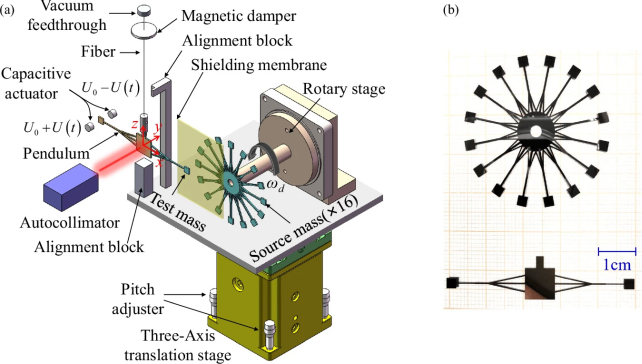
Scientists Measure Gravitational Pull Between The Smallest Objects Yet in Quest For Quantum Gravity
Diagram of the miniature torsion balance and rotating wheel used to measure the gravitational attraction between two 7.6-milligram silicon wafers. The wheel carries 16 wafers that pass the test mass in succession, producing a repeating gravitational tug. (An et al., Nature Communications, 2026)

But rather than placing a single mass nearby to exert a gravitational pull, the team built a rotating wheel, with 16 identical silicon wafers arranged around its circumference.

As the wheel turned, each wafer passed close to the test mass in succession, exerting a tiny gravitational tug.

The wheel completed a rotation every 10 minutes, meaning the gravitational tug repeated 16 times per rotation – a clear repeating signal that the researchers could distinguish from the background noise.

The entire apparatus was enclosed in a vacuum chamber, with a thin, gold-coated silicon membrane separating the rotating masses from the torsion balance to minimize interference from electrostatic forces.

And rather than allowing the balance to twist freely, the researchers used an electronic feedback system to hold it almost perfectly still, measuring the force required to counteract the gravitational attraction.

When they looked at the torque on the torsion balance, they found a gravitational attraction consistent with Newton’s predictions – including a minute tug calculated at just 471 attonewtons, or 0.000000000000000471 newtons, at the closest separation.

For context, that’s around 20 billion times weaker than the gravitational force holding a single 1-milligram grain of sand to Earth’s surface.

The researchers found that, even at these almost astronomically tiny scales, Newton’s universal law of gravitation still holds firm.

From their measurements, they were even able to calculate the gravitational constant (G), deriving a value consistent with the internationally recommended value, with an uncertainty of 5.3 percent.

This, to be clear, is still nowhere close to quantum gravity. But it’s a significant step closer than we were.

To get even closer still, physicists are developing a range of techniques to measure gravity at ever smaller scales, from torsion balances like Yang’s to systems that suspend tiny objects using light or magnetic fields.

Each approach comes with its own challenges, particularly the need to eliminate interference and preserve the delicate quantum states of the objects being studied.

Eventually, the goal is to measure gravity between objects whose behavior is governed by quantum mechanics, to see whether gravity itself has quantum properties.

Together, these different approaches offer hope that such a measurement may be within reach.

“The continued advancement of these approaches, each operating across different but increasingly overlapping mass regimes, holds promise that gravitational interactions between quantum-state objects may be observed in the foreseeable future,” Yang and his colleagues write.

The research has been published in Nature Communications.

This article was fact-checked by Fiona MacDonald and edited by Fiona MacDonald. While we pride ourselves on our process, we are only human. If you spot a mistake, please let us know.


Source link

Previous Post
Here’s Why It’s So Hard to Boost a Satellite

Here’s Why It’s So Hard to Boost a Satellite