









High above your head, it’s getting a bit crowded.
In low-Earth orbit, more than 13,000 satellites are currently circling the planet. They’re the backbone of your daily weather forecast, telephone and data communications, satellite internet services, and much more besides.
They’re also total sitting ducks.
A new study warns that a single nuclear detonation at a high enough altitude could disable virtually every satellite in low-Earth orbit, knocking almost all of them out within a month.
If it sounds like science fiction, it isn’t. Nukes in space have happened before.
During the Cold War, the US and USSR conducted 18 high-altitude nuclear explosions, ranging from Earth’s upper atmosphere and up into space.
The biggest of these – called Starfish Prime – launched in 1962, detonating a 1.4-megaton nuclear warhead at an altitude of 400 kilometers (249 miles) above the Pacific Ocean.
The effects of the explosion ended up disabling several satellites at the time, and the US and Soviets agreed a year later to suspend all above-ground nuclear testing as part of the Partial Nuclear Test Ban Treaty.
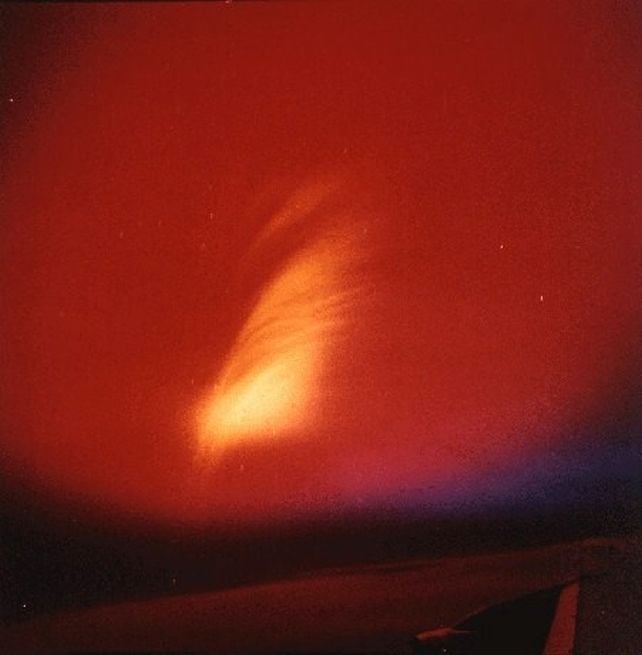
The scary thing is, even a less powerful warhead than Starfish Prime could wreak unimaginable havoc if a low-Earth orbit detonation happened today, according to calculations by researchers at the University of Wisconsin–Madison (UW) and Princeton University.
In their study – which hasn’t yet been peer-reviewed – the researchers simulated a 1-megaton nuclear explosion 500 kilometers above the South Atlantic, near a vast anomalous region where Earth’s magnetic field is unusually weak.
The conditions there – in what’s known as the South Atlantic Anomaly – would magnify the effects following the initial blast, trapping radioactive particles in pockets of space, through which satellites would keep traversing as they orbit Earth.
The same phenomenon unfolded after Starfish Prime.
“Electrons from radioactive fission-product decay became trapped in Earth’s magnetic field, creating an artificial radiation belt that damaged satellites,” the researchers, led by first author Zach Petersen, a UW astronomy-physics major student, explain in their paper.
“Unlike the prompt burst, a trapped belt repeatedly exposes spacecraft as they pass through it. A comparable event today would occur in a much more densely populated orbital environment.”
And then some.
In the researchers’ simulation – incorporating the 13,300 satellites active in low-Earth orbit as of January this year – a nuclear blast in the region of the South Atlantic Anomaly would disable 25 percent of the entire fleet after one day.
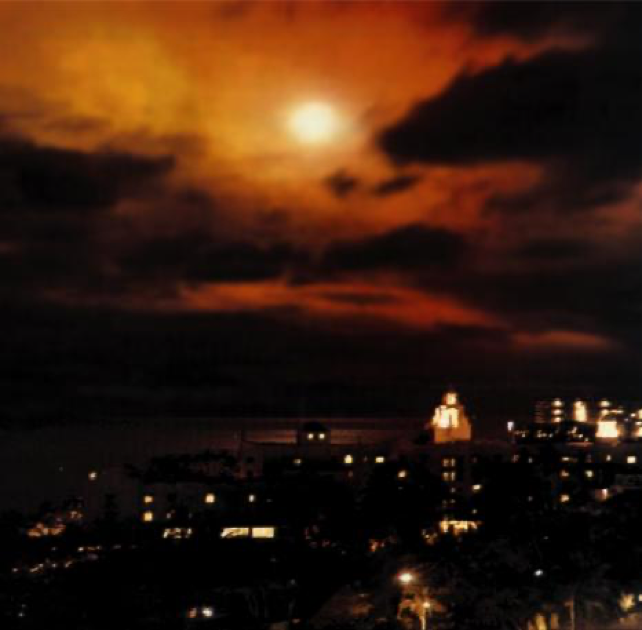
At the end of day three, 78 percent of satellites would be disabled, which would increase to 98 percent after a week, and 99.4 percent by day 15.
Even in a scenario where spacecraft were given strengthened radiation protection, 99.3 percent of all satellites would be disabled within 30 days.
In another hypothetical situation, deploying a much weaker 100-kiloton warhead, neutralizing 99 percent of satellites would take a year.
But radiation wouldn’t be the only peril.
As soon as a detonation occurs and the first satellites lose control over their maneuverability, it would increase the risk of collisions in space, with the researchers estimating approximately 20 resulting collisions within the first two years.
After 10 years, the collisions would have left approximately 3,900 new fragments of space junk orbiting Earth.
“Continued collisions among long-lived objects are expected to sustain debris production beyond the simulated decade, with the possibility of a slow buildup and eventual runaway growth on century timescales,” the team writes, noting that sending new satellites up after the calamity would also be a gamble.
“Restoring orbital services would require more than replacing the lost spacecraft: new satellites would need to survive the remaining radiation and debris. The prospect of rapid infrastructure loss followed by years of disruption reinforces the need to prevent the deployment and use of nuclear weapons in space.”
Or, in simpler terms, as nuclear policy researcher James McKeon described the findings in a post online:
“Tl;dr: it would be bad. Very bad. Very, very bad. We must do everything we can to prevent this from ever happening.”
The preprint paper is available on arXiv.
This article was fact-checked by Fiona MacDonald and edited by Fiona MacDonald. While we pride ourselves on our process, we are only human. If you spot a mistake, please let us know.


