

Archaeologists have noticed that mass ritual sacrifices in ancient Peruvian society sometimes occurred around the same time as moments of climate catastrophe.
Evidence of these grisly events has been found multiple times in the ruins of ancient societies that inhabited the Lambayeque Valley, between the Andes Mountains and the Pacific coast.
Given the tentative link between human sacrifice and El Niño events, archaeologists have theorized that these communities might have also turned to violence more broadly in response to the strain on ecological resources.
But new research published in Frontiers in Environmental Archaeology suggests that despite these instances of planned, ritualized violence, Lambayeque Valley societies were not particularly injurious outside of that context.
“If these big ritual sacrifices were indicative of some underlying crisis, we hypothesized that these events might have been extending into people’s everyday experience of the world,” says anthropological bioarchaeologist Thomas Snyder, of New York University.
Snyder and his co-author, bioarchaeologist Haagen Klaus of George Mason University, analyzed the skeletal remains of 1,633 individuals from 30 different sites in the Lambayeque Valley complex.
They were looking for signs of interpersonal violence or accidental injury.
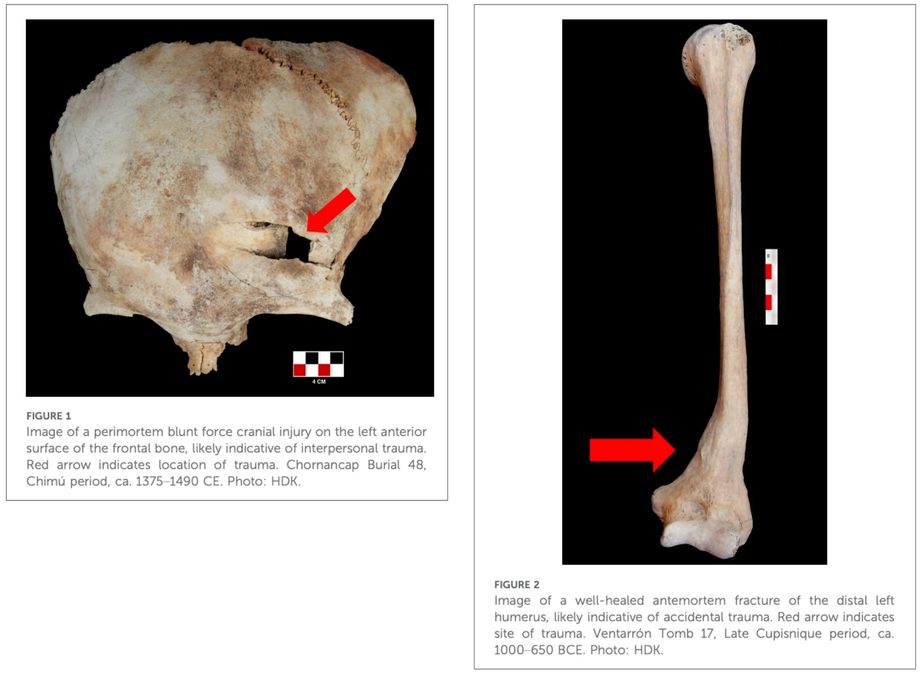
The bones they examined span around 3,000 years of human life in the Lambayeque Valley, from the pre-Columbian Cupisnique culture that emerged around 1500 BCE to the latter part of the Colonial period.
Snyder and Klaus thought the ecological stress of drought and flooding as a result of El Niño events would have led to people working harder, leading to more accidents. They also hypothesized that resource scarcity would spark fights between people desperate for food.
Although earlier studies have linked El Niño flooding to mass ritual sacrifices in the valley and nearby Andean cultures, it appears this violence did not necessarily extend beyond the ritual context.
“Leaders of the Moche and Sicán appear to have held power partly by their claims to be intercessors with the natural world,” Klaus explains.
“Large-scale events of human sacrifice just before the collapse of the Moche and Sicán political systems appear like attempts at bringing the forces of nature back into balance by offering their most precious lives to the supernatural. It’s here where the most extensive evidence of violence is found in Lambayeque.”
In Snyder and Klaus’s study, only 25 individuals in the entire Lambayeque Valley dataset had traumatic lesions on their skulls associated with interpersonal conflict.
Only 77 had traumatic lesions on their bodies, associated with accidental trauma.
No statistical relationship emerged between environmental predictors (like El Niño flood frequency and highland rain) and violence or accidental injury.
This is in stark contrast to what archaeologists have found at other sites in the Andes, where cranial trauma indicating interpersonal violence is seen at much higher frequencies.
The authors think communities in the Lambayeque Valley may have been protected from the stress of drought by their proximity to the ocean, which may have enabled more access to trade and an alternative resource for food.
“This really highlights that widespread violence isn’t a predetermined response to climate change,” Snyder says.
“In Lambayeque there’s 6,000 years of creative adaptations to El Niño and longer-term changes in climate, and widespread violence wasn’t one of them.
“As a society, we both get to and have to choose how we respond to our own climate crisis.”
The research has been published in Frontiers in Environmental Archaeology.
This article was fact-checked by Rebecca Dyer and edited by Rebecca Dyer. While we pride ourselves on our process, we are only human. If you spot a mistake, please let us know.