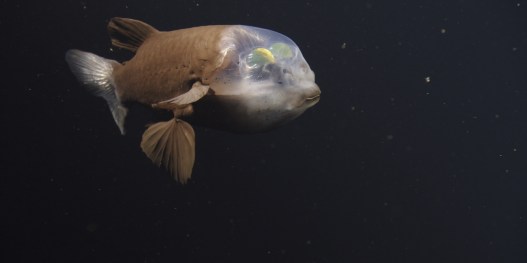


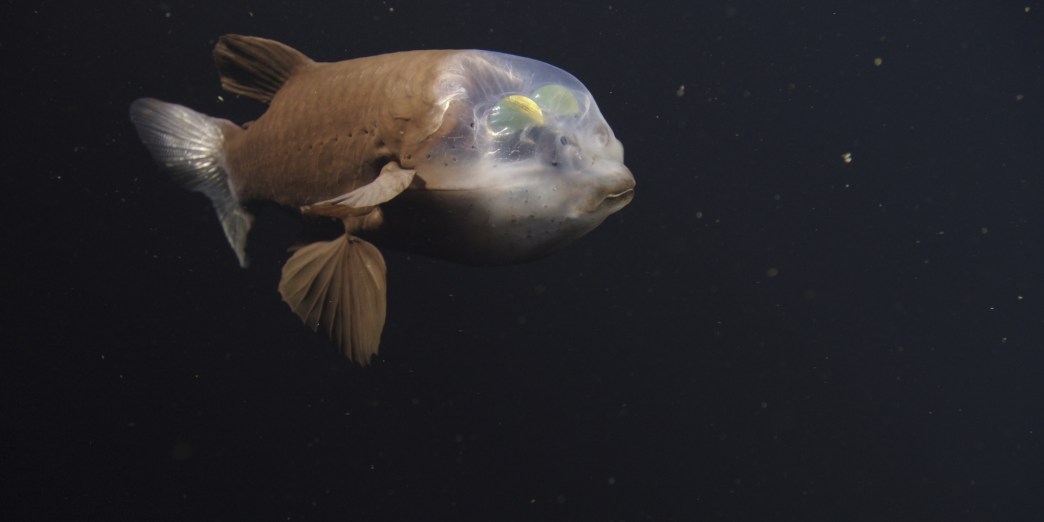
The barreleye fish—also known as the spookfish—is one of the strangest-looking critters in the ocean. The front of its head is semi-transparent, giving observers a clear look into its internal anatomy.
It’s not a fish that gets observed very often, though, which is why scientists are so excited about newly captured footage from the depths of the Monterey Canyon in the Pacific Ocean. Around 20 minutes of 4K video was recorded by a remotely operated vehicle (ROV) nearly 2,000 feet below the surface off the coast of California.
The ROV was operated by a team from the Monterey Bay Aquarium Research Institute (MBARI), and it was on its way back to the surface after a filming session when the barreleye was spotted in the murky waters.
It’s the first time the fish (Macropinna microstoma) has been spotted by MBARI researchers since 2021, and only the 11th occasion in approximately 7,000 dives by the ROV. The creature lives in what’s known as the twilight zone, which starts at 656 feet down. There’s not enough light for photosynthesis down there, so you won’t find plant life.
“Seeing a barreleye fish is a rare treat,” MBARI’s Steven Haddock said in a statement. “Crew from across the ship joined the science team in the control room, mesmerized by this remarkable animal. Deep-sea animals capture the imagination, creating wonder and awe that we hope will inspire stewardship of the largest living space on Earth.”
The transparent portion of the fish’s body means its eyes can be inside its head, looking around in all directions—but especially upward—for the silhouettes of prey to snack on. Another benefit of the see-through tissue around the eyes is the protection it provides the barreleye against the stinging tentacles of siphonophores, the spindly organisms from which the fish is known to steal food.
Getting such a close-up look at the barreleye will help researchers better understand how vision works at these depths and how the fish evolved to become so bizarre in terms of appearance.
“Macropinna reminds us of the surprising ways that animals have adapted to thrive in the ocean’s midwater,” added Haddock. “So many of them survive by looking for subtle optical cues, like a shadow passing overhead, and this sets off evolutionary competition, pitting bioluminescent camouflage against increasingly sophisticated visual capabilities.”
Sometimes the survival of the fittest is also survival of the most anatomically creative.
Enjoying Nautilus? Subscribe to our free newsletter.
Lead Image: MBARI