


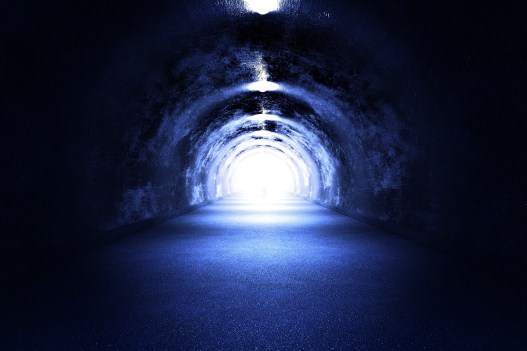


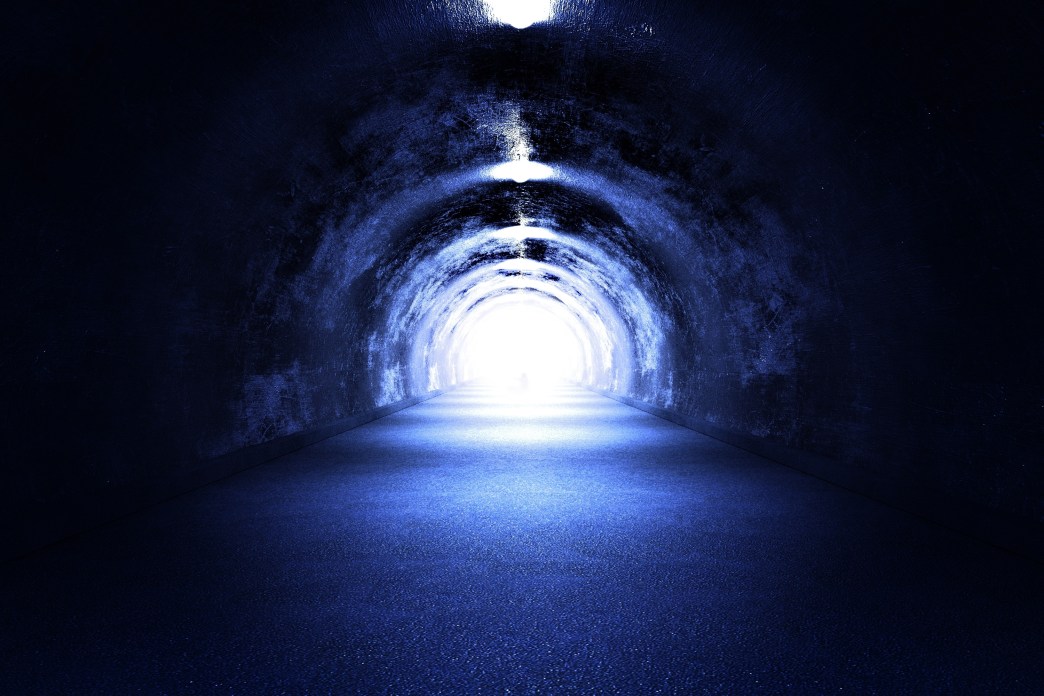
Near-death experiences are more common than many of us might think: Some studies estimate that between four and eight percent of the global population has had one, as have up to 23 percent of cardiac arrest survivors. These journeys into the borderlands of consciousness tend to feature a few common perceptual themes: ghostly figures and bright lights, tunnels, a sense of peace and calm. But questions about the nature of such experiences and how such perceptual phenomena arise abound.
Recently, visual artist and neurophenomenology researcher France Lerner and her colleagues asked 50 individuals who reported near-death experiences (NDE) to divide their recollections of them into phases, to reconstruct them using drawings of geometric shapes, and to describe the colors they perceived. The participants reported entering four types of spaces: cones, broad arches, gentle curves, and spaces resembling the inside of an egg. The cone shapes, the researchers note, look a lot like the tunnels ending in bright lights so characteristic of NDE stories.
Read More: “The New Science of the Near-Death Experience”
The study participants reported that the tunnels were generally colorless, while some of the arched spaces were vividly hued. The authors suggest that the cone shapes resemble what happens when peripheral vision narrows, as in fainting from low blood pressure, certain eye conditions, or when the eyes and the brain are deprived of oxygen. In those conditions, color sensitivity fades to the edges of vision. In addition, one of the brain’s visual pathways handles motion and brightness but is less good at managing color, which might explain the sensation of rushing through a tunnel towards a bright light. Lerner and her colleagues published their results in Frontiers in Psychology.
They point out that these results come with numerous caveats: The NDEs happened a median of about 15 years earlier, and some of them almost 80 years earlier. Participants chose from a menu of shapes, which could have influenced what they drew, and the researcher wasn’t blind to the hypothesis. No second person classified the drawings and there was no comparison group. But the authors say it’s an exploratory framework, not proof of universal motifs.
Lerner has been studying the spatial geometry, and visual patterns of movement and color characteristic to near-death experiences since she started her PhD in art and science in 2012 at the neurological department at the Liège University Hospital in Belgium. We spoke about why near-death experiences are difficult to study, how her work as an artist informs her research, and how the features of a near-death experience resemble a Rorschach test.
Why are near death experiences so difficult to study?
Because they are retrospective, first of all. It is very difficult to study them while they’re happening, so you have to find ways to measure what people tell you after the fact. The categorization of near-death experiences is also not very precise, and we can see now that they overlap with other types of experiences like psychedelic experiences, like meditation, that are non-life threatening.
Collecting individual descriptions of the phenomenology of the near-death experience is a good way of escaping this division between skeptic and mystic when it comes to these experiences. People have a religious, dogmatic, even theological view of near-death experiences. I’m trying to really bring it back to science in terms of neural correlates, what’s happening in the visual system.
With this study, you asked your participants to divide their near-death experience into phases, and then reconstruct the experiences using geometric drawings. What were you trying to find out?
Because these experiences are so emotional, people who have them overestimate or underestimate temporality. That’s why I asked the participants in my study to segment the experience into pieces, to get around this distortion of temporality.
Ordering an experience into chronological pieces helps you understand how it is organized in space. These spaces act like a container. Each scene has a special component. And then you start to make sense of the chronology and also to make a clear distinction between near-death experiences or NDEs and out of body experiences or OBEs.
In the OBE, it’s a little bit like being in virtual reality, where your body is physically in one place, but when you have the headset on, you are feeling like you are somewhere else. You become just a point of view.
The geometry is actually the visual field. These spaces that you see and, and this phenomena we’re writing about now is visual metamorphosia. Visual metamorphosia is when your visual field is inverted or oriented in different ways. This can happen to fighter pilots when they lack oxygen.
Are you going to continue to investigate near death experiences?
We started to develop a software program in 3D that will be for users and researchers to collect data across near-death experiences, out of body experiences, and also meditative and drug-induced states. I want to make the study of these experiences more rigorous, which means to have it digitalized. We also want to establish parallels with this new field called computational phenomenology, which bridges first person human experience with the structures of digital code and AI.
You’re an artist, and I was looking at your website and some of your installations. I noticed that one of the series is titled “resuscitation.” Is there any connection between that work and your work on near death experiences?
When you are an artist, you have this experience of creation, and creation is this moment where there is no time. It’s a kind of transcendental experience. So it’s very similar in some sense to the near-death experience, to any experience where time is distorted in some way: meditation, psychedelics. The installation you’re referring to is quite old, but there is always this connection between life and death.
This piece was actually quite personal, but I don’t mind because it was a victory. My daughter was sick. She had cancer when she was a baby. And we made it through. She’s 23. She’s alive and kicking. But this installation was about motherhood and the fact that it’s not as pretty and ideal as our stories of it often are.
It’s also survival. The mother cat will hold onto her baby by the scruff of the neck. It was about this. But also, my dad was a professor of medicine, and so it was always clear to me that there’s lots of life in [?]death and a lot of death in life. It’s a continuum, not a sharp border. But I’m a pure physicalist. I think that when you are brain dead, there is nothing left.
You mentioned in the study a number of Western and non-Western artists who have depicted altered states, including near death experiences. I wondered, do any of those works especially speak to you or could they inform scientific research?
I think it’s very interesting to look at the fact that we all have almost the same eyes, but the interpretation varies. It’s like with the Rorschach test. You will project your own culture onto whatever is in front of you. You will see whatever you need to see at the time when you are going to pass from one state to the other state.
The Tibetan book of Dead describes it very precisely. If you need to see angels there to help you, you will see angels. Our brain is great at producing hallucinations to help us. But the physiology of the visual system plays a part. It gives us clay to work with. Then some people interpret what they see as a river. For others it’s a tunnel. It’s amazing how we are prone to such interpretations.
Enjoying Nautilus? Subscribe to our free newsletter.
Lead Image: Virrage Images / Shutterstock


