







We still don’t fully understand the causes of dementia, but scientists are making progress.
Most encouragingly, research suggests that almost half of dementia cases could be reduced, at least temporarily, thanks to modifiable risk factors that can help to prevent or postpone the disease from occurring.
But a new study reveals we might have been overlooking a serious risk factor for cognitive decline, and it’s been hiding right under our nose.
According to a study in the Journal of the American Medical Directors Association, poor oral health could be a much greater contributor to dementia than we ever realized.
While a number of studies have linked oral health to dementia, it wasn’t included as one of 14 modifiable risk factors in the influential Lancet Commission findings updated in 2024, which in turn helped to inform new WHO guidelines released this year on dementia risk reduction.
That might bear some rethinking, based on new evidence uncovered by scientists in Japan.
In the study, researchers analyzed data from 47,293 adults aged 65 or older who took part in the Japan Gerontological Evaluation Study (JAGES), following the participants for approximately nine years, from 2013 to 2022.
During that follow-up period, 8,247 (17.4 percent) of the participants developed dementia, and the researchers wanted to investigate the extent to which poor oral health – measured by teeth count – was linked to dementia,
compared to the established risk factors listed by the Lancet Commission (excluding two that couldn’t be assessed using JAGES data: high LDL cholesterol and air pollution).
“We used the number of remaining teeth as an indicator of poor oral health, as tooth loss generally reflects the end point of a lifelong oral disease history, such as advanced dental caries and severe periodontal disease,” the research team, including first author and medical student Maho Iwata from Tohoku University, explains in their paper.
In their analysis, the researchers found that having fewer teeth was linked to a significantly higher incidence of dementia, increasing from an incidence rate of 1.63 (per 100 person-years) for people with 20 or more teeth, to 2.31 (for 10–19 teeth), 2.97 (for 1–9 teeth), and 4.34 (for people with no remaining teeth).
After adjusting for sex, age, and equivalent income, dementia risk was found to increase with fewer teeth, being 14 percent higher for people with 10–19 teeth, 12 percent higher for 1–9 teeth, and 27 percent higher for no teeth, compared to individuals with 20 or more teeth.
But the most striking finding came when the researchers compared poor oral health to the modifiable risk factors recognized by the Lancet Commission.
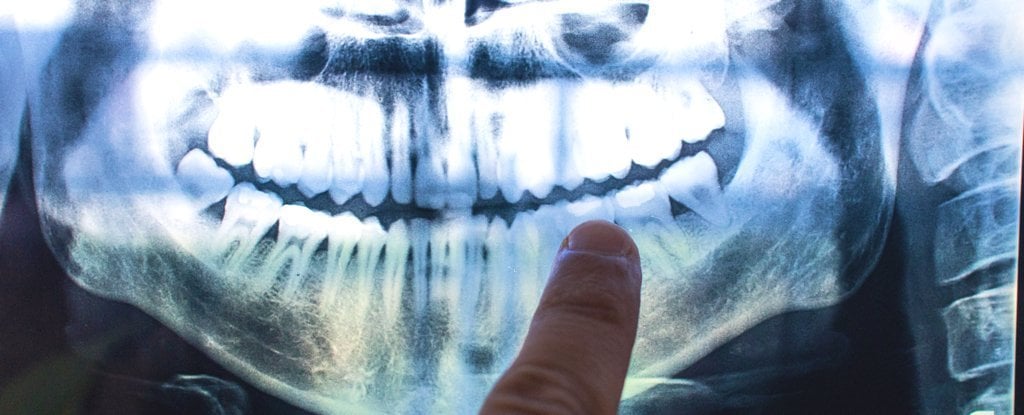
Using a statistical method called population attributable fractions (PAFs) to estimate how much risk factors might contribute to disease across a population if they played a causal role, the researchers calculated a PAF of 7.2 percent for tooth loss – meaning it could account for 7.2 percent of the cases of dementia in the study.
What’s surprising is that, over the total population, that 7.2 percent estimate was the third largest PAF overall, following only depressive symptoms (which hypothetically accounted for 10.5 percent of dementia cases) and social isolation (9.4 percent).
Even more remarkably, when the results were filtered by men only, tooth loss had the single largest PAF out of every risk factor in the study (at 12 percent), whereas for women, it was the fourth largest (6.1 percent).
That’s quite a finding, and the researchers say it suggests that tooth loss may account for a greater share of dementia cases than known risk factors such as physical inactivity, smoking, and low education.
“To our knowledge, this is the first study to quantify and compare the PAFs of poor oral health and a large number of other risk factors for dementia within the same population framework,” the team writes.
“In particular, in men, the PAF for tooth loss in our study was substantial and comparable to the top-ranked modifiable risk factors, such as depressive symptoms and social isolation, reported by the Lancet Commission, indicating its relatively large contribution to dementia onset.”

The researchers acknowledge a number of limitations with the study, including that the JAGES data relies on self-reported information from participants, which may be prone to bias or errors.
It’s also worth noting that PAFs are speculative, and even though the method estimates how risk factors might contribute to disease, the study doesn’t actually demonstrate that tooth loss causes dementia, or that preventing tooth loss would necessarily prevent dementia cases.
That said, the team says there are several pathways that could support the link. Having fewer teeth could impact the ability to chew and eat food, which could lead to poor nutrition, which is linked to cognitive decline.
Losing your teeth is also linked to social isolation, which is another risk factor for dementia. And tooth loss is also related to oral inflammation, which may lead to systemic inflammation, which can drive cognitive decline.
While more research is needed, the study authors say their findings show that oral health has major public health implications, urging that it should be integrated into dementia prevention strategies.
“This study demonstrates that tooth loss makes a substantial contribution to dementia incidence, comparable to major established modifiable risk factors identified by the Lancet Commission,” the researchers conclude.
“Together with the growing body of evidence, these findings argue for re-evaluating oral health as a key dementia risk factor and for its inclusion in future updates of the Lancet Commission report.”
The findings are reported in the Journal of the American Medical Directors Association.
This article was fact-checked by Fiona MacDonald and edited by Fiona MacDonald. While we pride ourselves on our process, we are only human. If you spot a mistake, please let us know.


