




We are only just beginning to understand how important the frozen parts of our planet are.
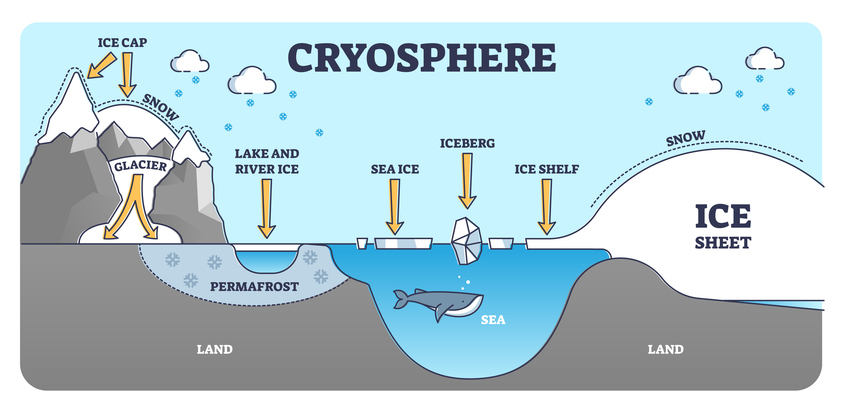
Together, they’re known as the cryosphere. Some of the cryosphere is transient, like sea or lake ice, snow caps, and frozen soil. Some has been frozen for much longer periods of geological time: the oldest known layer of permafrost in Siberia has been continuously frozen for 650,000 years.
The cryosphere influences how much water flows from the mountains, how high the sea levels rise, which pieces of land are connected, and the rhythms of life on Earth.
Given how central it is to our existence, an international team of scientists has defined a ‘safe operating space’ for the cryosphere, published in Science just in time for the global climate summit, COP31.
According to their research, we have already breached that safe operating space by burning fossil fuels, intensifying agriculture, and making drastic changes to how land is used.
“The cryosphere has already exceeded its planetary safe operating space, threatening the frozen foundations of our planet that have supported human civilizations for millennia,” says lead author Bo Su, a climate researcher at Stockholm Resilience Centre and Beijing Normal University.
“Compared to other spheres of the Earth system, our systematic understanding of the cryosphere arrived late – only in recent decades have we come to recognize its critical role in maintaining planetary stability, resilience, and habitability, and to grasp the severity of its ongoing degradation.”
The concept of a safe operating space comes from a 2009 paper by Johan Rockström and colleagues, along with the concept of planetary boundaries.
Rockström, who is director of the Potsdam Institute for Climate Impact Research, was also involved in the new cryosphere paper.
“This work substantially furthers our understanding of how cryosphere changes are threatening the stability and resilience of life-supporting conditions of the Earth system,” he says.
“As cryosphere risks unfold before our eyes – most recently with the floods in Nepal – the report’s arrival at COP31 issues an important reminder for global leaders of the significance of cryosphere governance.”
The researchers identified four key variables, and the boundaries that define a safe operating space for the cryosphere in each one, based on climate data from throughout the Holocene.
Earth has gone through many different phases when it comes to climate, but the conditions during the Holocene – which spans the past 11,700 years – have been relatively stable, and importantly, hospitable to human flourishing.
Outside of the boundaries of Holocene conditions, we don’t know if modern human societies can function.
According to the paper, to keep the cryosphere within a safe operating space, there should be at least 27.48 million gigatons of ice locked up on land.
There should also be, on average across each year, at least 19.8 million square kilometers of ocean covered by ice; -6.6 degrees Celsius (20.1 degrees Fahrenheit) temperatures in the permafrost; and snow covering at least 38.8 million square kilometers of land.
The data suggests we have already breached those boundaries.
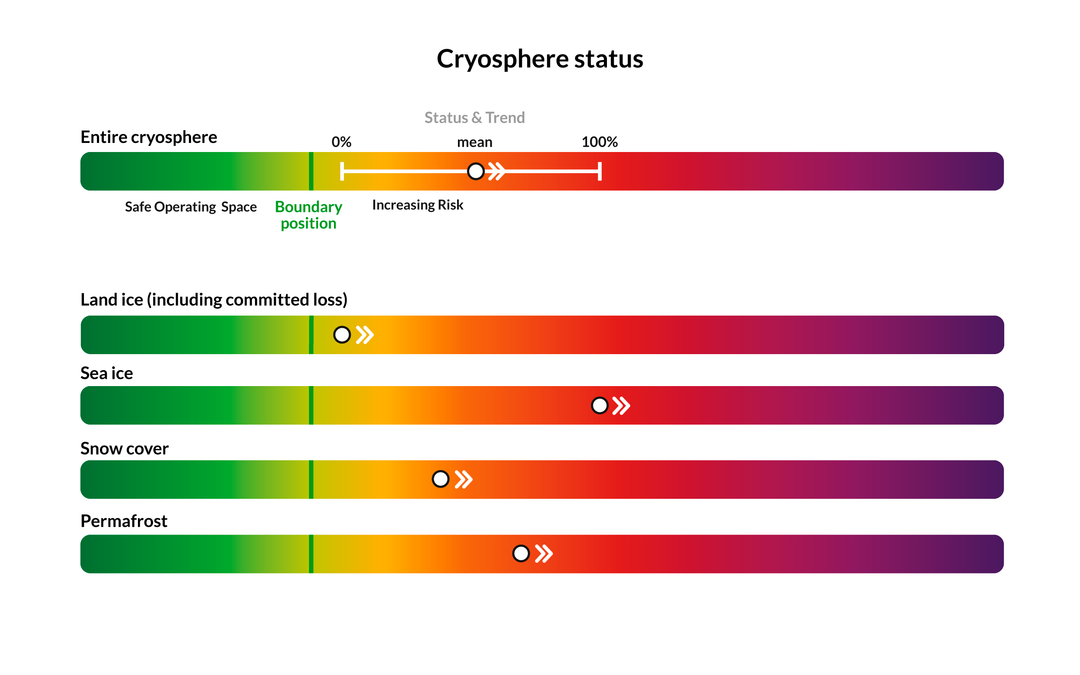
Scientists estimate the total global land ice in 2018 was around 27.63 million gigatons (right on the edge of safe), with more than an extra 0.64 million expected to be lost based on emissions that have already happened (crossing the line).
Average annual sea ice in 2024 was 16.5 million km², well below the boundary of 19.8, according to satellite data.
Permafrost ground temperature from 2000-2014 ranged from -6.0 to -5.3 degrees Celsius, based on climate modeling, which is warmer than the boundary.
In 2024, average annual snow cover was 35.9 million square kilometers, according to the ERA5-Land dataset, falling a few million square kilometers short of the boundary.
Basically, the cryosphere is likely already out of bounds on three counts, and committed to crossing the fourth.
“Maintaining and restoring Earth System resilience now requires urgent global action to halt and reverse greenhouse gas and black carbon emissions, and to reduce the effects of local human disturbances such as infrastructure expansion in cryospheric regions,” the scientists conclude in their paper.
“Humanity depends on the cryosphere for climate stability, ecological
integrity, freshwater security, and coastal protection. Neglecting the
cryosphere would lead to a profound underestimation of planetary risks.”
The research has been published in Science.
This article was fact-checked by Fiona MacDonald and edited by Fiona MacDonald. While we pride ourselves on our process, we are only human. If you spot a mistake, please let us know.


