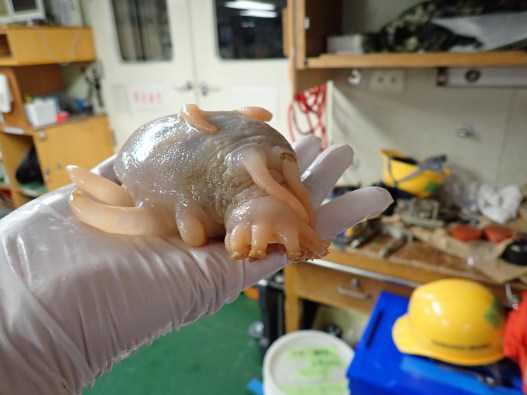


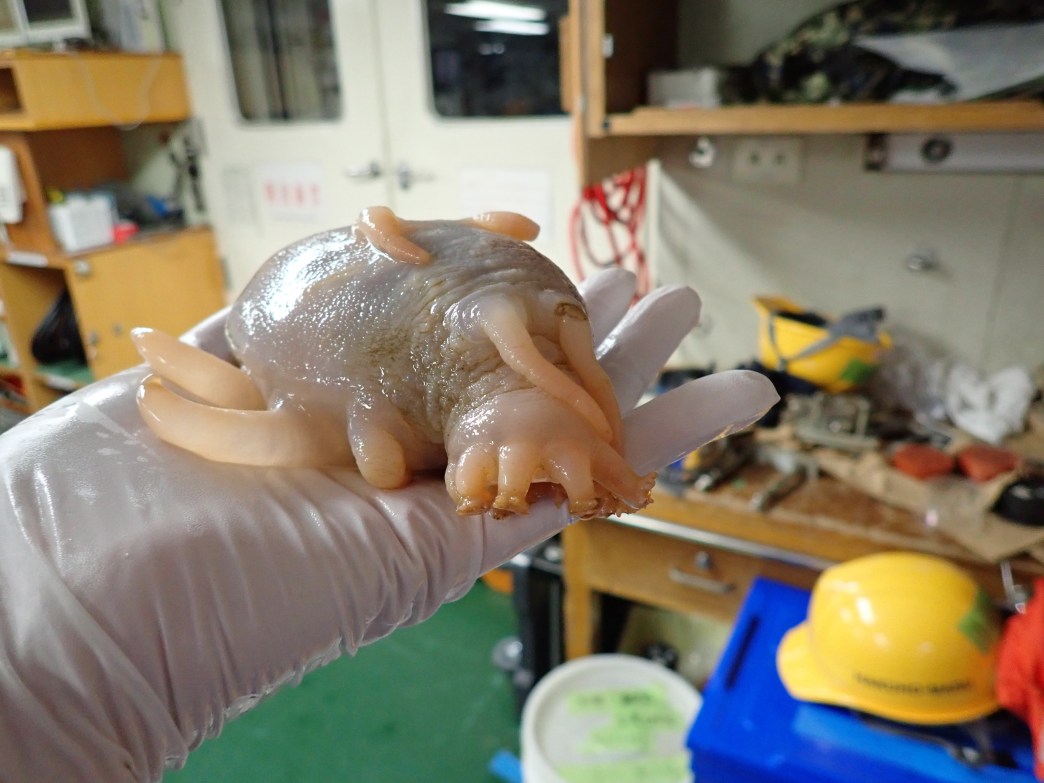
The translucent blobs of flesh that are sea pigs are some of the most unusual sights in the deep ocean. They’re also difficult to study. Some of them live more than 32,800 feet below the surface, so getting eyes on them isn’t easy.
Now researchers have made a new discovery about the microbes that call these sea pigs home. Having symbiotic bacteria living under the skin isn’t unusual for these types of creatures, but a recent study published in ISME Host Microbe details what could be a new species and a new genus of such bacteria.
Read more: “What Do You Know About the Deep-Sea Barbie Pig?”
The microbes were found in eight sea pigs collected off the northern coast of Japan in the Northwest Pacific, and they dominated the body walls of the echinoderms—76.4 to 98.9 percent of the bacterial DNA found under the skin was this new species.
“Taxonomic and genomic information about these body-wall inhabiting bacteria is scarce, and very few studies of deep-sea species have linked this information to the bacteria’s location within host tissues,” study author Yu Yoshida explained in a statement.
Not only is the bacteria new, it’s rather strange as well. It has a stripped-down genome (set of DNA instructions), and yet, it’s still capable of producing giant proteins to carry out work inside cells. The biggest protein the researchers found was 5,475 amino acids long, compared to around 300 for an average bacterial protein.
The study team has suggested Abyssoplasma scotoplanesicola for the name of the new species, which roughly translates as the “abyss-dweller that lives in Scotoplanes” (Scotoplanes being the genus of the sea pig).
So what does this mean for the jelly-like sea pigs, which waddle along at the bottom of the ocean, picking up dead bits of matter with their tubular feet? Well, we’re not sure. The assumption is they have some kind of mutually beneficial relationship that’s not yet obvious to us.
This much we do know, though: For the inhabitants of the deep ocean, sea pigs are a vital part of the ecosystem. They recycle nutrients and protect other marine life against predators, which is why scientists are keen to learn more about how they thrive and how they’ve evolved.
“We’d really like to understand how this bacterium could become so dominant in the body wall, the functions of the giant surface proteins, what competition it faces from other bacteria, and the effects on the host,” added Yoshida.
Of course, another literal deep dive will be needed to find out more.
Enjoying Nautilus? Subscribe to our free newsletter.
Lead Image: Hajime Itoh/The University of Tokyo/CC BY 4.0