







In case you missed it, it’s GTA VI launch week.
As far as video games go, it doesn’t really get any bigger than this, and the sixth game in the Grand Theft Auto series is shaping up to be the most monumental yet, on basically every level.
The sprawling open-world crime sim, in development for over a decade, has been built by a team of nearly 5,000 people, with a rumored budget of up to US$2 billion.
But a huge and hungry fanbase – who have their own dedicated meme about calling in sick this week to play the game – will almost certainly make GTA VI a blockbuster success, with one expert calling the title “the biggest release of any kind of entertainment I.P. in the history of humans”.
So yep, it’s a big, important deal.
But some things are bigger still, and even more important.
To drive that point home, scientists took the opportunity to make their own special release this week, coinciding with the GTA VI launch – publishing a new study in which they flooded the world of Grand Theft Auto.
The simulated flood – detailed in the journal Geoscience Communication – isn’t about pouring cold water on the GTA phenomenon. Far from it.
Instead, the researchers say that due to the incredible realism and familiarity of 3D game worlds, games like GTA are a powerful tool for communicating the transformational consequences of climate change.
“The growing graphical and topographic realism of modern open-world games has opened a new avenue for geoscience communication,” the researchers write in their paper.
“If the virtual landscapes players inhabit faithfully represent physical environments, those environments can become pedagogical objects in their own right.”
To illustrate their concept, geoscientists Paul Nörenberg and Hugues Lantuit from the University of Potsdam in Germany simulated a virtual flood of GTA V’s fictional city of Los Santos, which is closely modeled on Los Angeles.
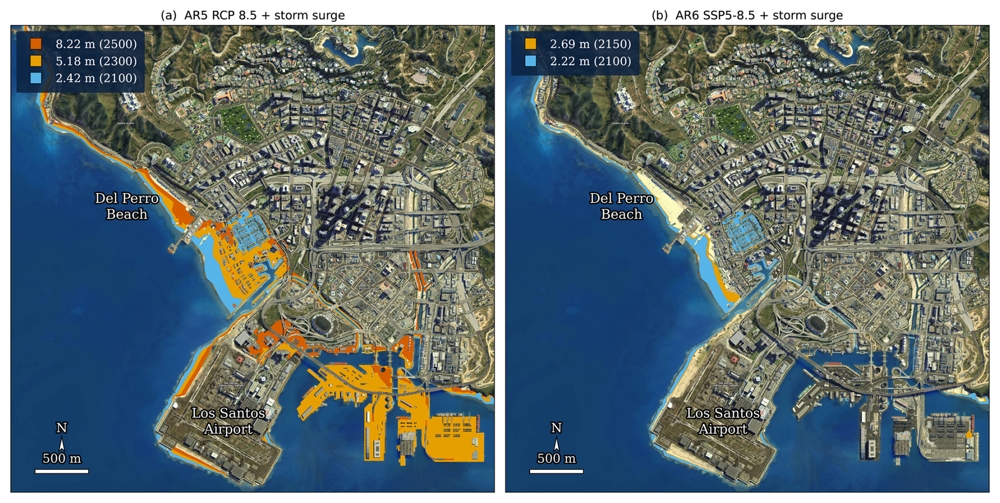
Using 3D terrain modeling, they accurately reconstructed the landscape of Los Santos and subjected its coastal environment to two different climate scenarios from the Intergovernmental Panel on Climate Change: RCP 2.6, representing strong emission reductions, and RCP 8.5, representing very high emissions.

Then they hit fast-forward, visualizing the levels of inundation from rising sea levels and incorporating the effects of extreme storm surges based on historical Los Angeles tide-gauge measurements.
No matter which way you look at it, Los Santos ends up losing land to coastal inundation, but the different climate scenarios produce very different outcomes.
Under the RCP 2.6 mitigation scenario, 2.2 percent of Los Santos’ land area becomes inundated in 2300 during a storm surge, but no major infrastructure ends up being affected.
By contrast, under the non-mitigation RCP 8.5 scenario, 5.1 percent of Los Santos is inundated in 2300, with projected sea level rise and extreme coastal water levels combining to reach 5.18 meters (17 feet).
By 2500, that combined water level could reach as high as 8.22 meters, inundating 6.5 percent of the city and jeopardizing the port, wastewater infrastructure, and coastal energy facilities.
These are upper-end projections based on simplified flood models, however, rather than predictions of exactly where or how much flooding will occur.
And, of course, Los Santos isn’t real.
But the city it’s based on is real, and as part of the study, the researchers compared their Los Santos simulations with existing flood models of Los Angeles, finding remarkably similar patterns of inundation.
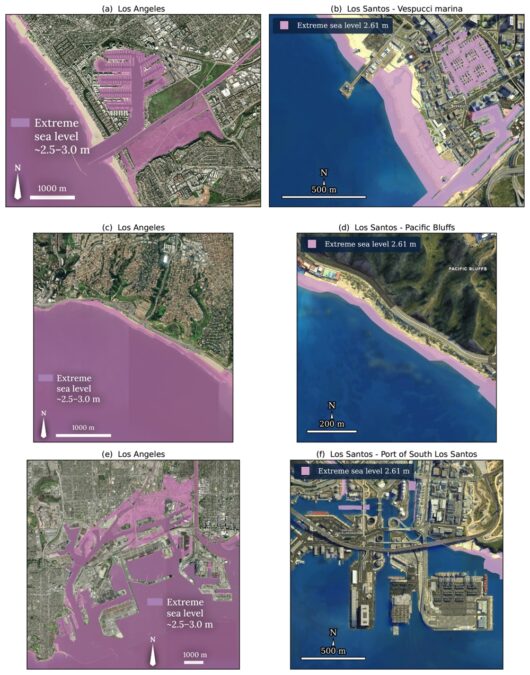
“This congruence supports the conclusion that the GTA V terrain is sufficiently faithful to real-world morphology to be scientifically meaningful for first-order coastal flood communication,” the researchers conclude.
“The question is not only what will flood, but whether the medium through which we communicate that risk is one that matters to the people who need to hear it. We argue that for the generation that grew up in Los Santos, it does.”
The findings are reported in Geoscience Communication.
This article was fact-checked by Rebecca Dyer and edited by Rebecca Dyer. While we pride ourselves on our process, we are only human. If you spot a mistake, please let us know.


