


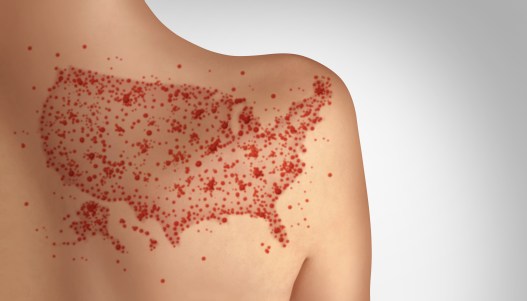





Researchers are beginning to show how neurons in the brain detect an infection and tailor physiological responses to fight it.Credit: Dr. Chris Henstridge/SPL
Washington DC
A viral cold or bacterial infection can leave you feeling miserable, but each infection produces its own mix of symptoms. Now, neuroscientists are discovering that the brain is the conductor of these responses — decoding the type of pathogen that has invaded, accessing memories of past bouts of illness and even mobilizing immune defences at the sight of a sick person.
The findings, many of which are unpublished, were presented on 15 November at the Society for Neuroscience annual meeting in Washington DC, and challenge the established view of what it means to feel unwell. Neuroscientists have long viewed neurological responses to infection as a one-size-fits-all response to inflammation, rather than a strategy tailored to the threat.
“Sickness is actually not a fixed program, although we often talk about it this way,” said Jessica Osterhout, a neurobiologist at the University of Utah in Salt Lake City, who chaired the session.
Decoding the threat
A bacterial infection and a cold caused by a virus can both result in fever and exhaustion, yet they rarely trigger the same constellation of symptoms. Bacterial infections, for instance, tend to suppress appetite far more sharply than do colds, which made Osterhout and her colleagues wonder how the brain tells various pathogens apart.

Your brain could be controlling how sick you get — and how you recover
In unpublished experiments, Osterhout’s team compared mice injected with a bacterial toxin with those given a compound that mimics a viral infection. To see how the brain distinguished between pathogens, the researchers profiled individual cells in circumventricular organs, which are specialized structures with unusually permeable blood vessels that surround brain ventricles.
When the body has an infection, cells in the circumventricular organs switch on sets of immune-related genes and release distinct mixes of chemical signals. Those signals diffuse to nearby neurons and create distinct patterns of activity for different pathogens, allowing the brain to customize its symptom profile depending on the threat.
Rather than acting as conduits that let inflammatory signals pass unchecked from the blood into the wider brain, these structures “may actually interpret them”, Osterhout said.
Anticipating illness
Sometimes, the brain doesn’t even wait for pathogens to enter the body to rally the immune system1. Andrea Serino, a neuroscientist at Lausanne University Hospital in Switzerland, studies how the brain maps peripersonal space, which is the area around the body roughly in arm’s reach.
When Serino’s team placed volunteers in virtual reality, they found that threat-monitoring brain regions became active when avatars bearing skin lesions caused by viral or bacterial infections approached, even when the figures were beyond arm’s reach away. Just 15 minutes of virtual exposure triggered a surge in frontline immune ‘sentinel’ cells in participants’ blood comparable to that induced by an influenza vaccine. This reaction did not occur when participants saw healthy-looking avatars or ones expressing fear.
These experiments suggest that the immune system uses “the predictive ability of the brain to react before pathogens enter the body”, Serino said.


