

Dark Mode Light Mode
Why AI-enabled scientific research is a double-edged sword
The US-China AI race is real – but Trump’s recent moves on ‘super intelligence’ are unlikely to give America any advantage
Science After Super Intelligence
Chemistry, medicine, materials and the technology shaping tomorrow — the best science stories from trusted sources, every day.

The US-China AI race is real – but Trump’s recent moves on ‘super intelligence’ are unlikely to give America any advantage

The US-China AI race is real – but Trump’s recent moves on ‘super intelligence’ are unlikely to give America any advantage The US-China AI race is real – but Trump’s recent moves on ‘super intelligence’ are unlikely to give America any advantage


Donald Trump is insisting that people drop their use of the term artificial intelligence (AI), in favour of “super intelligence”. This started on September 29, when he signed an executive order telling federal agencies to call AI super intelligence, because, in the president’s view, “artificial” makes it sound fake.

On October 4, he followed up with a super intelligence force to coordinate the federal government’s effort “to ensure that America continues to lead the world in Super Intelligence”.

This AI force is led by Jay Clayton, the director of national intelligence and a former chair of the Securities and Exchange Commission. Alongside him sit Federal Trade Commission chair Andrew Ferguson, the Pentagon’s technology chief Emil Michael and Scott Kupor, who runs the federal workforce.

The force reports to the president and his chief of staff and has 120 days to report on the risks and opportunities AI poses.

Is this serious national strategy or a branding exercise? The label itself tells us very little. What matters is whether the force can marshal what actually decides who leads in AI: compute, capital, talent and infrastructure. This is now a race, and the countries and organisations that move fastest and mobilise the most resources will hold a significant advantage.

Supporters can point to a genuine coordination problem. Responsibility for AI in Washington is scattered across intelligence, defence, competition policy, procurement and the civil service, which rarely act in concert.

Putting several of those agencies under one roof, reporting directly to the White House, could cut through that. Clayton has given a blunt assessment: “The risk of not being first is high.”

America also has a strong hand. According to Stanford’s 2026 AI Index, US private investment in AI reached US$285.9 billion (£217.24 billion) in 2025, roughly 23 times China’s US$12.4 billion (£9.42 billion). America’s largest tech firms are on track to spend more than US$650 billion on capital investment this year.

A body that helps clear bottlenecks the private sector cannot – grid connections, data centre permitting (approval), hiring technical talent into government – could add real value. Including the head of the federal workforce is a telling choice: governments have long struggled to recruit the people they need for AI.

Deeper problems?

Critics see something much thinner. The White House has not disclosed a budget, nor said whether the force will have regulatory powers or merely advise. It arrived shortly after leading firms, including OpenAI, Anthropic, Google, Meta and Nvidia, had signed a one-page White House accord committing to internal evaluations, external audits and board reviews.

Trump called it “morally binding”. But Democrat lawmaker Mark Warner, senior senator from Virginia, was scathing: “The president’s response? To rename it and tell the companies developing it to regulate themselves,” he said.

To my mind, there are three deeper problems. First, the US does not control the trajectory of AI. The same Stanford report found that the performance gap between the best US and Chinese models has narrowed to 2.7%, down from double digits in 2023.
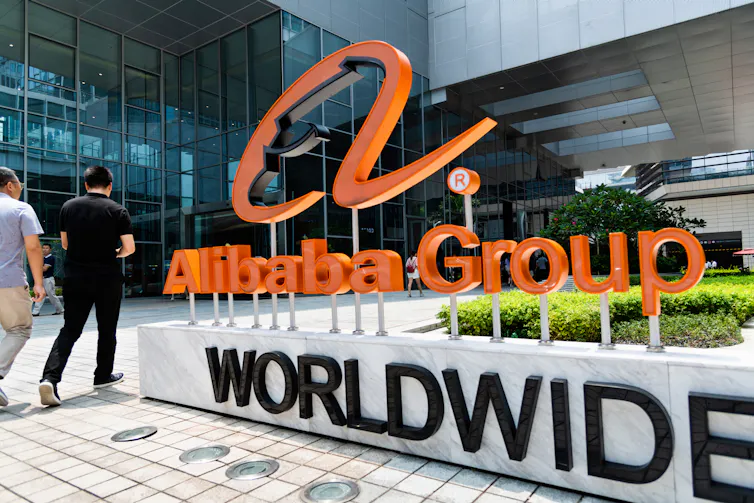
Alibaba building in Shenzhen.
The performance gap between US AI models and Chinese ones, like Alibaba’s Qwen series, has been narrowing.
hxdbzxy / Shutterstock

Beijing will pursue its own strategy whatever Washington calls its task force.
Second, the actors that matter most are private. The frontier AI labs (those at the cutting edge) have enormous commercial and strategic incentives of their own – and the previously mentioned investment figures are overwhelmingly made up of private money.

The companies will cooperate where interests align, on energy or export controls, for example. But I would not expect them to commit fully to a government programme. A voluntary accord with no enforcement mechanism shows where the leverage lies.

The third problem is timing. The US midterm elections heavily shifted control of Congress in the Democrats’ favour. This could reshape both funding for AI and oversight. Building national AI capability is a multi-year effort, and what is created by executive action can be undone the same way. For instance, President Trump revoked Joe Biden’s AI executive order on his first day back in office.

There is also a tension in the mandate itself. The force is asked both to win a race and to protect the public, yet its leadership is drawn from the intelligence, defence and competition enforcement sectors rather than from AI safety. Those goals do not always point the same way, and the announcement about the super intelligence force says little about how they will be balanced.

Is this better than nothing? Absolutely. Coordination has value, and the force could become a serious mechanism for concentrating resources at a scale commensurate with the stakes. But the test is not the name. It is whether the body secures a substantial budget, gains real authority over approval for infrastructure, procurement and hiring, and survives the political cycle.

AI policy is at a turning point. Yet a name, like super intelligence, is just a slogan. Until we see what resources the super intelligence force can command, and whether it can execute quickly and sustain that effort, I would put relatively little faith in it changing the trajectory of AI.


Source link

Previous Post
Why AI-enabled scientific research is a double-edged sword

Why AI-enabled scientific research is a double-edged sword

Next Post
Science After Super Intelligence

Science After Super Intelligence