





The journey from birth to death never did run straight nor smooth.
The human body seems to age in sudden leaps and bounds, and scientists are trying to figure out when these accelerations occur on a cellular level.
A new study on the human immune system suggests that our immune systems age faster at two sharp peaks.
The findings are published in Nature Communications.
Researchers in Singapore analyzed the single-cell transcriptomes of 1,828 healthy individuals of various ethnicities, aged 19 to 97.
This sort of analysis can reveal which genes are active in any one individual cell, and researchers compared 3.8 million immune cells in total.
Ultimately, they discovered two prominent peaks of change in gene activity.
These occurred around age 40 and after age 60.
Each peak was accompanied by signs of greater inflammation and a decline in the way immune cells maintain and manage RNA and proteins.
This decline, the authors claim, is one of the most striking findings, and its biological consequences are likely to be profound.
If a cell shows reduced protein synthesis, it can impair stress responses, limit growth potential, and may promote accumulation of misfolded proteins, which are associated with dysfunction and disease.
“We tend to think of aging as a gradual process, but our findings show that the immune system does not simply decline at a steady rate,” explains senior author Jacques Behmoaras, a biomedical researcher at Duke-NUS Medical School in Singapore.
“Instead, we see distinct periods of rapid change, particularly around 40 and again after 60, with T cells playing a major role.”
Interestingly, the authors found that the timing of these two immune aging peaks was slightly different for males and females.
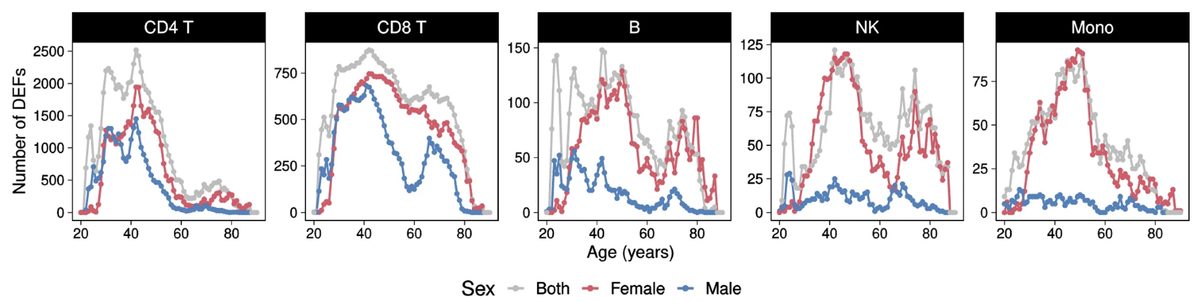
Females showed sustained activation of some cancer-fighting T cells, but in later life, aging signatures were found for B cells, natural killer cells, and T helper cells.
By contrast, males showed early-life fluctuations in the aging signatures of T helper cells.
“Understanding what drives these windows of immune aging could eventually help us identify when, and for whom, interventions may have the greatest benefit,” says Behmoaras.
“It could also shed light on why some autoimmune conditions disproportionately affect women.”
Females live longer than males on average, yet they experience a greater burden of age-related diseases, the researchers explain in their paper, led by Duke-NUS computational biologist Harry Park.
But why these sex differences exist, and how their aging timelines differ, remains relatively unexplored.
“Our findings build on previous evidence that T cells are among the immune cells most affected by aging,” says co-author and immunologist Antonio Bertoletti from Duke-NUS.
“Understanding what drives these nonlinear changes in T cells over time will be an important next step. Changes in T cell function may help explain why older adults are more susceptible to infections and inflammatory conditions.”

Findings from this recent analysis echo a 2024 study that reported molecular changes associated with aging occur in two abrupt lurches forward, one at the average age of 44 and the other around age 60.
That study has since faced criticism for its statistical methods, in a preprint that hasn’t yet been peer-reviewed and was co-written by two of the published study’s own authors. The authors are now working with the journal on corrections.
The new research from Park and colleagues in Singapore is one of the largest and most diverse investigations of its kind, according to Duke-NUS. It brings together participants from a dozen self-reported ethnicities, with about a third identifying as Asian.
While there was a lot of overlap in the age-related gene changes seen in male and female participants, there seemed to be more pronounced changes in gene activity associated with aging among females.
Their two peaks appeared to be somewhat higher.
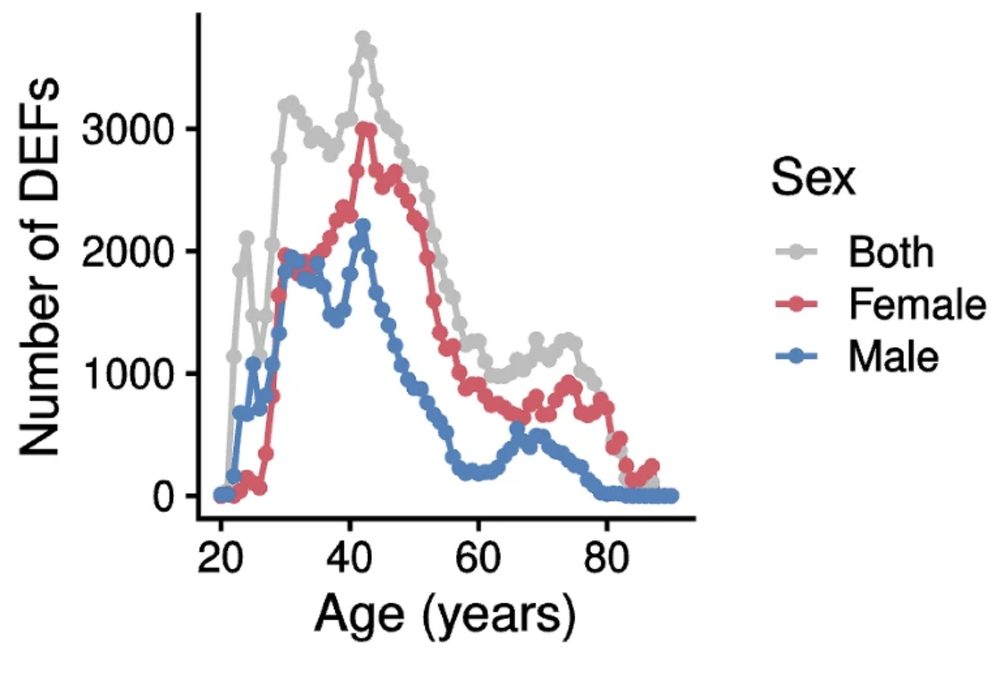
“These peaks remained after applying different sliding-window sizes, different statistical thresholds, different batch effect correction approach, and random downsampling,” the authors explain, “but were no longer detected upon random age permutation, confirming involvement of true biological signals.”
Whether or not these two aging peaks are ‘artificial’ constructs or real surges will require more research.
This study used a version of the same sliding-window method as the 2024 study, which critics say can produce false peaks on its own when some ages have fewer people, but without a smoothing step that was also flagged. Here, the peaks held up even when the team evened out the number of people in each age window.
When the team built biological aging clocks (AI models that estimate a person’s age from biological data) based on their results, they estimated a person’s age from the gene activity in their immune cells better when the clocks were split: one for males, one for females.
The male clock relied more on genes changing earlier in life, whereas the female clock relied more on genes changing later in life to predict age.
Related: Huge Review of 361 Studies Suggests Eating Less Protein May Slow Down The Aging Process
“The study gives us a more detailed map of how the human immune system changes across the lifespan, and importantly, how those trajectories differ between men and women,” says biological scientist Sheemei Lok from Duke-NUS.
“That knowledge is fundamental if we want to move away from treating aging as a one-size-fits-all approach and move towards more precise approaches to maintaining health as people grow older.”
The research has been published in Nature Communications.
This article was fact-checked by Rebecca Dyer and edited by Rebecca Dyer. While we pride ourselves on our process, we are only human. If you spot a mistake, please let us know.


