
Dark Mode Light Mode
Chemistry, medicine, materials and the technology shaping tomorrow — the best science stories from trusted sources, every day.

NASA Crashed a Spacecraft Into an Asteroid. 4 Years Later, We Can Finally See The Carnage.

NASA Crashed a Spacecraft Into an Asteroid. 4 Years Later, We Can Finally See The Carnage. NASA Crashed a Spacecraft Into an Asteroid. 4 Years Later, We Can Finally See The Carnage.


Four years ago, a monumental collision took place, 11 million kilometers (6.8 million miles) from Earth.

It wasn’t the biggest commotion that the Solar System had ever seen, but it was a huge moment for humanity.

NASA sent a spacecraft to a small asteroid and deliberately crashed it into the space rock – a first-ever test of a technology that could one day save us from an asteroid on an Earth-bound trajectory.

The asteroid itself was innocent – an acceptable casualty in a much larger war. And oh, what a casualty it was.

For a little over two years, the European Space Agency’s spacecraft Hera had been winging its way to Dimorphos to investigate the scene of the crime – and now it has revealed a giant scar across the entire width of the asteroid.

“Scientists debated whether Dimorphos had sustained an impact crater, changed its shape, or stayed the same,” says Hera principal investigator Patrick Michel of the CNRS’s Observatoire de la Côte d’Azur.

“Much to our surprise, the answer turns out to be all three at once! The face struck by DART has been flattened into an impact crater the size of a sports stadium, which extends across the asteroid’s entire width.”
YouTube Thumbnail

frameborder=”0″ allow=”accelerometer; autoplay; clipboard-write; encrypted-media; gyroscope; picture-in-picture; web-share” referrerpolicy=”strict-origin-when-cross-origin” allowfullscreen>

The mission was called the Double Asteroid Redirection Test, or DART, and the question it posed was a simple one: Can we change the trajectory of an asteroid by physically smacking it?

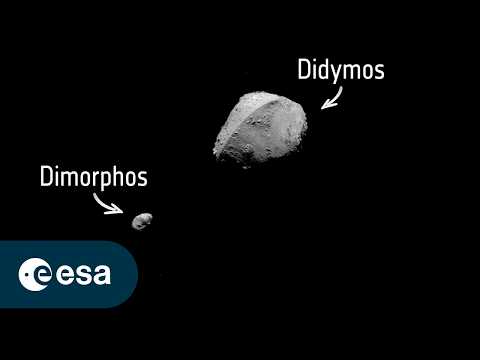
The target was a pair of asteroids gravitationally bound to one another – the larger, named Didymos, measuring about 730 meters across (2,395 feet), and the smaller, called Dimorphos, about 151 meters across.

Since Dimorphos is the smaller of the two, it would be easier to move, and any change in its orbit around Didymos could be readily measured using telescopes on Earth. So Dimorphos was DART’s target.

On 26 September 2022, after the spacecraft had traveled for a little over 10 months, the collision took place. Dust spewed forth, DART was toast, and the success was greater than anyone had dared to dream.

YouTube Thumbnail

frameborder=”0″ allow=”accelerometer; autoplay; clipboard-write; encrypted-media; gyroscope; picture-in-picture; web-share” referrerpolicy=”strict-origin-when-cross-origin” allowfullscreen>

NASA had set a minimum benchmark for success: reducing Dimorphos’s orbital period around Didymos by 73 seconds.

The actual reduction was a whopping 33 minutes – and the pair’s entire orbit around the Sun had also changed.

But alas, the cameras of a small Italian spacecraft named LICIACube, which had accompanied DART to photograph the impact, couldn’t see the damage through the enormous cloud of debris ejected by the impact. By the time the dust settled, LICIACube was long gone.

Whatever scars Dimorphos had retained from the encounter remained a mystery.

It wasn’t an idle question. Dimorphos is what is known as a rubble-pile asteroid. Rather than a single, solid chunk of rock, it’s an agglomeration of smaller rocks held together by their mutual gravity – and that gravity is exceedingly weak.

This complicates predictions about how such an asteroid might respond to an impact. In fact, simulations published in 2024 suggested that DART might not have left a distinct crater at all, instead reorganizing the asteroid’s constituent rocks into an entirely different shape.

To find out, it required sending something that could give us visual confirmation – and that’s where Hera enters the scene. Launched in October 2024, the spacecraft carries a suite of instruments designed to investigate DART’s impact on the Didymos-Dimorphos system.
Four Years After NASA Crashed a Spacecraft Into an Asteroid, We're Finally Getting a Good Look at What We Did
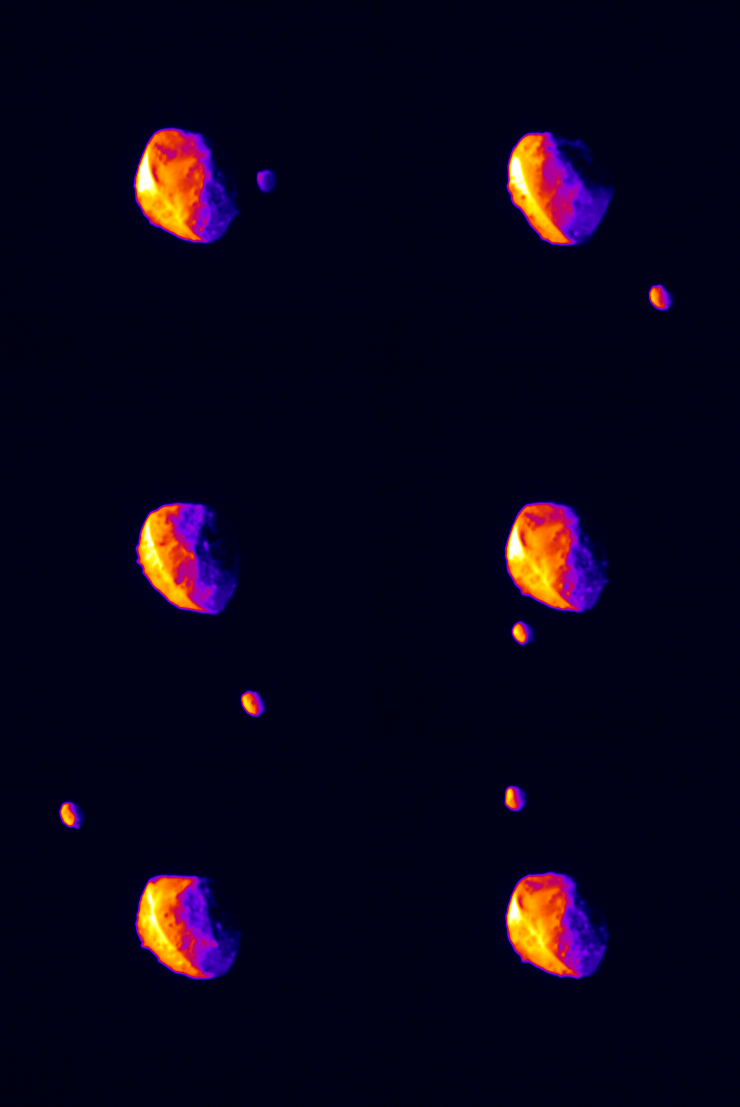
An animation of the asteroid pair captured by Hera’s thermal infrared imager (TIRI). Warmer regions are redder and brighter, while cooler ones are bluer and darker. (ESA)

And what it has found is a curious combination of destruction and preservation.

On the side of Dimorphos struck by DART, the asteroid’s once-rounded profile has been dramatically flattened. The impact crater is so large relative to the asteroid itself that it has changed the rock’s overall shape.

Elsewhere, however, the landscape looks remarkably familiar. Scientists comparing the new images with those obtained by DART before the collision have been able to recognize individual boulders that appear to have remained in place.

So DART did excavate a crater, and it did reshape the asteroid – but it also left some of the terrain apparently untouched.

But the changes to Dimorphos go beyond the superficial.

Prior to the impact, Dimorphos was thought to be tidally locked to Didymos, much as the Moon is to Earth, perpetually presenting the same face to its larger companion. Well, not so much anymore.

“In addition, as Hera returned more images, it became clear that the DART impact has left Dimorphos tumbling wildly in its orbit,” says Hera mission scientist Michael Kueppers of the ESA.

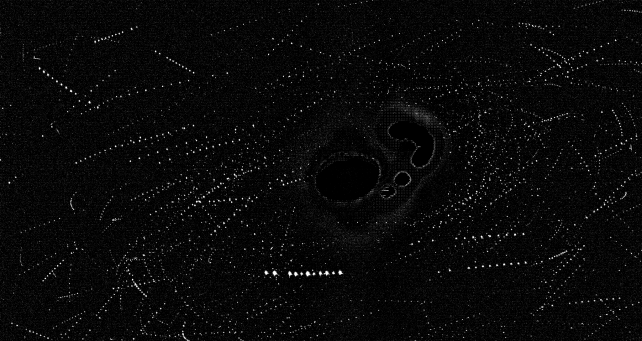
“Another big surprise is that Hera is showing that the asteroids are surrounded by hundreds of orbiting boulders, just a few meters in size. The team will have to take account of these objects in the coming weeks as the mission moves in closer to acquire higher-resolution images of the asteroids.”
Four Years After NASA Crashed a Spacecraft Into an Asteroid, We're Finally Getting a Good Look at What We Did
A composite of 11 long-exposure images revealing the swarm of boulders around the asteroid. (ESA)

It’s possible that at least some of these boulders are souvenirs of DART’s visit. In 2023, observations from the Hubble Space Telescope revealed a swarm of 37 boulders that appeared to have been dislodged from Dimorphos by the impact.

Subsequent simulations suggested that some of the ejected rocks could remain gravitationally bound to the asteroid pair long enough for Hera to encounter them.

Establishing the origin of this much larger population of boulders observed by Hera could help scientists piece together the aftermath of the collision.

But the investigation has only just started. Hera reached the asteroid on 4 November 2026, and has a lot of plans for the months ahead.

At time of writing, it is at a distance of around 25 to 30 kilometers (16 to 19 miles) from the asteroid pair; in December, it will move in as close as 13 kilometers to capture progressively higher-resolution views.

In January, it will deploy a pair of cubesats that will get closer still – Juventas, which will take the first-ever radar measurements of an asteroid’s interior, and Milani, which will measure the external environment.

Together, their intel is expected to provide invaluable insights. By determining Dimorphos’s mass and structure, scientists will be able to better understand how efficiently DART transferred its momentum to the asteroid – and how other asteroids might respond to a similar wallop.

“Sixty-six million years ago, an asteroid impact changed the course of life on Earth. Today, for the first time in history, humanity is validating how to prevent such an event from happening again,” says Hera mission manager Ian Carnelli of the ESA.

“NASA’s DART mission demonstrated that we can change an asteroid’s orbit. Hera is now revealing what happened to the asteroid itself. By combining these two missions, humanity is taking a decisive step towards making asteroid deflection a reliable tool for protecting our planet.”

This article was fact-checked by Peter Dockrill and edited by Peter Dockrill. While we pride ourselves on our process, we are only human. If you spot a mistake, please let us know.


Source link

Previous Post
Navigating grief in academia: ways to find balance

Navigating grief in academia: ways to find balance

Next Post
Scientists discover mysterious lakes more than a mile beneath the Red Sea

Scientists discover mysterious lakes more than a mile beneath the Red Sea