


In classical physics, the rules of causality are imperturbable.
A train can’t arrive before it has departed. The consequences of an action must always follow that action, and there are strict limits to how far and how fast its influence can travel.
But in the realm governed by quantum interactions, the classical rules can get a little … squishy.
And if gravity gets involved, things might get downright weird.
Now, physicists Giordano Cintia, Federico Piazza, and Samuel Ramos of the Center for Theoretical Physics in France have shown mathematically how quantum fluctuations of gravity could blur the boundaries of cause and effect, turning causality’s certainty into a matter of probability.
“There is an intrinsic source of uncertainty due to quantum gravity to the exact time at which an information signal reaches its recipient,” the researchers told ScienceAlert.
In classical physics, as described in Einstein’s theory of special relativity, nothing can travel faster than light in a vacuum.
That includes information – and anything else that could transport an influence from one event to another.
One of the results of this hard speed limit is a set of strict constraints on which events in the Universe can influence each other.
For example, if the Sun is suddenly snuffed out, we cannot know about it until 8 minutes later – the time it takes for the last of its light to travel to Earth.

frameborder=”0″ allow=”accelerometer; autoplay; clipboard-write; encrypted-media; gyroscope; picture-in-picture; web-share” referrerpolicy=”strict-origin-when-cross-origin” allowfullscreen>
Or if a star explodes 1,000 light-years away, and you sneeze a second later – the sneeze cannot have been caused by the supernova, even if you have a photic sneeze reflex, because the light from the explosion won’t reach Earth for another 1,000 years (minus one second).
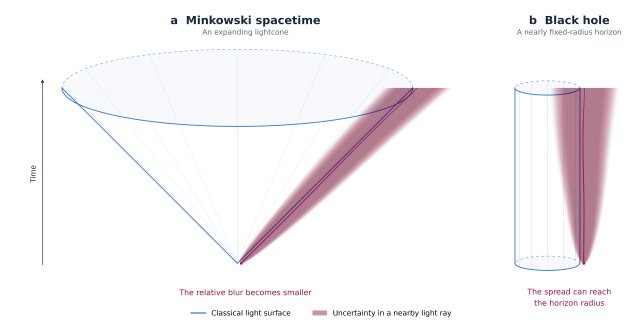
Physicists represent these constraints using something called a light cone – an imaginary boundary extending through spacetime from a particular event, encompassing all the places that a signal traveling at or below the speed of light could reach.
Events inside the future light cone can be influenced by the original event. Events outside it cannot, because doing so would require information to travel faster than light.
This extends to Einstein’s theory of general relativity, too, even though the geometry is more complicated. Here, spacetime isn’t a rigid, unchanging backdrop. Mass and energy curve it gravitationally, bending the paths that light follows – and, consequently, distorting the shape of light cones.
But even in curved spacetime, the boundaries of the cones remain precisely defined. Given a particular spacetime geometry, there is no ambiguity about which events can influence which.
Quantum mechanics operates by a different set of rules.
At the Universe’s smallest scales, particles and fields can exist in superpositions of different states – combinations of seemingly contradictory possibilities – with their properties described in terms of probabilities rather than definite values.
And if gravity is quantum in nature, as physicists suspect, then the geometry of spacetime sculpted by that gravity should be subject to those same rules.
To investigate what this could mean for causality, Cintia, Piazza, and Ramos used quantum field theory to calculate how fluctuations in the geometry of spacetime could affect the propagation of a light-speed signal.
Picture two observers. One is in Marseille and the other in Paris; or one is on the Moon and the other on Mars. Wherever they are, one sends a photon toward the other, who awaits its arrival.
In classical physics, if we know the geometry of spacetime, the departure time, and the speed of light, the arrival time can be calculated precisely.
But if the spacetime geometry is subject to quantum uncertainty, so too is the photon’s arrival time.
“What is physically happening is that the photon travels on a quantum superposition of metrics,” the researchers told ScienceAlert.
A metric is a mathematical description of the geometry of spacetime. In effect, rather than traveling through a spacetime with one precisely defined geometry, the photon is traveling through a quantum superposition of different possible geometries.
To understand how the resulting uncertainty builds up over the course of the photon’s journey, the researchers examined the effects of gravitons – hypothetical quantum particles that would be to gravity what photons are to light.
They modeled a signal traveling through a thermal bath of gravitons – a hypothetical environment populated by gravitons with a distribution of energies corresponding to a particular temperature.
They found that, rather than averaging out over the course of the signal’s journey, the fluctuations produced a cumulative uncertainty that grew with the square root of the time elapsed since its emission.
This is characteristic of what’s known as a random walk – a succession of random steps that, over time, can take a wanderer increasingly far from their starting point.
“A much more naive picture, perhaps suggested by the random walk result, is that the photon bounces against gravitons along its path,” the researchers explained.
The longer the signal travels, the fuzzier the once-sharp borders of the light cone become.
This doesn’t necessarily mean that information can travel faster than light, or that effects can precede their causes. Rather, it introduces an intrinsic uncertainty into the boundary between events that can influence each other and those that cannot.
Under most circumstances, this effect would be vanishingly small. But there is one place in the Universe where the consequences could be profound: the event horizon of a black hole.
According to a prediction made by Stephen Hawking in the 1970s, black holes aren’t entirely black. They emit thermal radiation because of quantum effects near the event horizon, slowly losing mass until they could evaporate completely.
That radiation should include gravitons, creating the kind of environment Cintia, Piazza, and Ramos investigated in their calculations.
But there’s something else that makes black holes particularly interesting.
“The horizon of a black hole can be seen as a bundle of light rays kept together by the enormous gravity,” the researchers explained.
Ordinarily, the uncertainty in the position of a light cone’s boundary grows much more slowly than the light cone itself expands.
But the event horizon of a black hole is a special kind of causal boundary, defined by light rays that can neither escape the black hole nor plunge deeper into it. And it doesn’t expand as time passes in the same way that an ordinary light cone does.
If the quantum uncertainty in the causal boundary’s position continues to accumulate, the researchers suggest, it could eventually become comparable to the radius of the event horizon.
And this is where weird doesn’t even begin to cover the consequences.
One of the biggest unsolved problems in physics is what’s known as the black hole information paradox.
According to general relativity, nothing that crosses the event horizon of a black hole can ever return to the outside Universe. But according to quantum mechanics, information about the physical state of a system cannot be destroyed.
If a black hole eventually evaporates entirely through Hawking radiation, what happens to all the information about the matter it has swallowed?
Physics has part of an answer.
In 1993, theoretical physicist Don Page calculated that, under quantum mechanics, information about the material that has fallen into a black hole should start to be recoverable from its Hawking radiation roughly halfway through the black hole’s lifetime. That milestone is now known as Page time.
But according to Hawking’s original calculations, that radiation is purely thermal. It carries no information about the material that fell into the black hole – leaving a big question mark over the mechanism of information escape.
When Cintia, Piazza, and Ramos extrapolated their calculations to a black hole, they found that the time it would take for the quantum uncertainty in the position of the event horizon to grow to the size of its radius was of the same order as the Page time.
So, around the point in a black hole’s lifetime when information should start to become recoverable, the distinction between inside and outside the black hole could become profoundly blurred.
It’s a beautifully neat result, although the researchers caution that their calculations for black holes are, at this time, speculative. They suggest that future experiments using interferometers to measure tiny fluctuations in the travel time of light could offer a way to probe the underlying physics.
“Our mechanism is evocative of the possibility that the general-relativity geometric picture is perhaps classical,” they said, “too classical.”
The research has been accepted in Physical Review D and is available on arXiv.
This article was fact-checked by Rebecca Dyer and edited by Rebecca Dyer. While we pride ourselves on our process, we are only human. If you spot a mistake, please let us know.


