


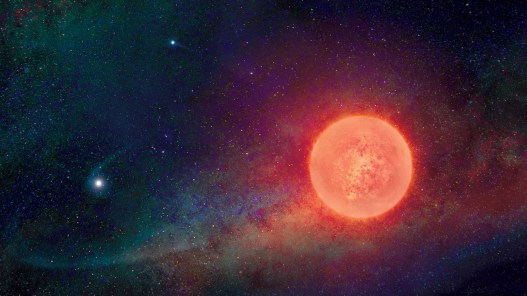


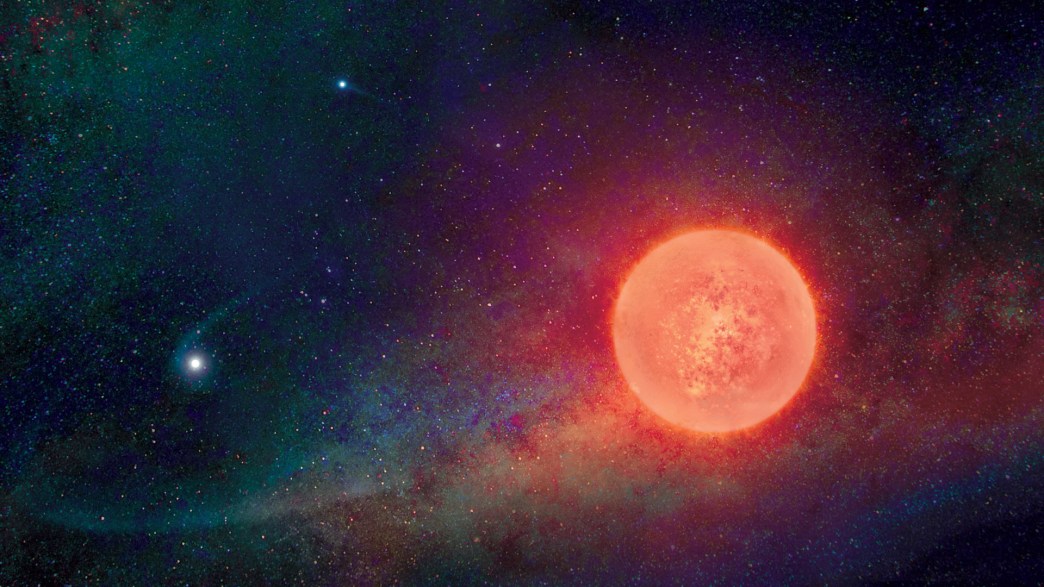
There are many oddities out in space—as David Bowie foretold—and astronomers have just discovered yet another: a triple-star system some 28 light-years from Earth that shouldn’t really exist in its current form.
For decades, experts thought this system contained only two star remnants. The data showed a red dwarf (the smallest type of hydrogen-burning star, significantly smaller than the sun) being orbited by a very distant white dwarf (the burnt-out remnants of a dead star, typically about the size of Earth).
Read more: “Did Astronomers Finally Witness a Black Hole Eat a White Dwarf for the First Time?”
What was hiding was another white dwarf much closer to the central red dwarf star. A reanalysis that started in 2019—and has now been published in the journal Astronomy & Astrophysics—offers clues as to what exactly this unusual stellar system has in it. “We were actually looking for planets,” study author Étienne Artigau said in a statement. “Instead, we found something much more surprising.”
The velocity changes of the red dwarf suggested that something with much more mass than an exoplanet was pulling on it, which is how the white dwarf was uncovered. While these white dwarf remnants are the size of Earth, they’re about 200,000 times heavier—entire stars crushed down into (relatively) tiny specks.
Why is all of this so unexpected?
Before this inner white dwarf became a white dwarf, it would’ve ballooned in size, becoming around 40 percent bigger than the sun. Under normal circumstances, that would have pulled in the red dwarf and swallowed it up. But somehow, the red dwarf beat the odds and is still there—though it’s not clear how. “The system should not exist,” study author Patrick Dufour said. “We have no clean explanation for how it got here. That is the question driving our next observations.”
The new triple-star system has been given the name Welopōʻai, which means “path of family traits” in Hawaiian—an acknowledgement to the two telescopes that made the discovery, both located on Maunakea on the Big Island.
It promises to be of great value in studying how different types of stars and their inner structures evolve, and how matter reacts when under extreme densities. After all, it’s the closest triple-star system including two white dwarfs that’s ever been discovered, and there’s no other system like it within 100 light-years of Earth.
Enjoying Nautilus? Subscribe to our free newsletter.
Lead Image: Benoît Gougeon/Université de Montréal


