





The scarred gray face of the Moon is a picture of inscrutable stoicism, but there may be quite a bit more going on below.
Scientists have long suspected that the Moon’s volcanic past left it riddled with tunnels, hollowed out by rivers of molten rock eons ago.
Now, subtle variations in the Moon’s gravitational pull have yielded evidence of four such tunnels – each potentially more than a kilometer wide, concealed beneath just 100 meters of lunar rock.
Such tunnels – particularly ones that haven’t collapsed – are a bit of a scientific Orthrus.
On one hand, they represent an important window into the Moon’s geological history. On the other, they could one day become safe havens for lunar explorers, offering protection from the harsh radiation and temperature extremes to which the Moon is prone.
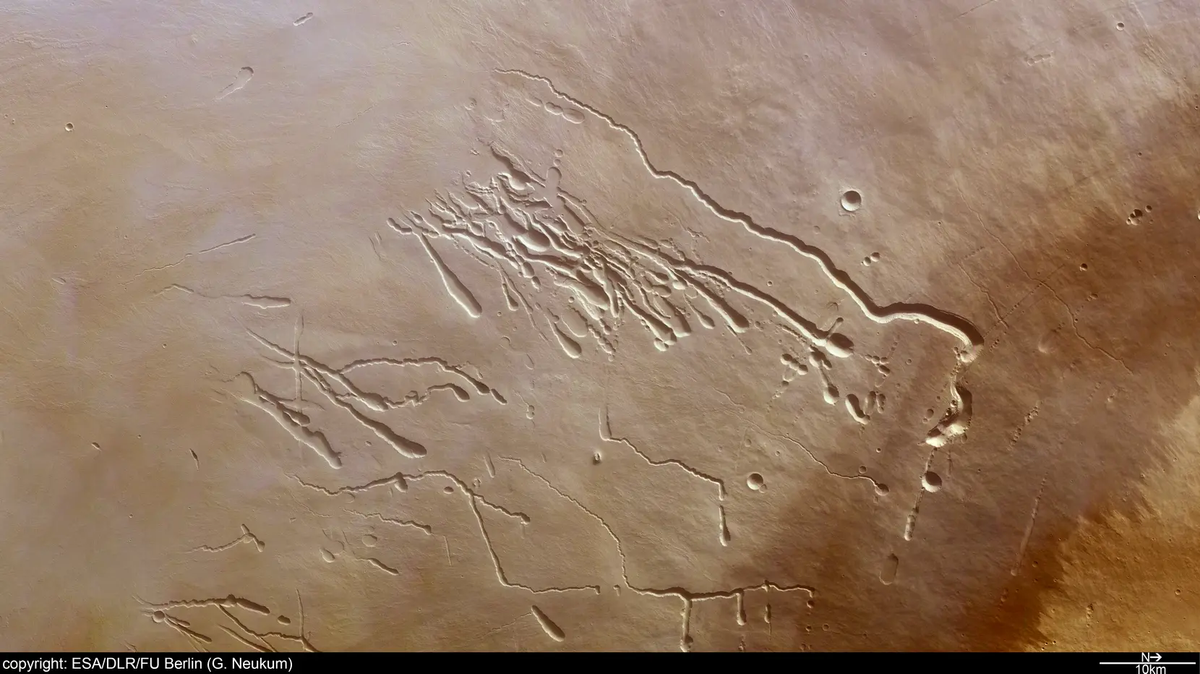
Lava tubes are not a Moon-only phenomenon. They can be found right here on Earth, forming when the surface of a flowing river of lava cools and hardens, creating an insulating roof beneath which molten rock continues to flow.
As the eruption subsides and the remaining lava drains away, it can leave in its wake a long, hollow tunnel, capped by a roof of volcanic stone.
On the Moon, these structures could be much more imposing, owing to different formation conditions.
Weaker gravity, higher rates of lava eruption, and the relative ease with which lunar lava flowed could have allowed the formation of subterranean structures on a scale that dwarfs their terrestrial counterparts.
The problem lies in finding them. At an average distance of 384,400 kilometers (238,855 miles) from Earth, picking out small details on the craggy surface of the Moon by eye can be tricky enough – let alone working out what lurks beneath.
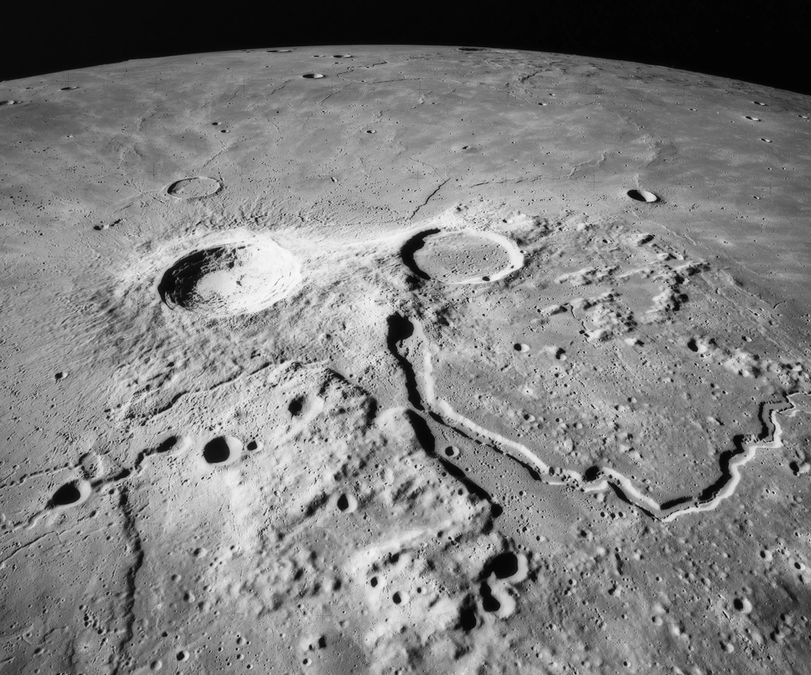
There are clues, though. The lunar surface is marked by long, winding channels known as sinuous rilles, some of which may be the remnants of collapsed lava tubes.
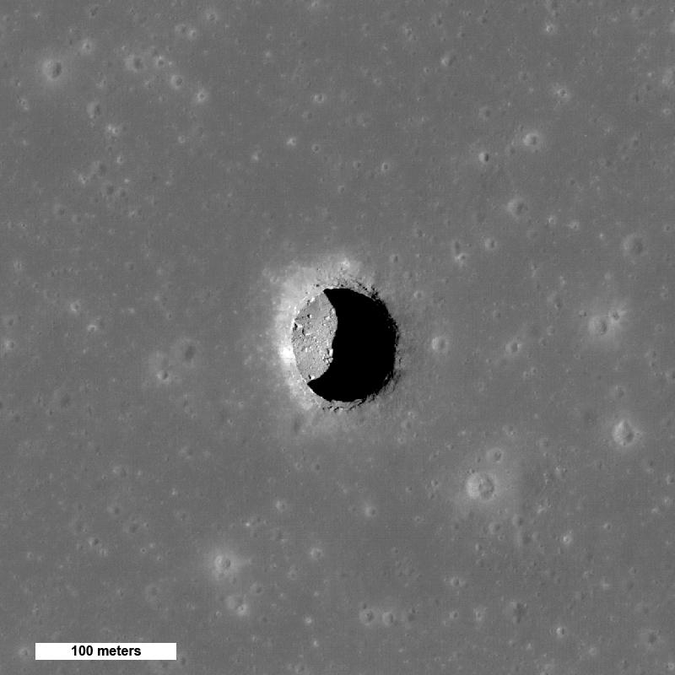
And dotted across the lunar landscape are deep pits that could be skylights – places where a small section of a lava tube’s roof has caved in.
There’s also more than one way to skin a cat – or try to figure out what’s inside the Moon.
A hollow tunnel, you see, contains less mass than an equivalent volume of solid rock. This means that the Moon’s gravitational pull should be ever so slightly weaker in the vicinity of a lava tube – a discrepancy that can be detected by spacecraft orbiting overhead.
Between 2011 and 2012, NASA’s twin Gravity Recovery and Interior Laboratory (GRAIL) spacecraft mapped the Moon’s gravitational field in unprecedented detail, measuring tiny changes in the distance between them as they flew over regions of differing gravity.
Using that data, studies in 2017 and 2024 identified several spots where lava tubes could be hiding, with estimated widths of up to 9 kilometers.
It didn’t take too long for the kibosh to arrive, though – subsequent studies found that, in all likelihood, many of those tunnels would have been too wide to support the weight of their own roofs.
So, when NASA released a higher-resolution model of the Moon’s gravitational field in May 2025, geoscientists Juan Losarcos and Andrew Dombard of the University of Illinois Chicago took another look to see if they could find something a bit more structurally sound.
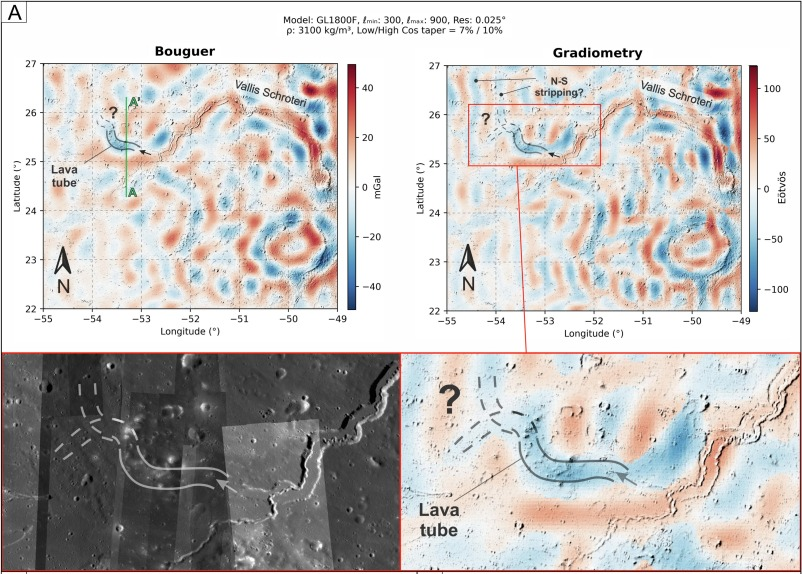
They painstakingly mapped tiny dips in the gravitational field, after accounting for the Moon’s surface topography, comparing them with simulations of the gravitational signatures that hollow tunnels of different dimensions would produce.
Then, they compared these with observations of the lunar surface, looking for geological features that might support the presence of an underground cavity.
Four candidates stood out – one in the vicinity of Vallis Schröteri, the largest sinuous rille on the Moon; one at Rima Mairan; and two near the Wollaston crater.
In each case, the gravitational signature was consistent with a tunnel less than 2 kilometers wide, buried beneath around 100 meters of rock – dimensions much more in keeping with what we now know about the structural limitations of lunar lava tubes.
And the geological features associated with all four suggest that they may have formed in a slightly different way from the process described earlier.
Rather than forming a roof over a vast, open river of lava, they may have started out as much smaller underground channels, gradually enlarged as the molten rock flowing through them melted and wore away the surrounding material – like a giant Moon worm boring a hole, rather than a Moon caterpillar building a cocoon.
However, at this point, all four can only be classified as candidates rather than confirmed detections. Other variations in the density of lunar rock could produce similar gravitational signatures, and the researchers can’t directly measure the dimensions of the cavities using gravity data alone.
Future radar observations and more detailed geological mapping could help establish whether the tunnels really are there.
The researchers also note that their reliance on geological clues on the surface means that entirely intact lava tubes, with no telltale collapses in their roofs, could be particularly difficult to find.
The results suggest that the Moon may be even better at hiding its crannies and hollows than we thought it was, and that there may be far more of these hidden passages lurking beneath the ground than its surface might suggest.
“Such pristine tubes,” the researchers write, “could preserve important evidence of lunar volcanic and thermal evolution, even if they are less accessible for exploration.”
The research has been published in Icarus.
This article was fact-checked by Fiona MacDonald and edited by Fiona MacDonald. While we pride ourselves on our process, we are only human. If you spot a mistake, please let us know.


