





Long after the bacteria that causes Lyme disease is gone from the body, some patients continue to experience symptoms like fatigue, body aches, and brain fog.
For most people, a course of antibiotics to kill the bacteria, Borrelia burgdorferi, is enough to reach full recovery.
But it’s unclear why, for an estimated 5-20 percent of treated patients, that is not the case.
Now, a team of scientists from Tufts University has shown that a B. burgdorferi infection can make lasting changes in the bone marrow of mice, affecting the immune system long after the bacteria itself is gone.
The research is published in the journal iScience.
“Epigenetic changes in the bone marrow imprinted by Borrelia burgdorferi infection may essentially revise the immune system’s ‘biography’ and how it responds over time,” says microbiologist Tanja Petnicki-Ocwieja, the study’s senior author.

frameborder=”0″ allow=”accelerometer; autoplay; clipboard-write; encrypted-media; gyroscope; picture-in-picture; web-share” referrerpolicy=”strict-origin-when-cross-origin” allowfullscreen>
We already know the Lyme disease bacteria can affect the body’s adaptive immunity, but this new research shows how it might have far-reaching effects on innate immunity, too.
Innate immunity is often the body’s first line of defense against intruders.
Macrophages are white blood cells with a few key roles in the body’s innate immune system.
A regular day in the life of a macrophage involves chewing up old cells and cell debris.
Some macrophages have fixed positions in the body; others roam around, looking for wound sites to help out at, or pathogens to fight.
Macrophages deal with whatever cell, pathogen, or debris needs to be recycled by engulfing it with their entire ‘body’.
When a macrophage first comes into contact with the bacteria that causes Lyme disease, Borrelia burgdorferi, it will also send out an alarm in the form of pro-inflammatory cytokines.
These tiny proteins summon more macrophages and other immune cells to join the battle. Where there is one bacterium, usually there are many more.
But after mice were infected with B. burgdorferi, “the macrophages appear to sound fewer of those alarms,” says Petnicki-Ocwieja.
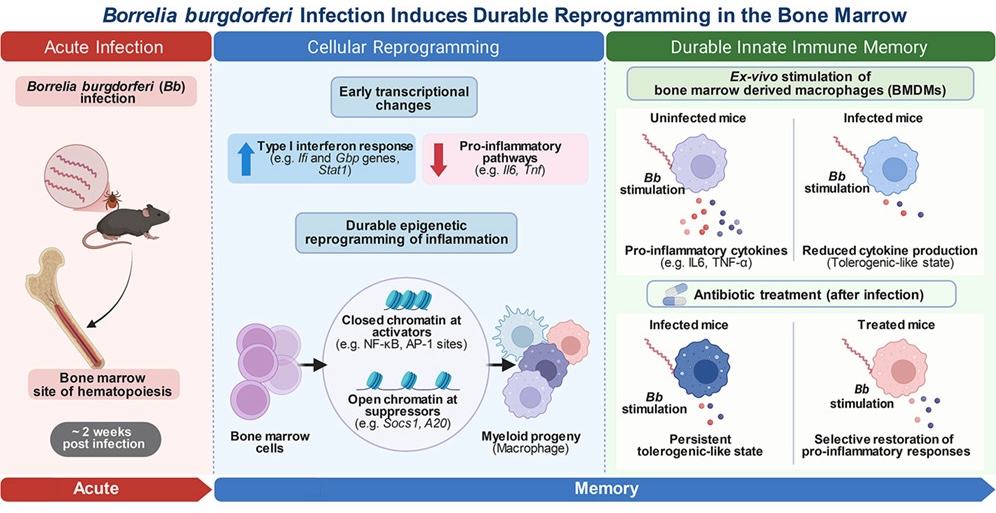
The bacteria had left an epigenetic mark in bone marrow-derived macrophages, suppressing genes usually involved in the inflammatory response.
Killing off the bacteria with antibiotics helped to restore some pro-inflammatory signatures at the genetic level. Adaptive immunity was still suppressed, but the scientists saw a “robust rebound effect” in the bone marrow.
On the other hand, recovery of the macrophages’ cytokine-based ‘alarm bells’ was mixed.
According to immunologist Yuelin Zhong, the study’s first author, the results suggest “that an individual’s first exposure to B. burgdorferi is enough to cause long-term effects on the immune response”.
But scientists have yet to confirm that B. burgdorferi has the same effect in the human body. The Tufts team plans to investigate that next.
“My hope is to sequence these epigenetic marks to create profiles of what Lyme disease does to an individual’s immune system,” Petnicki-Ocwieja says.
“We can then use that to see if the profiles belonging to patients who have long-term symptoms look different from patients who have successfully recovered.”
This could help explain why some people experience prolonged effects after infection and perhaps even lead to treatment or prevention options.
In the meantime, it helps to recognize the distinctive rashes that Lyme disease produces, since early diagnosis and antibiotics greatly reduce the chance of long-term effects.
The research has been published in iScience.
This article was fact-checked by Peter Dockrill and edited by Peter Dockrill. While we pride ourselves on our process, we are only human. If you spot a mistake, please let us know.


