


Major depressive disorder is the most common mental health issue in the world, affecting hundreds of millions of people at some point in their lives. Even worse, a significant number are unable to find treatments that work for them.
That means new approaches are urgently needed.
New research published in JAMA Network Open by a team led by UiT The Arctic University of Norway provides further evidence that intermittent theta-burst stimulation (iTBS) could be a genuinely effective option.
This treatment is already in use, but this study put it to the test against a sham, or placebo, something that hasn’t been done extensively for once-daily iTBS protocols before.
That kind of controlled comparison should give a truer indication of the treatment’s real-world benefits.
The most important finding is that patients given iTBS did indeed show improvements in their depressive symptom scores.
However, as the trial went on, there were some interesting results for those on the placebo treatment too.
“In this randomized clinical trial of adults with MDD, a fixed 10-session schedule of once-daily iTBS resulted in greater reductions in clinician-rated depressive symptoms than sham during the treatment phase,” write the researchers in their published paper.
Things took a somewhat surprising turn later, though.
iTBS works by using a coil pressed against the patient’s head, which delivers focused magnetic fields through the skull, activating neurons in the dorsolateral prefrontal cortex – a part of the brain linked to mood and executive function.
The study involved 73 adults with MDD, aged between 22 and 65. They were split up into two groups: 41 underwent iTBS treatment, while the other 32 underwent a procedure that appeared to be the same, but used a modified coil incapable of reaching the brain.
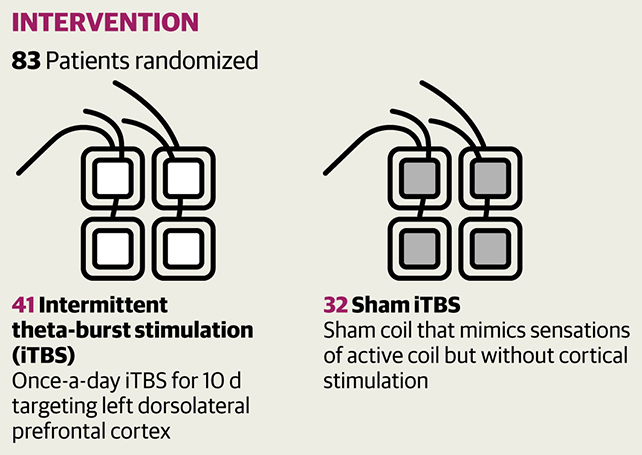
Crucially, iTBS can be faked pretty easily: The placebo group would have felt the same pressure on their head and heard the same knocking sounds.
“The sham coil differs in winding configuration, with one loop reversed, resulting in a diffuse and attenuated magnetic field, further reduced by internal shielding,” explain the researchers in their published paper.
“Consequently, the induced field is insufficient for cortical stimulation, while preserving comparable auditory and scalp sensations via superficial stimulation.”
After 5 and 10 days of daily treatments, the iTBS group showed notably better depression scores based on interviews with clinicians, compared to the placebo group.
However, there was little difference in self-reported symptoms.

Treatment was stopped after 10 days for all participants.
Four weeks later, when following up with the volunteers, the researchers found that the iTBS group had remained steady in their clinical depression scores – and that the placebo group had caught up, showing the same improvement on average.
That might seem odd, but it’s happened before.
“The substantial symptom reduction in the sham group aligns with prior evidence that sham TMS is not physiologically inert but may involve non-specific factors such as expectancy-related, sensory, and contextual influences that contribute to symptom improvements,” write the researchers.
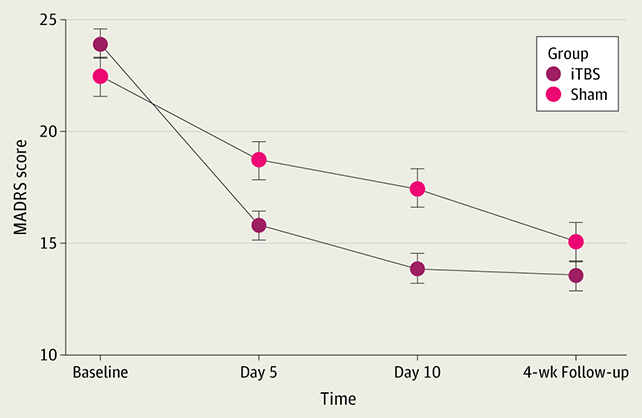
These findings give experts useful context regarding iTBS: short-term gains are definitely possible, but may not continue in the same way over time after the treatment stops (courses of this treatment are often longer than they were here).
The study is also interesting from the placebo perspective.
It’s not certain what caused the improvements here, but it may be that the psychological boost of thinking they were receiving treatment helped the participants.
It also means that future trials should be carefully calibrated in terms of how long they last, how treatments are compared with control groups, and how much time remains before a final follow-up check-in.
Related: Vagus Nerve Stimulation Improves Severe Depression by 70%, Major US Trial Finds
“From a clinical perspective, these findings highlight the importance of treatment duration and follow-up when interpreting clinical response,” write the researchers.
“Treatment duration may shape outcomes, with fixed, short treatment courses potentially facilitating symptom improvement.”
The research has been published in JAMA Network Open.
This article was fact-checked by Clare Watson and edited by Rebecca Dyer. While we pride ourselves on our process, we are only human. If you spot a mistake, please let us know.