


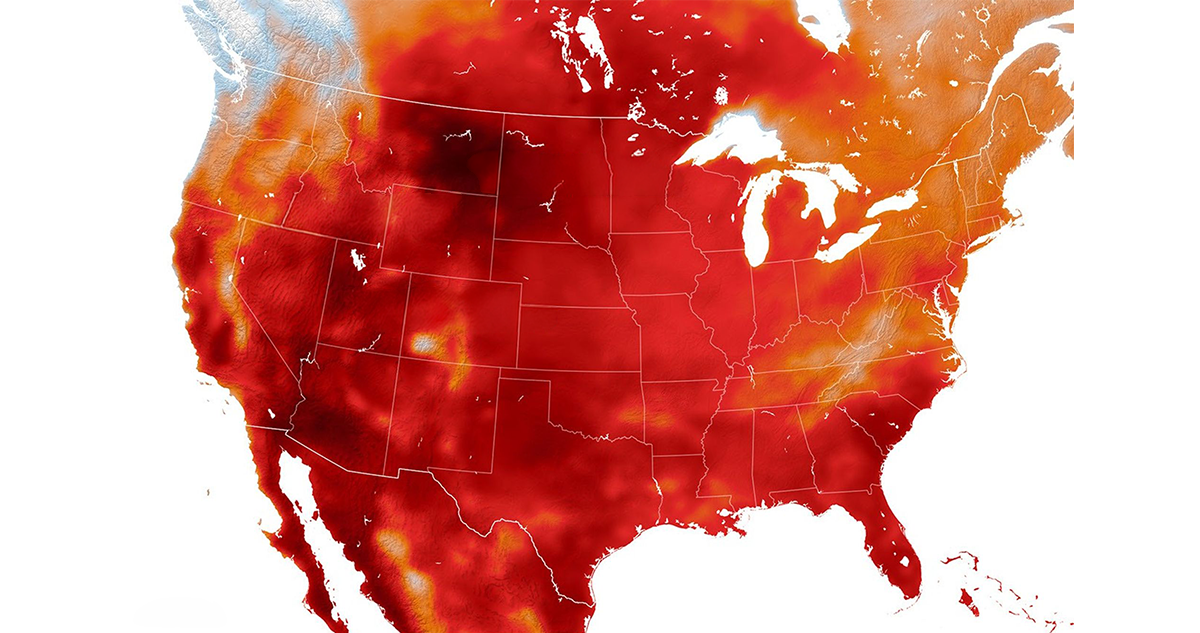
If you celebrated the Fourth of July outdoors on the East Coast, you’re no stranger to the punishing effects of a heat dome. These weather systems occur when masses of air under high pressure prevent convection and cloud formation, trapping heat in one breeze-less, baking area. Heat domes form slowly and tend to linger, and when coupled with high humidity, they produce a kind of “steam-cooker” effect. For the unfortunate human beings caught inside, they’re sweltering, stifling, and even life-threatening.
Read more: “Extreme Heat Will Change You”
While the eastern July 4 heat dome has now passed, there’s another one baking the central United States. NASA recently released an image of temperatures from across the continental U.S. modeled from data recorded by the Goddard Earth Observing System on July 12. It shows the plains states blanketed in oppressive heat, sending temperatures soaring above an estimated 110 degrees Fahrenheit in some regions.
On the ground, weather stations located at airports in Montana, Utah, and Wyoming recorded the highest temperatures since record-keeping began, circa the early 20th century. According to NASA, extreme heat conditions like this have proliferated in the past four decades due to climate change. Their research shows that summer heat waves have roughly doubled from two to four per month from 1980 to 2023.
In other climate news, smoke wafting southward from the wildfires raging in Canada could provide some respite from the sun. But with climate change, sometimes even good news is bad news.
Enjoying Nautilus? Subscribe to our free newsletter.
Lead image: NASA Earth Observatory / Michala Garrison