
Dark Mode Light Mode
EESC calls for prevention-first approach to European wildfires
Polymer sponge could save stars of the silver screen from ‘vinegar syndrome’ destruction | News
Yale propose breakthrough for agricultural PFAS remediation
Chemistry, medicine, materials and the technology shaping tomorrow — the best science stories from trusted sources, every day.

Polymer sponge could save stars of the silver screen from ‘vinegar syndrome’ destruction | News

Polymer sponge could save stars of the silver screen from ‘vinegar syndrome’ destruction | News Polymer sponge could save stars of the silver screen from ‘vinegar syndrome’ destruction | News


Close up of a damaged strip of celluloid film held by a hand in latex gloves. The film features two women in mid-century living room and clothing but the film is cracked and broken and parts of the images have turned white.

The slow degradation of classic film reels could be headed off by a polymer sponge that mops up the chemical that catalyses their breakdown. If this sponge can be scaled up it could make the storage of old movies far cheaper, as they currently require refrigeration and low humidity to prevent damage.

In the early 20th century, movies were shot using film made of cellulose nitrate. However, this material is unstable and highly flammable and was replaced with cellulose acetate. What wasn’t realised at the time was that, over the long term, cellulose acetate is prone to degradation and ‘vinegar syndrome’ is now a well-known issue in the art preservation world. Objects made of cellulose acetate undergo deacetylation in warm, humid conditions and release the acetic acid that gives the problem its name. The acetic acid autocatalyses the breakdown of cellulose acetate, resulting in a vicious cycle of degradation that ends with film reels crumbling.

Low humidity and temperatures help delay the onset of vinegar syndrome but even films stored in ideal conditions may develop vinegar syndrome just 70 years after they were made, meaning that there is an urgent need for new ways to preserve films from the silver screen era.

A team from the University of Florence and the Film Restoration Laboratory L’Immagine Ritrovata in Bologna got together to create a material that could adsorb acetic acid, preventing the worst of the autocatalysed damage. The researchers made a sponge-like material by cryo-polymerising polyethyleneimine with 1,4-butanediol di-glycidyl ether, forming a network with a large, open structure packed with amines that they hoped would adsorb both water and acetic acid.
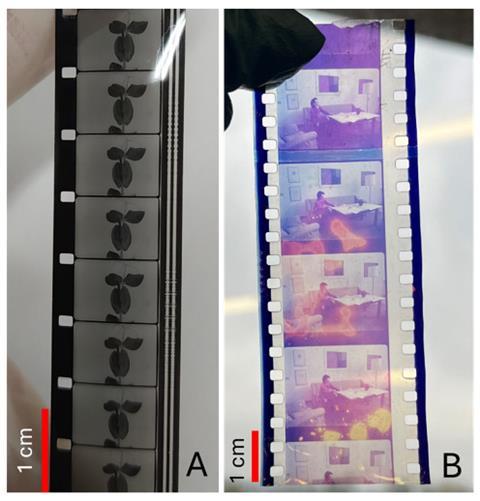
Two side-by side photos of film strips on a lightbox. One strip of a plant is not degraded and the other shows a man sitting in on a sofa in a living room with degraded colours and blotches of orange on the frames.

The team then artificially aged samples of cellulose acetate, as well as pieces of real movie reels, by first placing them in an acidic atmosphere to begin the breakdown process. After the deacetylation process had begun in the film samples, they were next moved to a warm and humid environment. After about 50 days, samples that were aged alongside the polymer sponge showed far less deterioration than the controls. ‘[This material] also protects other films around it because, if one is degrading, the emission of acetic acid could bring damage to films or books or other cultural heritage objects,’ explains Francesca Porpora at the University of Florence, who presented the work at the 10th EuChemS Chemistry Congress in Antwerp, Belgium.

Porpora says that storing films in huge climate-controlled vaults is very energy-intensive and archives are looking for effective and more sustainable solutions. She adds that her group is currently working with the Cineteca di Bologna, which has large collections of film, with the aim of testing this material on an archival scale. Her team is also looking into a nanoparticle-based system to protect films from vinegar syndrome.
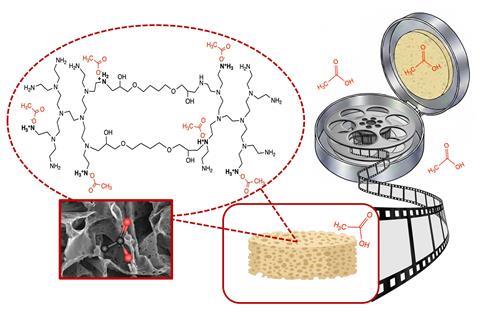
A scientific diagram showing the molecular and micro structure and an electron micrograph of a polymer sponge applied to the inside of celluloid film cases to absorb acetic acid.

Maite Maguregui Hernando, a researcher at the University of the Basque Country, Spain, who has developed bio-based gels to clean cultural heritage items, says that vinegar syndrome is ‘one of the most urgent threats in motion picture film preservation’. She says that this is what makes this work ‘compelling’. ‘Crucially, these sponges leave no residues that can harm the delicate emulsions, remain structurally stable across reuse cycles and can be placed directly inside standard film cans,’ Maguregui Hernando says. ‘They offer a practical, ambient-temperature solution for institutions that lack cold storage, buying vital time for at-risk reels waiting for digital migration.’

She does note that the polymer sponge has some limitations, though. While the sponge ‘breaks the autocatalytic feedback loop, it does not halt the underlying, moisture-driven hydrolysis of the cellulose acetate itself’. Maguregui Hernando adds that an indicator, such as a colour change, would also be a useful addition to know when the sponge is saturated.


Source link

Previous Post
EESC calls for prevention-first approach to European wildfires

EESC calls for prevention-first approach to European wildfires

Next Post
Yale propose breakthrough for agricultural PFAS remediation

Yale propose breakthrough for agricultural PFAS remediation