


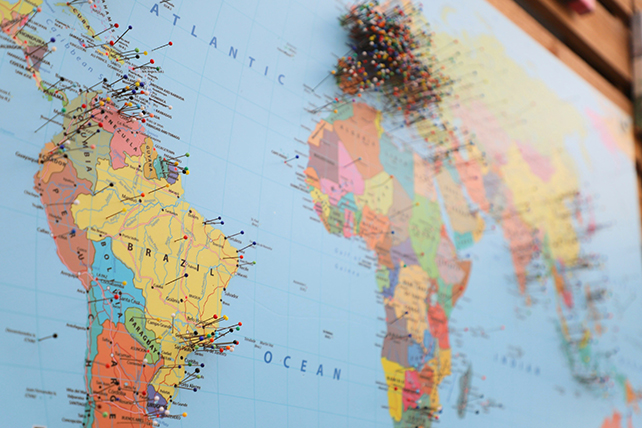
The Four Color Theorem is one of the most famous (and long-standing) puzzles in math: is it possible to use just four colors to shade in all of the regions on any map, with no two neighboring areas sharing the same color?
English mathematician Francis Guthrie first suggested it might be possible in 1852, but a full proof wasn’t presented until 1976.
A more accessible proof arrived in 1997, less reliant on computer calculations that were difficult to verify, but its algorithms took a long time to compute on larger maps.
Now, an international team of researchers has made a significant further breakthrough in the Four Color Theorem, coming up with algorithms that work much faster when calculating the colors for maps of any size.
More than a century and a half after Guthrie first speculated that four colors might be enough for any map, mathematicians now have an optimized framework to prove it, and the implications extend beyond coloring in map segments too.
frameborder=”0″ allow=”accelerometer; autoplay; clipboard-write; encrypted-media; gyroscope; picture-in-picture; web-share” referrerpolicy=”strict-origin-when-cross-origin” allowfullscreen>
“The previous proofs showed that it is always possible to color a map using four colors, but they are not very good at actually finding the colors for each individual region on a map,” says computer scientist Mikkel Thorup, from the University of Copenhagen in Denmark.
“The new algorithm is efficient and provides a much faster way of coloring.”
At the center of the new approach is a way of finding patterns within a map, patterns that the researchers term reducible configurations.
They work like starting points, locations from which the four-color patterns can be calculated.
The more starting points there are, the faster the coloring can be calculated. The approach also helps to simplify the map initially, with the rest of the complexity added in later and the colors tweaked to fit.
“Think of reducible configurations as handles you can grab hold on to start four coloring,” says mathematician Carsten Thomassen, from the Technical University of Denmark.
“We show that graphs do not contain just one handle, but an astonishing number of them. Nobody knew that before.”
While the 1976 and 1997 proofs showed that four colors would work on any map, three decades after the last proof we’ve got another one that optimizes the problem and tackles it more efficiently – and which scales up much better.
“We have gone from what mathematicians call quadratic time to linear time,” says Thomassen.
“This means that if a map contains ten times as many regions, the computation only becomes about ten times slower. With the previous algorithm, it would have become about 100 times slower.”
Across two papers, one of which was presented at the IEEE Symposium on Foundations of Computer Science (FOCS), the researchers combined both mathematics and data structures to develop a fresh algorithm for the map problem and a carefully calibrated way of deploying the algorithm.
It’s testament to the dedication of the researchers (which they describe as a “disease”) that we’re still seeing innovation around a problem that thousands of mathematicians have worked on over the last 174 years.
What’s more, because math can be used to turn maps into graphs – represented by points and connections – the same process that’s applied here to the Four Color Theorem could also help with other mathematical puzzles, the researchers suggest.
We just got a newly optimized calculation method that could also help with tackling other kinds of surfaces
“The remarkable thing is that because there are so many handles, the idea can also be applied to other kinds of surfaces besides a flat map,” says Thorup.
“For example, surfaces with holes, such as a swim ring or a piece of Emmental cheese.”
“That is why we believe the result could have significance far beyond the Four Color Theorem.”
The research is available on arXiv, here and here.
This article was fact-checked by Fiona MacDonald and edited by Fiona MacDonald. While we pride ourselves on our process, we are only human. If you spot a mistake, please let us know.


