




In a hidden cave on a small island off the coast of Sweden, a tragedy has lain buried for thousands of years.
There, buried under the ancient sediment, archaeologists have found the bones of a young woman and a fetus, estimated to be around 32 to 34 weeks of gestation.
The incredible discovery was made in Suder Vagnhus cave on the island of Lilla Karlsö, a nature reserve in the Baltic Sea off the coast of Gotland, uninhabited by humans.
If archaeologists’ estimates are correct, the bones may have been resting there for 8,000 to 9,500 years.
And that could rank the find among the oldest known burials of a pregnant woman with fetal remains still in place.
But that’s not the only discovery waiting on the island. Now, only the wildlife calls Lilla Karlsö home – but the woman and fetus may not have been buried there alone.
“We do have one or possibly two more individuals identified in the cave (at least one young child), though only from a few individual bone elements, indicating that the cave had been used as a burial site or something similar,” archaeologist Alexander Sjöstrand of Uppsala University in Sweden told ScienceAlert.
“This also corresponds with the sister island of Stora Karlsö and cave Stora Förvar, where they had approximately 15 individuals from the same time period in a similar cave excavated during the late 1880s.”
The entrance to Suder Vagnhus has been well known for a long time – it stands on the island’s coast, elevated above sea level, its 18 by 18-meter (60 by 60-foot) entrance gazing out on the Baltic Sea like a vast empty eye socket.
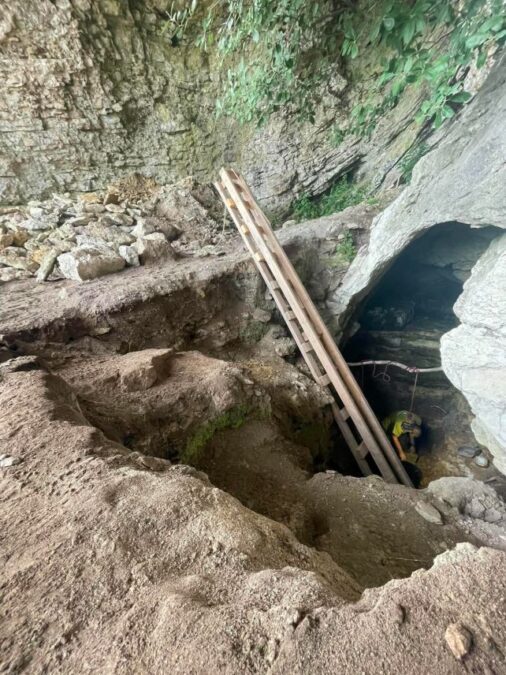
In 1992, however, a secret was discovered: Tucked away at the bottom of the eastern wall, hidden by rubble and just big enough for a person to squirm through, was the small entrance to a side cave.
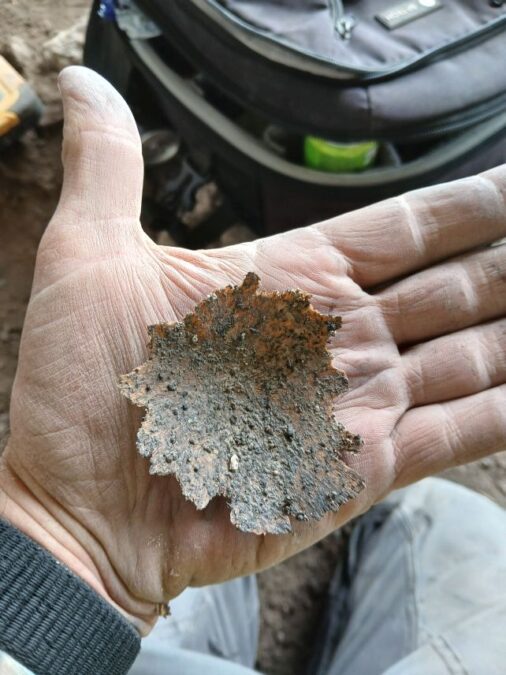
An initial foray yielded a small cavern and an array of animal bones – and radiocarbon dating of one sheep skull dated to the 14th century, suggesting the chamber may have lain undisturbed for some 700 years.
To protect it against incursion from animals and curious visitors, the chamber entrance was once again sealed with limestone blocks until Sjöstrand and his colleagues began their excavation in 2023.
It was in this tucked-away side chamber that the remains were discovered.
And the position of the tiny bones left little doubt that the woman had been pregnant when she was buried.
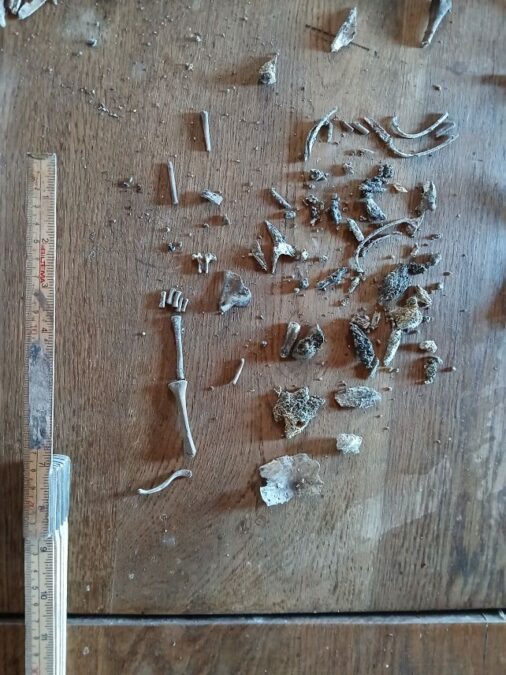
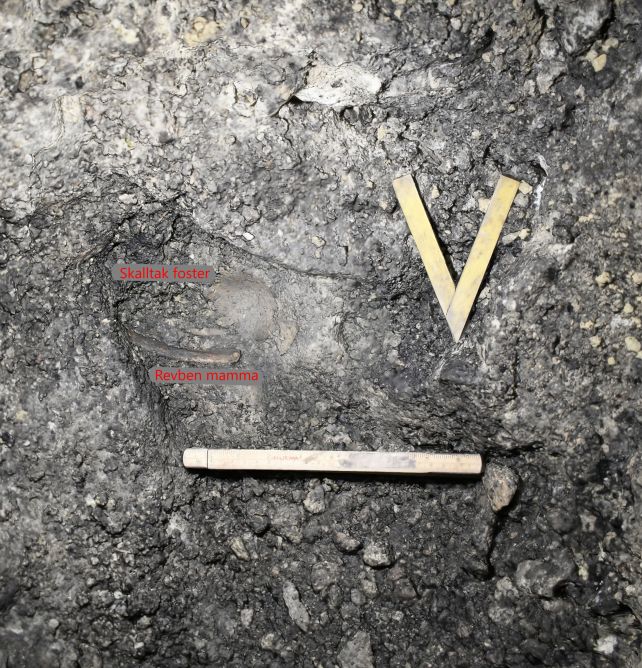
“The fetus was located in the abdominal area with some of the mother’s ribs found strongly indicating the fetus was inside,” Sjöstrand told ScienceAlert.
“The fetus is also positioned head towards the mother’s feet, and as far as we’ve been able to tell on the mother’s position, face towards the spine, which aligns with the age of the fetus having turned in the stomach, getting ready for birth.”
The woman appears to have been a teen, around 14 to 19 years of age, with the bones uncovered so far suggesting she may have been buried in what is known as the “Hocker” position, curled up on her side – a position Sjöstrand said would fit typical burials of the time period, in keeping with the picture that she was deliberately interred.
Meanwhile, because the fetal bones were very well preserved, the researchers were able to measure them, particularly the long bones, which were consistent with a third-trimester developmental stage.
What is not known is how she died, or whether the pregnancy had anything to do with it.
“We have some thoughts on it, but it’s to early to speculate publicly,” Sjöstrand said.
The remains of pregnant women with fetuses are scarce on the archaeological record, despite the dangers posed by pregnancy and childbirth for much of human history.
One major reason is that human remains in general are relatively rare – indeed, only a very small percentage of any living population enters the archaeological record. Organic material breaks down readily, even bone.
And smaller, more delicate bones are even less likely to survive.
“Fetus and infant bones are very small and very fragile; there aren’t that many places in the world where the environment in which the bones are buried is conducive to preservation, especially for anything close to this timeframe,” Sjöstrand explained.
Another reason for this could be that many maternal deaths occurred during childbirth, after which the baby may have either survived or been buried separately.
And, in some rare cases, a pregnant woman can appear to give birth after death, a phenomenon known as coffin birth, which occurs when the gases of decomposition build up in the body and push the fetus out.
So a burial more than 8,000 years old, with a fetus still inside the mother’s body, could be a rather special find indeed.
“From what I’ve found so far, it’s not unheard of to find pregnant women, but it’s quite rare,” Sjöstrand said.
“Cases that are 8,000 years and older are extremely rare, with only a few examples where the fetus is well preserved. So this find seems to be one of the few finds of this type and quality.”

Further investigation will be needed to pin down the date.
For now, archaeologists have placed the remains between 7,000 and 10,000 years old based on the cave’s stratigraphy (rock layers) and comparison with finds from nearby Stora Karlsö, with 8,000 to 9,500 years considered the most likely range.
Radiocarbon dating should provide a more precise age.
Related: A Fetus Was Preserved Within an Egyptian Mummy Because It ‘Pickled’, Scientists Say
DNA analysis could also confirm a genetic relationship between the woman and the fetus. And that’s even before getting to the remains of the other individuals uncovered in the cave.
For now, however, the dig continues. The most important information may still be buried in the cave sediment.
“The mother is fragmented but well preserved, and we still have not excavated her completely,” Sjöstrand said.
“If we could find more of the hip, legs, and shoulder, that would go a long way to see her exact burial position and confirm how she was buried.”
This article was fact-checked by Clare Watson and edited by Clare Watson. While we pride ourselves on our process, we are only human. If you spot a mistake, please let us know.
.jpg?w=95&resize=95,95&ssl=1 "The Job-Interview Tattoo Guy Everyone Got Mad at Finally Explains Himself")


