


Photons act in freaky ways that remind us that nothing is as it seems at the smallest scales and most fundamental levels of existence.
Photons are the smallest possible bits of electromagnetic energy and are massless, allowing them to travel at the speed of, well, light.
Yet these feats may be their least fascinating properties because they also exhibit wave-particle duality, behaving both like waves and particles depending on how they’re measured – as shown in Thomas Young’s famous 19th-century double-slit experiment.
Further probing this wave-like duality, physicists from the University of Oslo (UiO) explored a question that has never been asked before: what happens when you try to cut a photon in two, like lopping off the ickily oxidized end of an overripe banana?
“Surprisingly, we will find that a truncated photon is a complicated state involving photon numbers up to infinity,” the researchers say.
“In other words, by ‘cutting away part of the photon’ with a shutter, we effectively create a bunch of new photons.”
Of course, since a photon is an elementary particle, it cannot actually be cut in half, unlike an oxygen-browned banana.
So the researchers calculated what would happen if one were to remove an optical shutter – basically a mirror – while it’s in the act of reflecting a photon.
Instead of creating two photons traveling in opposite directions, removing the mirror may produce many photons, or a quantum quirk known as superposition, in which photons exist in multiple states simultaneously.
When measured, this quantity can theoretically end up being any number of photons: either zero, a few, or a bunch, up to an infinite amount.
But could one really generate infinite photons, either in theory or in practice?
“There is a common misunderstanding about this work. When truncating the photon by removing the mirror, the expected number of produced photons is not infinite.” Johannes Skaar, a theoretical physicist at UiO and one of the study’s co-authors, told ScienceAlert.
“If the mirror is removed slowly, the number is small; if it is removed quickly, the number is large.
“But the expected number is never infinite – that would have required infinitely fast mirror removal, which is not possible.”
Indeed, the probability of measuring a large number of photons decreases if the mirror is removed slowly.
“Another misunderstanding is that photon truncation is difficult to do in practice. That is not true.” – theoretical physicist Johannes Skaar
Additionally, even though vacuums are seemingly empty in classical physics, “it is well-known that the transformed vacuum state contains photons,” the researchers say, and the act of removing the mirror “converts vacuum energy to real photon energy.”

And although ‘cutting’ a photon can’t be as simple as slicing a loaf of deliciously tangy, airy sourdough, it’s not that hard, Skaar said, because photons exist in various wavelengths.
“Another misunderstanding is that photon truncation is difficult to do in practice. That is not true,” Skaar told ScienceAlert.
“Indeed, narrow-band photons can be very long, several meters, even kilometers. For such a photon, the [mirror] does not have to be unrealistically fast.”
Related: Amazing Theory Accidentally Reveals The Precise Shape of a Photon
Finally, this experiment reveals a surprising effect depending on where it’s observed, Skaar notes: “this complicated mixture state is locally equivalent to a single photon and vacuum (zero photons) to the left and right of a narrow transition region.”
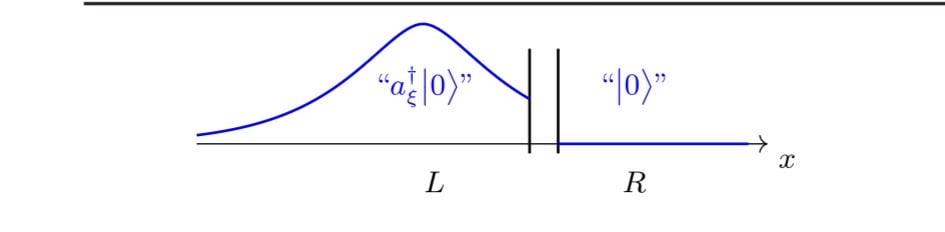
So while there might appear to be a brilliant effusion of many photons in a small region separated by the mirror, looking to its left would present a single photon, while looking to the right would present zero photons, or ’empty’ space.
Perhaps it’s an understatement that the authors admit that “this state is rather complicated.”
This research is published in Physical Review Letters.
This article was fact-checked by Michael Irving and edited by Rebecca Dyer. While we pride ourselves on our process, we are only human. If you spot a mistake, please let us know.