





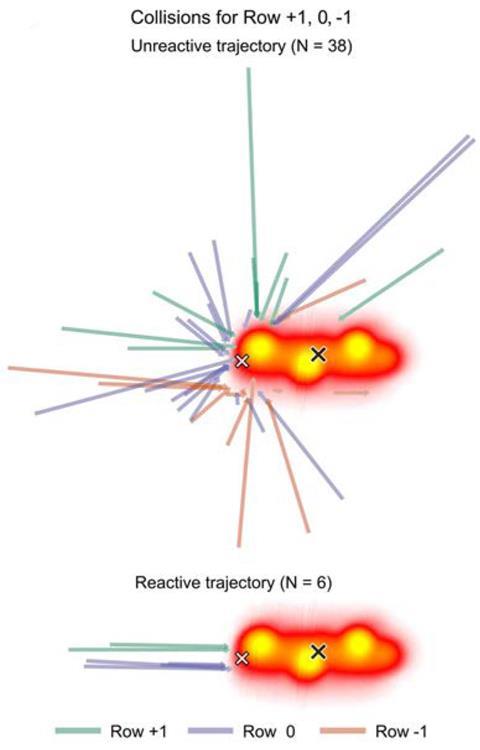
The likelihood that two colliding molecules react depends strongly on the angle, researchers in Europe have shown.1 The research could potentially be extended to study the effects of other variables on collision outcomes and, ultimately, to design more efficient chemical reaction pathways.
When atoms or molecules collide, the particles may simply bounce off each other. Alternatively, the collision can lead to bonds breaking or forming. The factors governing whether a collision is reactive or not are still not fully understood, however. In 2018, chemical physicists in the group of John Polanyi at the University of Toronto in Canada – who shared the 1986 Nobel prize in chemistry for work on reaction dynamics – aimed difluorocarbene molecules adsorbed onto copper at each other and used scanning tunnelling microscopy (STM) to show that they were more likely to react in the case of a head-on collision than a glancing blow.2
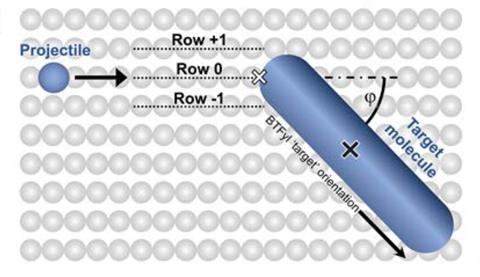
In new work, chemical physicist Matthew Timm, a PhD student in Polanyi’s 2018 collaboration, and colleagues in the group of Leonhard Grill at the University of Graz in Austria, together with theoreticians at the Czech Academy of Sciences in Prague, extended this to study molecular orientation in reactions. They did this using rod-like dibromoterfluorene molecules chemisorbed at various angles onto the ridged surface of face-centred cubic copper. First, they used an STM to pluck off one of the terminal bromine atoms, leaving the highly reactive BTFyl radical. They then electrically accelerated difluoromethylene radicals towards this radical and used the STM to measure whether or not a bond was formed. The energetic barrier for projectiles to travel along these rows on the copper was much lower than for them to hop across ridges, meaning that the texture of the surface ensured that the projectiles hit the chemisorbed targets in precisely their intended positions.
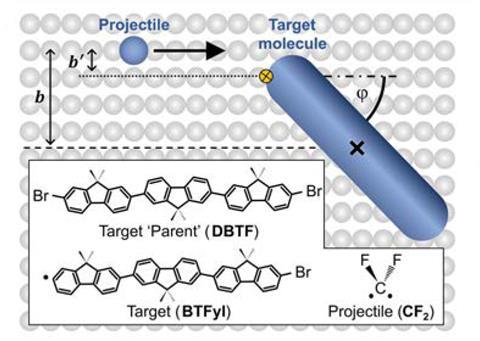
The researchers found that, when the projectiles approached the target carbon on the BTFyl radical at an angle of less than 1° from the molecule’s axis, a bond was always formed. When the angle was greater than 15° or the projectile was displaced even one row down from the radical bonding never occurred. Curiously, bonding sometimes occurred when the molecule was aimed one row too high, meaning it should have missed the radical altogether. Theoretical calculations suggested that displacement of the underlying surface by the chemisorbed radical could help facilitate movement of the projectile between rows. Calculations carried out by the team reveal that this narrow region of reactivity is governed by steric effects.
The researchers now want to look at how the spatial sensitivity of the reactivity varies if the target atom or the degree of steric hindrance within the molecule changes. ‘These are questions that are interesting to me and I think should probably be interesting to the wider community – how to make a bond easily and efficiently and how to design molecules to make these bonds,’ says Timm.
Theoretical chemist Jonas Björk at Linköping University in Sweden describes the simultaneous control of the position and angle of impact on the target as ‘extremely clever’ and ‘a great contribution’. He suggests the techniques could now be used to study the effects of different chirality, or to examine molecules on different, less reactive surfaces such as silver and gold to see whether a trend can be obtained and perhaps extrapolated to estimate the behaviour in free space. ‘The more types of chemistries we can do the more we can see how these parameters affect chemical reactions between colliding molecules,’ he concludes.


