


Right now, there’s a quiz bouncing around social media that can pin down where your dialect is from using just 24 questions. Originally developed by Harvard linguists more than 20 years ago, the quiz asks how you pronounce certain words (i.e., merry versus marry) as well as the regional colloquialisms in your vocabulary (hoagie versus grinder versus sub). The result is an eerily accurate map of where your accent comes from, and likely where you grew up. But beyond being a neat party trick, it’s a window into the astonishing diversity of just one language in just one country (the global breadth of English dialects is truly staggering).
But why?
For starters, they’re strong signals of cultural identity. According to research, our accents actually start in the womb and are so deeply ingrained they even color our non-verbal vocalizations. For example, a 2009 study found that French infants cry with a rising melody, ending on an up note. The cries of German infants, on the other hand, follow a slightly more mournful falling melody. Now, a new study published in PLOS One has uncovered the evolutionary roots of dialects by investigating our closest non-human relatives: chimpanzees.
Read more: “What Became of the Chimps Who Revolutionized Our Understanding of Animal Behavior?”
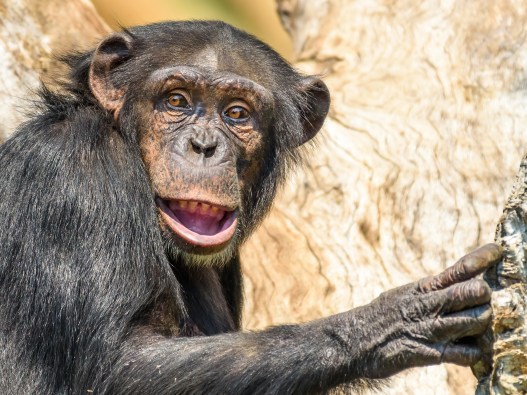
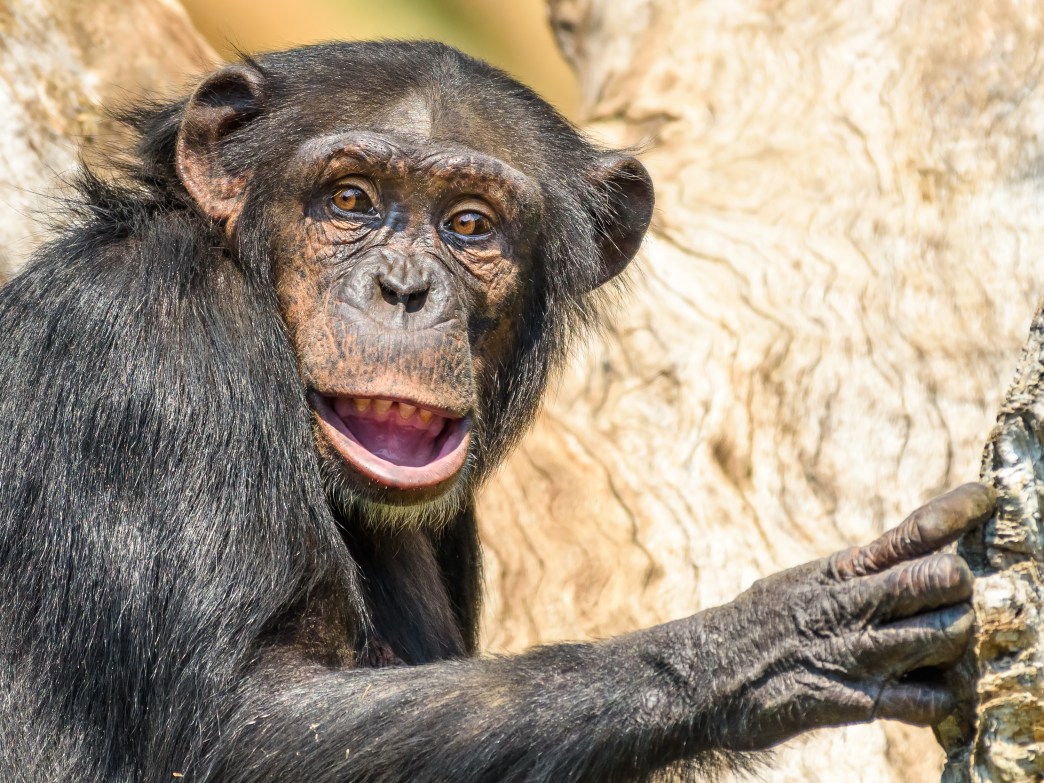
Like humans, chimps have their own vocalizations used for different purposes (pant-hoots for long-distance communiques, grunts for short-range chatter, etc.), and they also come in different regional dialects. Similarly, these chimp accents signal population identity, but they can change over time. In fact, a 2015 study of two different chimp troops that were translocated together found their grunts eventually blended and converged as the rest of the community did.
To find out when these distinct accents develop, a team of primatologists studied 30 infant and juvenile chimpanzees, focusing on the acoustic characteristics of their grunts, whimpers, and laughs (the most common sounds produced by young chimps). They found that juvenile chimpanzees produce subtly different vocalizations of all three types, but infants only showed variation in their laughs and grunts (their whimpers were fairly similar).
In other words, unlike humans, these chimps weren’t born with their accents, they developed them as they matured. According to the team, this is likely because laughter and grunts are more speechlike, while the more constrained whimpers serve as an alarm function, alerting mothers to the location of baby chimps when they’re out of sight.
But their findings do mirror human vocalizations in another way. Laughter, a non-verbal vocalization associated with positive emotion, actually shows more variation across human languages than negatively tinged vocalizations, like screaming and crying (the French versus German infant study notwithstanding). The same, it seems, is true of chimps.
Now to find out if they call long sandwiches hoagies or grinders.
Enjoying Nautilus? Subscribe to our free newsletter.
Lead Image: Radu Bercan / Shutterstock


