



You have full access to this article via your institution.
Hello Nature readers, would you like to get this Briefing in your inbox free every day? Sign up here.
Sleep deprivation can be dangerous, but it’s difficult to measure.Credit: Getty
Chemical tags on proteins in a mouse’s brain serve as a marker of both the length of a sleep session and how likely an animal is to wake up at a given moment. An enzyme adds these tags to proteins on the surface of brain cells, and their levels follow a predictable rhythm, researchers found. The extent of protein tagging stayed high and steady when mice were awake and began a slow decline when they fell asleep, spiking if they experienced a brief interruption in their slumber.
Nature | 5 min read
Reference bioRxiv preprint (not peer reviewed)
The debate over whether artificial intelligence (AI) systems might become conscious has inspired some tech firms to hire philosophers. But researchers still haven’t agreed on what gives rise to consciousness in humans, let alone in an AI chatbot — and some say the issue is a red herring. “What we might see is a sort of capture of consciousness research by the AI sector,” says consciousness scientist Anil Seth. On the plus side, the influx of interest might help to validate a field that was not taken seriously as a scientific endeavour for years — and bring in all-important funding.
Nature | 8 min read
A small number of fertility clinics around the world are offering controversial mitochondrial replacement therapy (MRT): a procedure to furnish clients’ embryos or eggs with donated mitochondria. The theory behind the treatment — which remains unproven in rigorous clinical trials — is that the donor’s mitochondria might help the embryo to mature. “I’m pretty horrified,” says fertility specialist Richard Anderson, who reviewed the MRT offering of one of the clinics identified by Nature. He says that the technique is difficult, the risks are high and the benefits are uncertain.
Nature | 8 min read
Features & opinion
All living cells emit a faint glow, thanks to ‘biophotons’ produced by their metabolic activity. In the past, researchers have theorized that cells might use this glow as a way of communicating with one another, but the idea was dismissed as pseudoscience. Now, the study of biophotons is making a comeback, with some researchers hopeful that a cell’s glow could be a subtle marker of health, or a way of sending signals to its neighbours. “It’s one of those fields that feels like it is on the edge of respectability,” says biochemist Nick Lane.
Nature | 12 min read

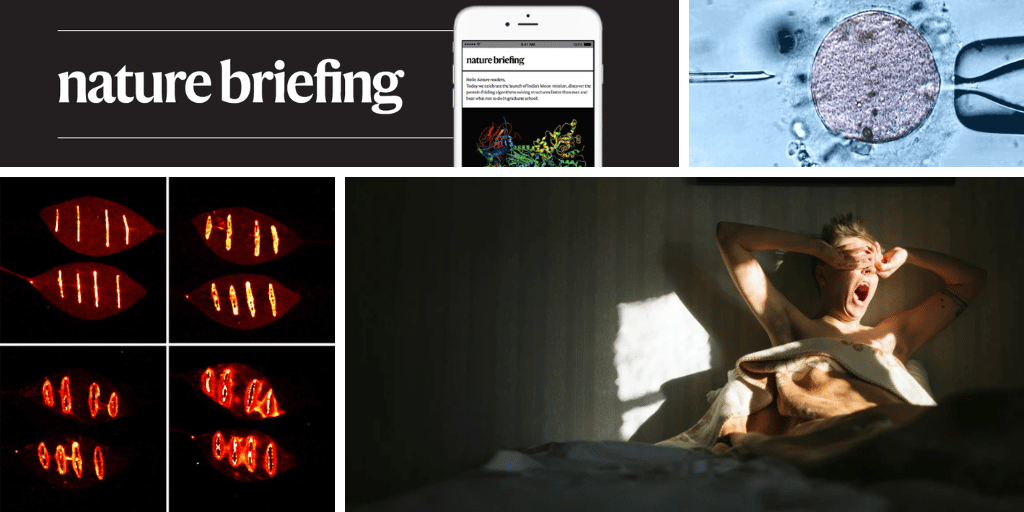
Biophoton emissions from a cut leaf change over three days.Credit: Vishnu Seshan/University of Calgary
In The Art and Science of Ernst Haeckel, science historian Julia Voss and zoologist Rainer Willmann bring together 450 of the polymath’s drawings and watercolours of the natural world. Over his long and varied career, Haeckel identified thousands of species, many of which he depicted in the detailed and colourful illustrations that the book contains. Although his racist and eugenic personal views should be deplored, “it is still possible to be impressed by the sheer breadth of Haeckel’s artistry”, writes science journalist Josie Glausiusz in her review.
Nature | 6 min read
“With the benefits of AI tools come fresh patient-safety risks — and questions about who is responsible when things go wrong,” write a group that includes physician-scientist Eric Topol. This legal uncertainty could cause patients to fall into liability gaps when things go wrong, and hospitals to avoid useful tools because of concerns about murky legal risks. The authors define seven levels of AI capabilities — similar to the graded levels used by regulators for aircraft and self-driving cars — to help regulators, policymakers, governments, courts and health-care bodies to plan for future medical-AI systems.
Nature | 15 min read
Today I’m enjoying the surprising benefits of a five-minute dance break — not just this second, it’s hard to type while dancing — which seems to have various benefits for the body and mind.
The question is: what music to put on? Let me know your playlist for a good boogie — plus any feedback on this newsletter — at [email protected].
Thanks for reading,
Flora Graham, chief editor, Nature Briefing
With contributions by Jacob Smith
• Nature Briefing: Careers — insights, advice and award-winning journalism to help you optimize your working life
• Nature Briefing: Microbiology — the most abundant living entities on our planet — microorganisms — and the role they play in health, the environment and food systems
• Nature Briefing: Anthropocene — climate change, biodiversity, sustainability and geoengineering
• Nature Briefing: AI & Robotics — 100% written by humans, of course
• Nature Briefing: Cancer — a weekly newsletter written with cancer researchers in mind
• Nature Briefing: Translational Research — covers biotechnology, drug discovery and pharma