Bewilderingly, most of the matter in the Universe seems to be invisible.
All the visible stuff like galaxies, stars, and the sugary, raspberry-flavored gas clouds that leave us so jaw-gapingly awed (and hungry) only make up about 15 percent of the Universe’s matter.
The rest is composed of unseen dark matter, which only interacts with gravity and seems essential for anchoring major celestial structures like galaxies and clusters of galaxies.
Current attempts to detect dark matter, whatever it may be, include using vats of super-cold liquid xenon or probing the glowing heart of the Milky Way for explosively self-annihilating particles.
Yet such efforts have failed to demystify this murkiest of matters – perhaps because we’ve been looking in the wrong places.
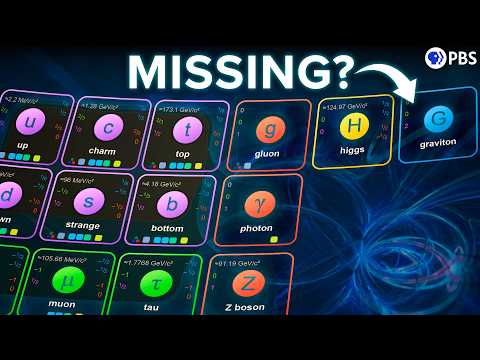
Instead of seeking, say, exploding dark matter, researchers say that perhaps we should search for the signs of dark matter transforming into even more esoteric particles, such as the hypothetical gravitons that may imbue the Universe with gravity.
As detailed in a paper published in the journal Physical Review D, a team of physicists suggests searching for the indirect signs of dark matter decaying into gravitational particles, which themselves may then transform into particles of light.
frameborder=”0″ allow=”accelerometer; autoplay; clipboard-write; encrypted-media; gyroscope; picture-in-picture; web-share” referrerpolicy=”strict-origin-when-cross-origin” allowfullscreen>
This strategy relies on the Gertsenshtein effect, “whereby the gravitons produced in dark matter decays can convert to photons in large-scale magnetic fields along the line of sight to an observer,” the researchers explain.
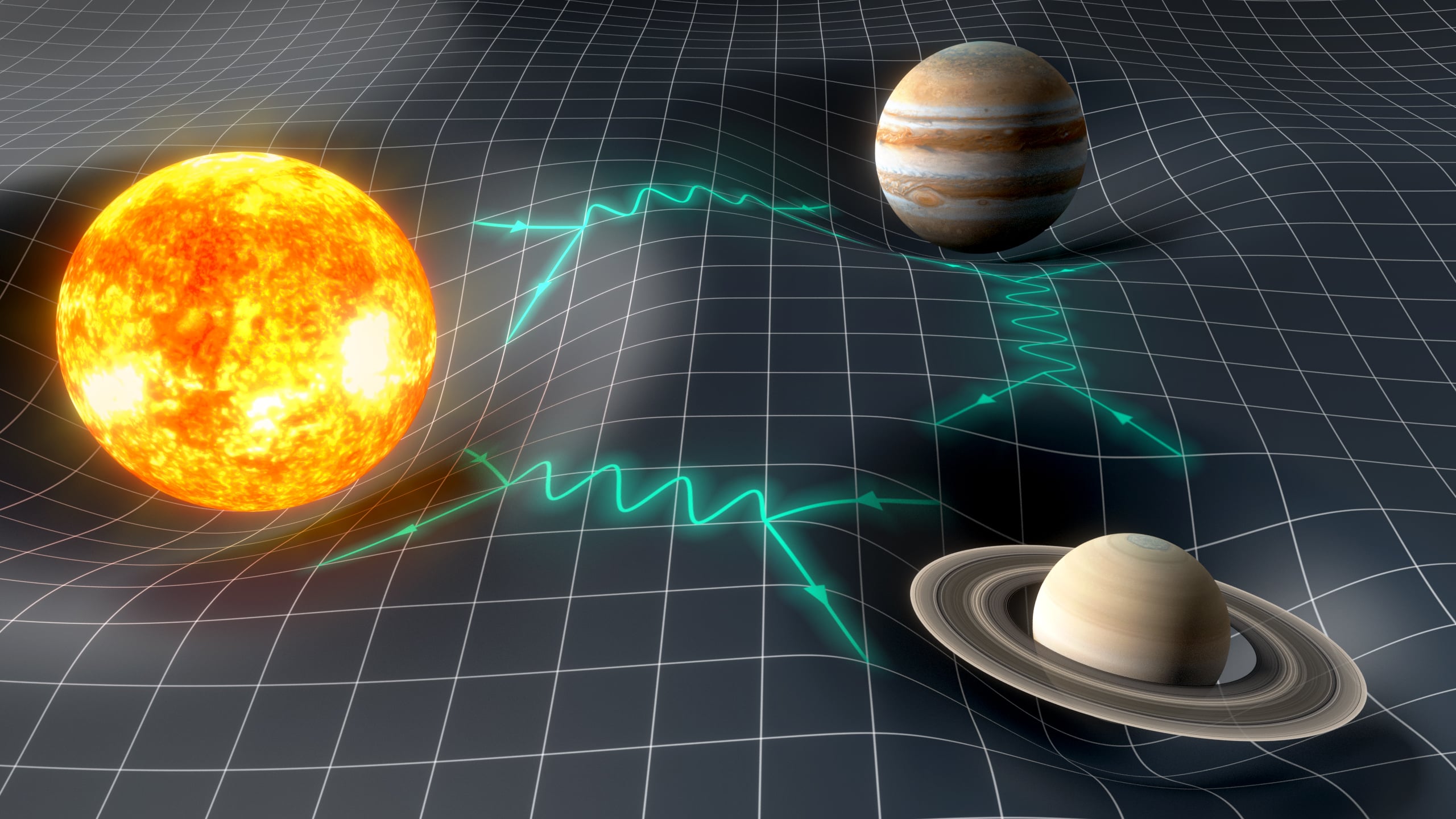
Gravitons are hypothetical particles thought to carry the force of gravity, similar to how photons carry the electromagnetic force.
Yet gravitons have eluded science for over a century. We have little, if any, evidence that gravitons exist, and their interactions may be so weak that some physicists believe we’ll never detect them.
So the researchers’ novel technique focuses on a cascade of cosmic decay.
Dark matter particles in the early Universe may have decayed into gravitons, which may have been converted into gamma-ray photons as they propagated through the magnetic fields between galaxies.
This is most likely to occur within the cosmological filaments of gas, dust, and stars that link the cosmic web, the largest known structure in the Universe, the researchers say.
As the researchers note, it is estimated that these filaments comprise up to 30 percent of our present Hubble volume, the observable portion of our Universe beyond which objects are receding faster than the speed of light as the Universe expands.
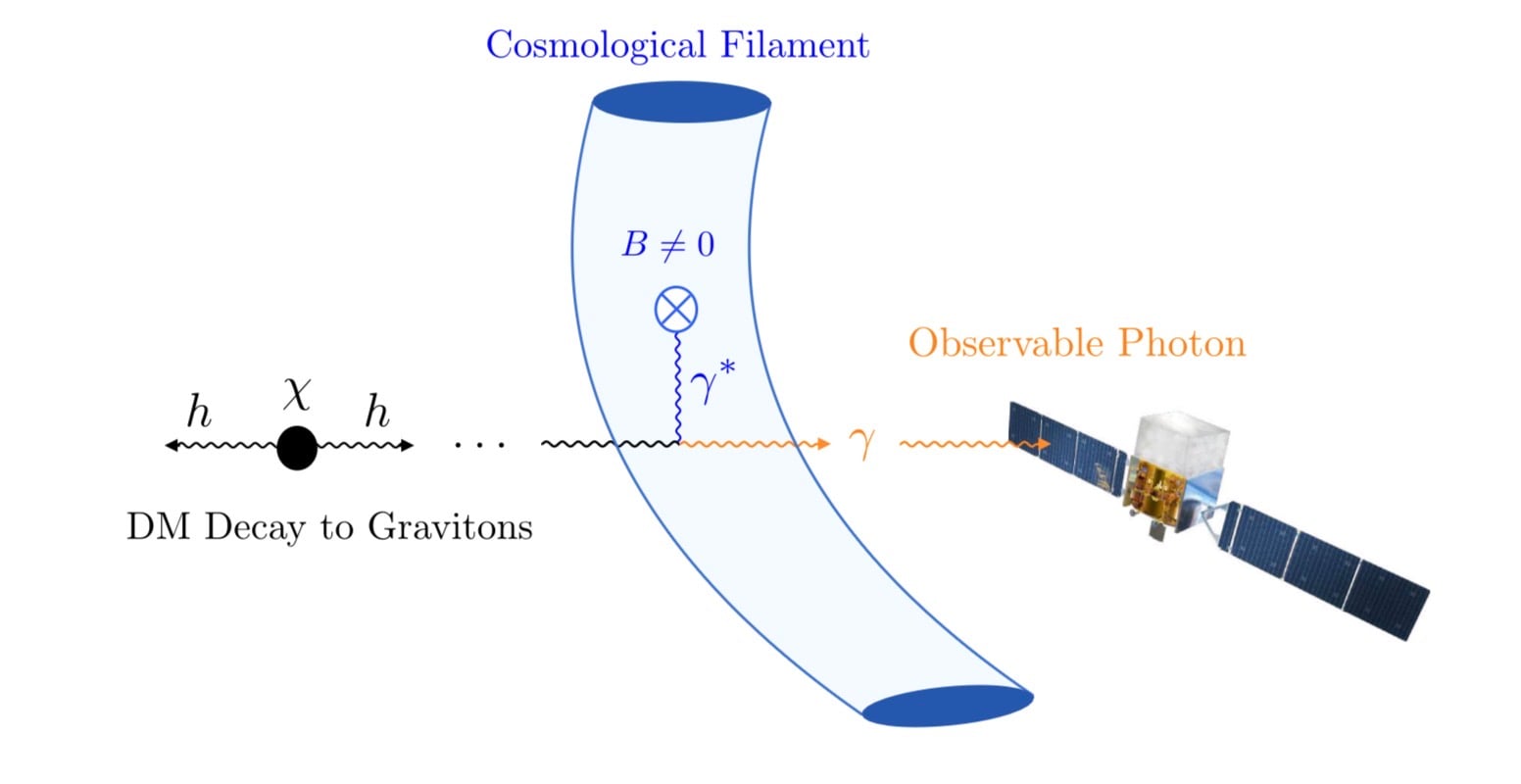
Filaments also exhibit expansive magnetic fields that remain coherent, or uniform, across millions of light-years.
These magnetic fields are also very weak, just billionths of a gauss in strength, compared to Earth’s surface magnetic field of around 0.5 gauss, which is still 100 times weaker than your typical fridge magnet (yes, weaker, that’s not a typo).
So, addressing the big question: How will the researchers know if they’ve actually discovered this potential dark-matter-graviton-photon decay?
By detecting an excessive gamma-ray flux, compared to the background gamma-ray levels they determined using the Fermi Gamma-ray Space Telescope.
This may also shift our dark-matter focus from galactic centers to intergalactic space.
“Intriguingly, given the cosmologically long distances required for appreciable graviton-photon conversion in filaments, this signal arises predominantly from extragalactic sources, not from the Galactic center,” where many researchers are searching for dark matter signals, the researchers write.

Finally, this scenario benefits from its adherence to the Standard Model, the leading theory of particle physics.
“We emphasize that this effect is a Standard Model process and that the only new physics considered here is the hypothesis that dark matter can decay to gravitons,” the team notes.
Related: The Large Hadron Collider May Already Have Detected Hints of Dark Matter
Future work could involve scanning the sky with the Advanced Particle-astrophysics Telescope, a next-generation, space-based observatory that has been proposed and, if launched as planned, would improve sensitivity to this dark matter decay channel by an order of magnitude, compared with the Fermi telescope used in this study.
This research is published in Physical Review D.
This article was fact-checked and edited by Clare Watson. While we pride ourselves on our process, we are only human. If you spot a mistake, please let us know.