


For as long as there’s been life on Earth it’s been shielded by our planet’s magnetic field. And yet, we still don’t know a lot about how this invisible protector has shaped our biology. A new study published in the journal Aging is aiming to correct this by making that field disappear.
“We live our entire lives within the Earth’s magnetic field,” study author Lisa Chakrabarti of Nottingham University explained in a statement. “It passes through our bodies, our cells and every living organism on the planet, yet we know surprisingly little about whether and how this invisible force affects the way our cells work.”
Read more: “How Our Perceptions of Aging Can Affect Our Social Lives”
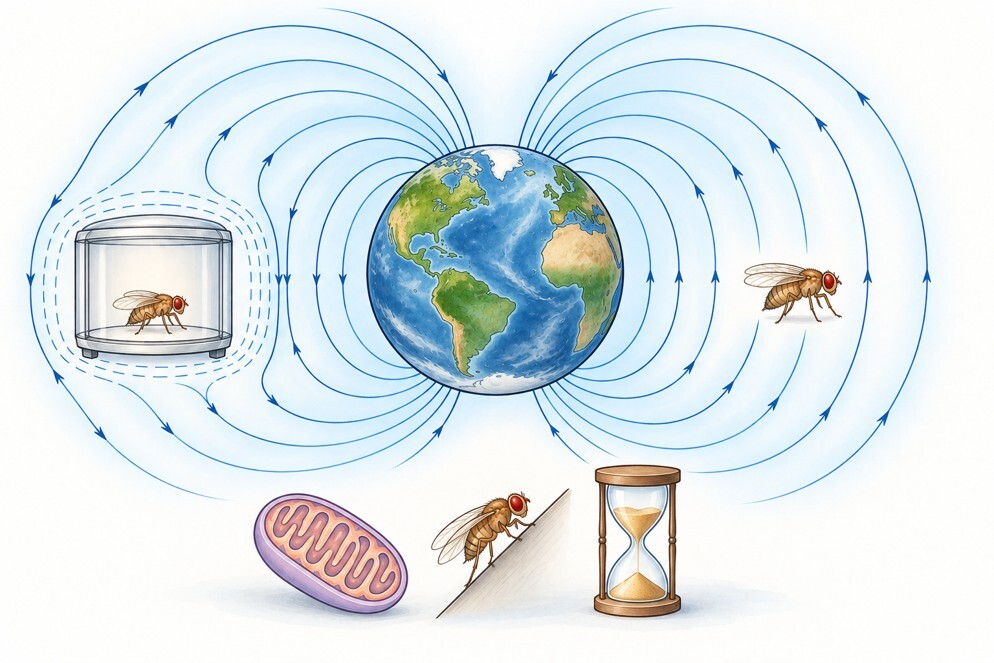
To find out, Chakrabarti and a team of veterinary scientists from Nottingham University placed fruit flies in special cages designed to shield them from magnetic effects. The team used two different kinds of flies: the normal wildtype variety and a lineage with a mutation in the Pink1 gene. Commonly used to mimic the effects of early onset Parkinson’s disease, these flies have mitochondrial deficiencies that result in a lack of motor control (so they can’t actually fly) and a much shorter lifespan. The team monitored both groups to find out how long they lived and measured their physical performance by watching how many could crawl up the sides of their vials.
Interestingly, the shielded Pink1 mutants lived about 20 percent longer than they normally would, but they showed reduced physical performance. The wildtype flies, on the other hand, showed improved physical performance but a diminished lifespan. Weird, right?
So what’s going on?
According to the researchers, the two groups of flies responded differently because of their mitochondria. Pink1 mutants typically produce more reactive oxygen molecules, but showed a dramatic reduction without the effects of Earth’s magnetic field (which may explain the increased lifespan). However, when they exerted themselves by crawling up the walls, they produced more reactive oxygen molecules than the wildtype flies (which may explain their reduced physical performance).
Importantly, these findings don’t mean the ambient magnetic field has a positive or negative effect on health, just that different underlying metabolic states react differently to changes.
“Our results raise the intriguing possibility that the Earth’s magnetic field forms part of the biological environment to which life has adapted throughout evolution,” Chakrabarti said. “Understanding how cells sense and respond to magnetic fields could ultimately reveal new ways of manipulating mitochondrial function in aging and disease.”
Enjoying Nautilus? Subscribe to our free newsletter.
Lead Image: University of Nottingham