

When geneticists from the University of Edinburgh successfully cloned the first mammal, they named it Dolly, after the now departed singer/songwriter Dolly Parton. The reason, they said, was that Dolly the sheep had been cloned from the cell of a mammary gland and “we couldn’t think of a more impressive pair of glands than Dolly Parton’s.”
It was crass, but Dolly the human responded with her characteristic Southern charm and class, offering condolences when her namesake passed away. “I was sorry when she died, though I don’t want be cloned myself,” she said in an interview with The Guardian. “I want to get on out of here when I can.”
And now she has. This low-flying angel with a voice like drizzled honey passed away at the age of 80 from an undisclosed and brief battle with cancer. During her time on Earth, Parton left behind a scientific legacy that extends beyond a sophomoric joke—one defined by her love of humanity, giving heart, and unrelenting optimism.
Read more: “Why Shouldn’t a Horsefly Be Named After Beyoncé?”
A study published just last year delving into Parton’s song lyrics found that they were brimming with positivity for over half a century. According to the researchers, Parton’s consistently upbeat oeuvre was a rarity for recording artists, especially during a time when sunny sentiments in pop music were dwindling. Similar studies into the works of Bob Dylan and the Beatles found the emotional content of their lyrics soured over time—but not Parton’s.
And of course there was her philanthropy.
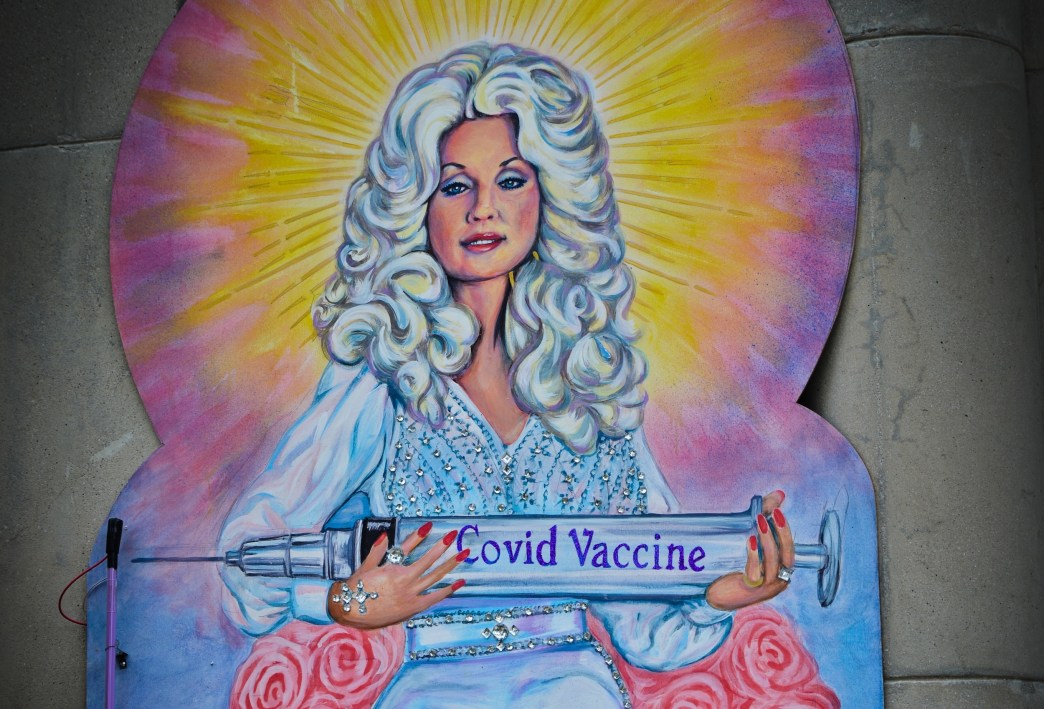
Famously, Parton donated $1 million to Vanderbilt University to research treatments and vaccines for the novel coronavirus when the pandemic gained steam in 2020. The resulting Dolly Parton COVID-19 Research Fund directly supported research that contributed to the development of Moderna’s COVID-19 vaccine (as well as funding antiviral drug and monoclonal antibody studies). When the jab debuted, Parton was first in line to get “a dose of her own medicine,” posting a video of herself singing “Jolene,” replacing the temptress’ name with “vaccine.”
It wasn’t the first or last time Parton lent her voice and financial support to science. In 1994, she donated her song “You Gotta Be My Baby” to a charity album for HIV/AIDS research. In honor of her niece, a leukemia survivor, she gave the Pediatric Cancer Program at Tennessee’s Monroe Carell Jr. Children’s hospital $1 million in 2017 and then another $1 million to study infectious diseases in 2022. Her trademark theme park, Dollywood, was also home to the largest non-releasable bald eagle sanctuary in the world.
But Parton’s greatest contribution might have been through her Imagination Library program. Inspired by her father, who couldn’t read, Parton started the initiative in 1995 to provide free books to kids from birth until age five. Since then, the Imagination LIbrary has expanded to five countries, mailing more than 330 million free books to date.
Beyond promoting childhood literacy, the effort has offered researchers a sort of natural experiment to study the effects of early reading. Kids participating in the program read more often and for longer than their peers, and were also better prepared for kindergarten. Parton said her father may have been prouder of the Imagination Library than the entirety of her career, and her family has requested donations be made there in lieu of flowers.
“If your actions create a legacy that inspires others to dream more, learn more, do more, and become more, then, you are an excellent leader,” Dolly Parton once said.
She lived her life accordingly.
Enjoying Nautilus? Subscribe to our free newsletter.
Lead Image: Suzanne C. Grim / Shutterstock