


.jpg "How to Claim Your Cut of Apple’s 0 Million Siri Settlement")

Although we often talk with our dogs, cross-species communication is poorly studied. It requires animals to interpret cues and signals outside of their own species’ behavioral frameworks. Still, in numerous scenarios, cooperation between species could prove useful—for example, in finding and exploiting resources—something a study published in the journal Animal Behaviour recently examined.
“From the examples we know, individuals coordinate their actions to access shared resources, like food, or to exchange resources for services, such as protection from predators,” explained lead author Katie Dunkley, a biology research fellow at the University of Oxford, in a press release.
Dunkley, in collaboration with a team of 57 co-authors, conducted a research review of instances of cooperation between different animal species, finding that it occurs across a range of taxa and ecological settings. Cooperation is facilitated through a combination of body movements, visual displays, calls, and other behavioral cues. Case in point: The specialized chattering trills and whistles of greater honeyguide birds (Indicator indicator) lure humans to bees’ nests where they share in the sweet bounty found there.
Read more: “Birds of a Feather Talk Together”
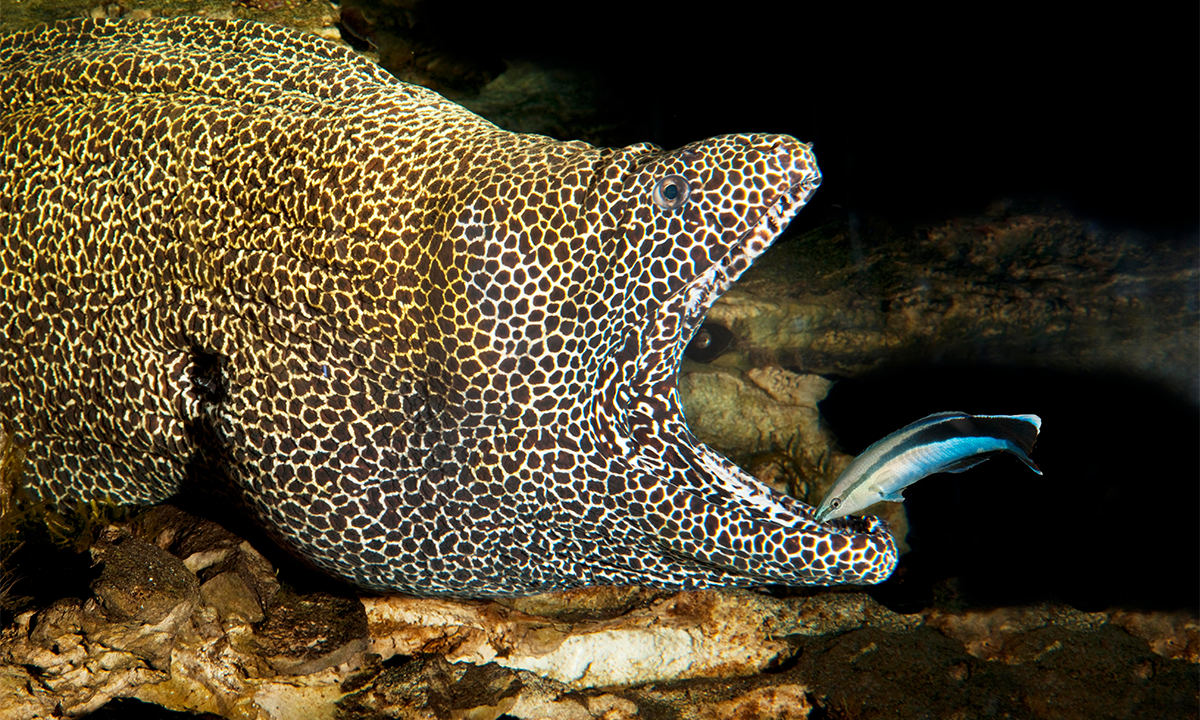
Some signals are predictably repeated, such as the stereotyped motions of cleaner wrasses (Labroides dimidiatus) that communicate their intentions to engage in mutualism by cleaning predatory fish. The “client” fish adopts an angled body pose to telegraph its readiness for removal of ectoparasites by the wrasse. These signals offer a way for both species to benefit while reducing the risk that the cleaner fish gets eaten or refuses to take the cleaning.
Other signals vary, depending on the individual and context. For instance, Irrawaddy dolphins (Orcaella brevirostris) are known to herd fish into fishermen’s nets and then share in the catch. Depending on the dolphins’ body movements, fishermen know when and where to cast their nets. While it’s hard to prove that Irrawaddy dolphins are intentionally signaling humans, real-time behavioral interaction does occur that determines fish yields.
The distinction between fixed and flexible signaling may in part reflect the extent to which communication is genetically inherited or culturally transmitted. Some genetic traits, such as the bright body coloration and dark lateral stripes of cleaner fishes, apparently evolved after the mutualism, perhaps to accentuate the cleaner fish’s intention signals. Moreover, fish that are obligated to serve in the cleaning role have strong patterning, while fish that can also use other food resources don’t.
“Studying how information flows between species gives us a powerful window into how communication systems originate, change, and sometimes coevolve,” added Dunkley.
Either way, they’re definitely speaking each other’s language.
Enjoying Nautilus? Subscribe to our free newsletter.
Lead image: slowmotiongli / Adobe Stock