







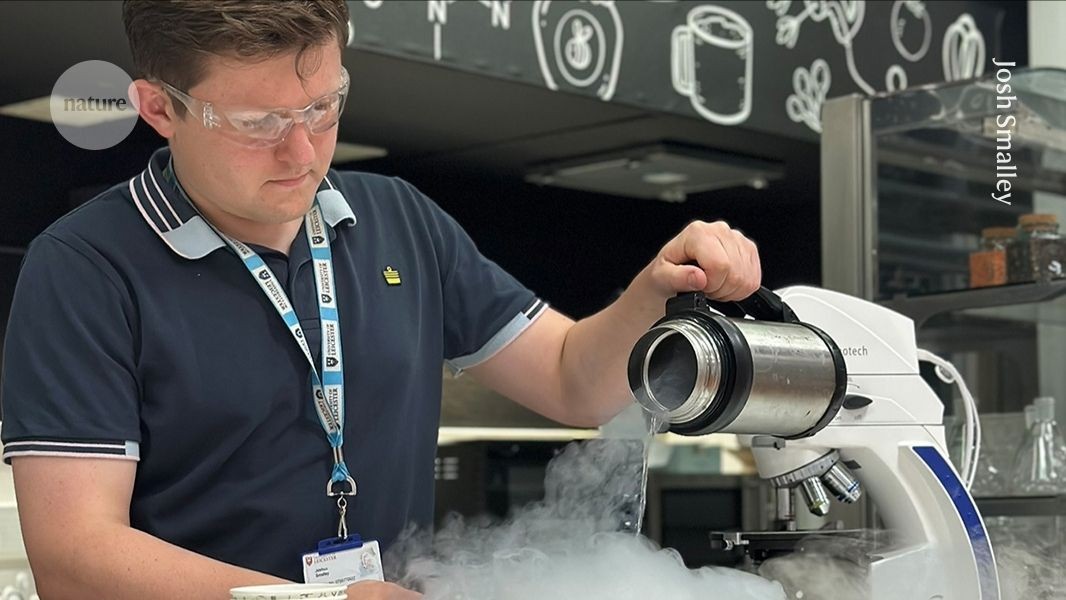
Organic chemist Josh Smalley uses baking concepts to teach science and engineering to children.Credit: Josh Smalley
A career in science can require perseverance and determination, with long days in the laboratory or in the field. There is often little free time for a social life, let alone charity work.
But despite these pressures, many researchers seek out volunteering opportunities to develop friendships and find purpose in their local communities.
Some are influenced by family members, and many are motivated to serve and help people by their religious beliefs. Scientists who have moved to another country might work with diaspora communities to connect with their roots.
In some cases, researchers volunteer for a charity because they are conscious of the privilege that they have been born into, according to Lia Bote, a third-year PhD student at the Wellcome Sanger Institute in Hinxton, UK.
Bote says: “You soon realize that it is not about assuaging guilt, it is simply about being able to contribute with the specific skills you have. I just happen to be a researcher, and they need researchers. It is something that I have derived a lot of joy from, being part of a community.”
Here, Bote and five other researchers describe how and why they juggle charity work with their day jobs — and some of the unexpected returns on their time investment.
MARIA PIA COSMA: Personal growth opportunities
Tissue-regeneration researcher at the Centre for Genomic Regulation in Barcelona, Spain, and a volunteer at the charity Casa Solidaria.
I started volunteering with Casa Solidaria, a charity that provides food to homeless people in Barcelona, Spain, three years ago.
On one Wednesday each month, three other volunteers and I cook around 50 meals (usually rice with some vegetables and meat). I add some fruit and take the food to a distribution point. There is always a line of people waiting.
One volunteer, a man who was previously homeless, organizes the queue because sometimes the situation can become tense. No matter who is standing there in front of us, it’s important to speak to them with kindness and dignity. The work is rewarding. It involves doing something good for society and it provides an enriching opportunity for personal growth. As a principal investigator, I feel that I have a duty to help others in a broad sense and to be a role model for my students.
How I harness research to inform humanitarian relief efforts
Before I began working with Casa Solidaria, I volunteered through my church to help the Italian diaspora community here in Barcelona. There was a woman facing legal action who had to attend court. She had no passport, and was in and out of jail and living on the streets.
My husband and I helped her to get a place in a hostel, put her in touch with the Red Cross, a charity that helps people in crisis, and worked with lawyers and the Italian consulate to get her the documents that she needed. Eventually, we supported her through the process of finding a job in a call centre and renting an apartment. Once that happened, I decided that I wanted to continue volunteering with a charity.
It is extremely fulfilling to help others. I love my work — it’s my passion — but you need other activities in your life, too.
CAROLINE YAO: Paid work potential
Biostatistician and plastic surgeon based in Los Angeles, California, who volunteers for a charity called Operation Smile.
I first heard about Operation Smile, a charity that provides cleft-lip and palate surgery and care in low- and middle-income nations, in 2009 when I was a medical student at the University of Southern California in Los Angeles. I met the organization’s chief medical officer Billy Magee, a plastic surgeon, when we were doing overnight surgery to realign a person’s broken jaw. While waiting to start, we began talking about Operation Smile. I asked about the data that the organization was collecting. Although the team kept patient records, the information was not designed to be analysed in a scientific way.
I did my residency with Magee and, on top of my medical training, began a voluntary research project on how best to track outcomes of the surgeries that Operation Smile had performed. I spent three to five hours of my own time on the project each week.
Operation Smile had just started a global fellowship programme, and I became the third fellow. Since 2009, there have been 49 of us. I visited more than 15 countries in 2 years, meeting nurses, surgeons, students and people receiving treatment, to ensure that the data collected by Operation Smile were applicable and feasible for each setting.
When I returned from travelling, I spent four years as a volunteer analysing the data alongside my paid work as a physician.

Plastic Surgeon Caroline Yao has travelled around the world to provide cleft-lip and palette surgery to children and find ways to improve treatment outcomes.Credit: Caroline Yao
After that, I helped to design a surgeon training programme for cleft-lip and palate reconstruction, as well as data-collection systems. When I started volunteering there, Operation Smile only collected photos from before and after each surgery. Now, with a full data repository that has been standardized and validated, the organization can evaluate results more effectively, identify barriers to care and run research studies.
I split my working life into thirds. I spend one-third of my time as a plastic surgeon for adults in Los Angeles. Another third is spent doing paediatric plastic surgery at the non-profit Shriners Children’s Southern California hospital in Pasadena. And I spend the final third doing paid work for Operation Smile as the senior vice-president of research and patient metrics.
I still volunteer for Operation Smile: I mentor the current global fellows and conduct research. I have also partnered with technology company Microsoft on an initiative called AI For Good. The initiative develops tools to synthesize data and deliver specialist speech therapy, using a mobile-phone app, to people who lack access to it in low- and middle-income countries.
To other scientists considering volunteering, you should do it even if people tell you that it’s not possible to fit it in. You must create the opportunity on your own, and convince your employers that it’s worthwhile.
Throughout my training, I was told: people don’t do that. You’re a scientist, or you’re a surgeon. But science and surgery weren’t my only passions.
Even though I am still in the mid-career stage, I can already tell that my philanthropic work is going to be my legacy. It’s what I live for day to day. It’s what I want to show my three children and the rest of my family. It’s what I’m most proud of.
LIA BOTE: From naivety to empowerment
PhD student studying infectious diseases at the Wellcome Sanger Institute in Hinxton, UK, and volunteer for a grassroots organization called Kanlungan.
I started volunteering when I was a teenager after I moved from the Philippines, where I was born, to Malaysia. I went to an international school in Kuala Lumpur that was attended by many wealthy students. I recognized the privilege that came with that and talked to my teachers about wanting to give back to my community.
The school ran a programme that involved teaching refugee children from nations such as Myanmar, Syria and Afghanistan who had been displaced by conflict. I taught English and mathematics to children between the ages of 5 and 16 after school and during the summer holidays. I was also 16 at the time.
I thought highly of myself at first, but soon learnt that I was being a bit naive and coming at the job from a place of pity. I was just a person who was developing a set of skills, including teaching, that was enabling me to contribute to my community. I realized that my volunteering didn’t have to be any more profound than that.
I left Malaysia in 2019 to study biological sciences at University College London and returned to Kuala Lumpur when the COVID-19 pandemic struck the next year. From Malaysia, I volunteered with a grassroots youth organization in Manila, raising pandemic-relief funds for Indigenous people who did not have access to face masks or educational supplies.
The organization also hosted webinars for senior-school and university students about COVID-19 vaccine misinformation and the obligations faced by young people to protect older and more vulnerable people. Our team also invited Filipino scientists, physicians and politicians to use social media to combat misinformation and provide information about vaccine drives.

Cancer Research UK bets on Manchester with £6-million funding boost
I began volunteering with a charity called Kanlungan after I returned to London in 2021. It supports the welfare and interests of Filipino and other migrant communities in the United Kingdom.
I joined a Kanlungan research project that aimed to reveal and highlight the experiences of workers from the Philippines, especially people in domestic roles, in the United Kingdom during the COVID-19 pandemic. The findings highlighted how the pandemic did not affect all groups equally, and allowed the researchers and I to make some policy recommendations to the UK government.
The report that we produced also touched on intersectionality — how the pandemic had revealed racialized elements of discrimination against Asian communities, which affected a lot of migrants from the Philippines who were frontline workers. I also found that the pandemic disproportionately affected domestic and care workers, who were mainly women, in terms of the physical and emotional abuse that they received.
In 2024, the University of Cambridge, UK, funded a project to document the experiences of care workers in both informal domestic contexts and care homes. Kanlungan researchers asked about their treatment in the workplace, their visa situation (their immigration status is often precarious) and what policy changes they would like to see. For example, we found that the care-worker sector does not have a formal process to report mistreatment by employers like the one available to people who work for the UK’s National Health Service. We fed this back as a policy recommendation to the independent public inquiry ordered by the UK government into its handling of the COVID-19 pandemic.
I recognize that my research training can be helpful for my community and is a great way to make friends. My teenage volunteering work came from a place of misplaced compassion. Now, volunteering feels more empowering. I get to see how care workers have taken control of their dignity in a space that has not always provided them with it.
It feels like something to do alongside my career, and part of this might come from my Christian faith. I would like to continue volunteering, guided by opportunities and my experiences rather than having a grand plan for it.



.jpg "White Supremacists Love Armie Hammer’s New Movie")


