


On 17 February 1998, Voyager 1 made human history.
At 10.4 billion kilometers (6.5 billion miles) from the Sun, out past the orbit of Pluto, it overtook Pioneer 10 to become the most distant human-made object ever.
Every moment of every hour since that historic milestone, it has pushed farther and farther; every picosecond now the farthest, now even farther still, making continuous history with every millimeter.
Today, on 18 November 2026, nearly 50 years after its launch, Voyager 1 has reached another exceptional milestone: a distance of one light-day from Earth, equivalent to around 25.9 billion kilometers (16.1 billion miles).
That means Voyager 1’s light-speed radio signals now take a full 24 hours to reach Earth.
Because Earth orbits the Sun, its distance from Voyager 1 fluctuates throughout the year, sometimes increasing and sometimes decreasing.
But Voyager 1 is traveling outward so relentlessly that even when Earth starts to move back toward it, the spacecraft will remain more than a light-day away.
The light-day barrier crossing is permanent.
“When I was first working on Voyager back in 1977, I never expected Voyager 1 to reach one light-day,” planetary scientist Linda Spilker of NASA’s Jet Propulsion Laboratory told ScienceAlert.
“I am so proud to be a part of the Voyager mission that has been a pioneer in the exploration of our Solar System, first visiting the outer planets, Jupiter, Saturn, Uranus, and Neptune (the latter for the first and only time), then exploring our own heliosphere from Earth to the heliopause crossing, and now exploring interstellar space, the space between the stars.”
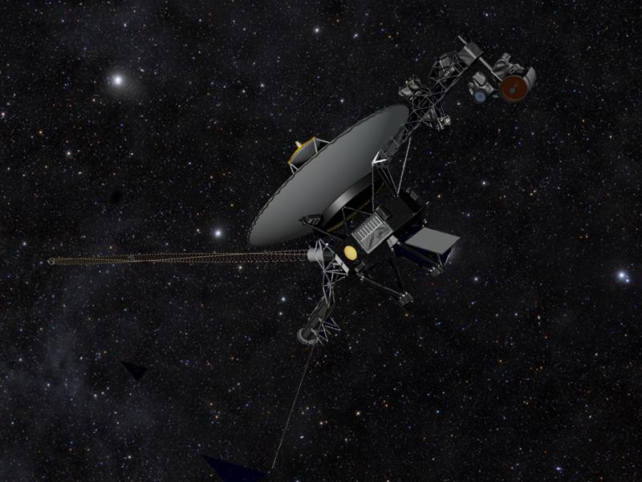
It’s 1977, and the heady days of the Space Race between the US and the Soviet Union have faded. Humanity landed on the Moon, looked around, and gave itself a nice pat on the back for a job well done.
But back at NASA’s Jet Propulsion Laboratory, a new era is dawning. After years of planning, engineering, and preparation, two spacecraft were poised to embark on a bold new journey: to go where no human-made object had gone before.
They are the Voyager probes – Voyager 1 and Voyager 2, each carrying scientific instruments and an optimistic message for aliens, should one day they wash up on the shores of another civilization.
Even so, some of the scientists involved were more conservative in their aspirations for Voyager.
“I recall putting a ‘Uranus or Bust!’ sticker on the shipping container for our Voyager 2 instrument,” physicist Bill Kurth of the University of Iowa told ScienceAlert.
“I recall putting a ‘Uranus or Bust!’ sticker on the shipping container for our Voyager 2 instrument,” physicist Bill Kurth of the University of Iowa told ScienceAlert.
“I thought getting to Uranus, beyond the nominal Jupiter-Saturn mission, would be great!”
The launch timing was carefully chosen to make the most of the Solar System’s stately orbital dance: A rare alignment of the outer planets, occurring roughly once every 176 years, offered an opportunity to use the gravity of one planet to slingshot a spacecraft toward the next.
Voyager 2 launched first, on 20 August 1977. Voyager 1 followed on 5 September.
Taking a faster route, Voyager 1 reached Jupiter in 1979, and Saturn in 1980, and its observations showed us things about the two worlds and their moons we’d never seen before – that Saturn’s rings are actually composed of hundreds of smaller ringlets; that Jupiter is lashed by lightning; and that its moon Io is covered in active volcanoes.
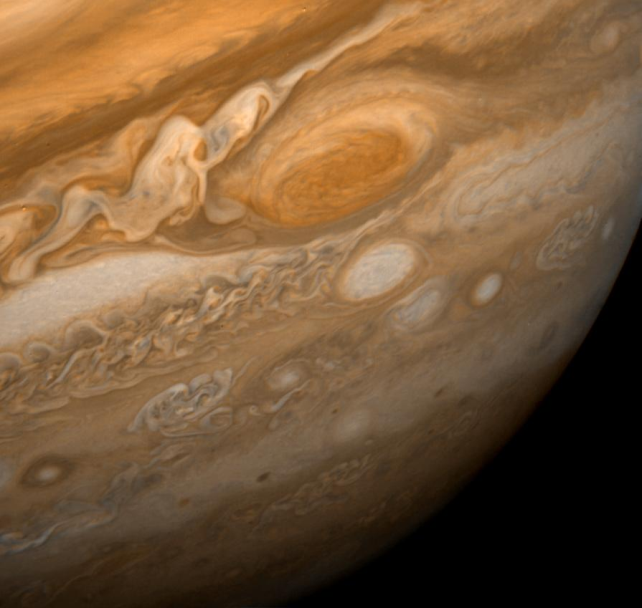
Then, a gravity assist from Saturn, combined with a close flyby of its moon Titan, sent it on a trajectory out of the plane of the planets, leaving Voyager 2 to continue the tour – taking the scenic route past Uranus and Neptune in 1986 and 1989, respectively.
“There’s no way I could have imagined the discoveries these two spacecraft made during their planetary phase. Every planet, every moon held surprises we did not anticipate,” Kurth said.
“At the Voyager 1 Jupiter encounter, I asked if I could stay and see what came back from these instruments I helped test and calibrate. I never dreamed I’d still be doing that nearly 50 years later!”
Voyager 1 sailed serenely on, leaving the planets far behind.
There was that historic milestone in 1998; then, in 2004, it crossed a boundary known as the termination shock, where the solar wind – the stream of charged particles flowing outward from the Sun – abruptly slows as it encounters pressure from the space beyond.
Voyager 1 was now traveling through the heliosheath, the turbulent outer layer of the heliosphere – the vast bubble wherein the Solar System’s planets reside, carved out by the constant, powerful plasma wind streaming out from the Sun.
The solar wind weakens over distance. Eventually, its outward pressure is perfectly balanced by the very faint pressure exerted by interstellar space. The point at which that happens is the heliopause – and, after crossing the termination shock, it would take Voyager 1 another eight years to reach it.

frameborder=”0″ allow=”accelerometer; autoplay; clipboard-write; encrypted-media; gyroscope; picture-in-picture; web-share” referrerpolicy=”strict-origin-when-cross-origin” allowfullscreen>
On 25 August 2012, at a distance of around 18.2 billion kilometers (11.3 billion miles) from the Sun, Voyager 1 finally crossed the heliopause, becoming the first human-made object to enter interstellar space.
But nobody knew for certain at the time.
The probe’s instruments recorded a dramatic drop in charged particles originating inside the heliosphere, accompanied by a surge in cosmic rays arriving from beyond it. Yet the magnetic field stubbornly refused to change direction as scientists had expected.
It would take another year, and a disturbance from the Sun that caused the surrounding plasma to oscillate, before scientists could measure its density and confirm that Voyager 1 had indeed crossed into the space between the stars.
“One of the big mysteries revealed by Voyager is that the magnetic field beyond the heliopause remains mostly aligned with the field inside the heliosphere, not the direction of the interstellar field,” Kurth explained.
“There are several possible explanations for this, but I don’t think there’s consensus behind any of these. I hope that we can continue following Voyager far enough to find out if and where the rotation to the expected interstellar direction occurs.”
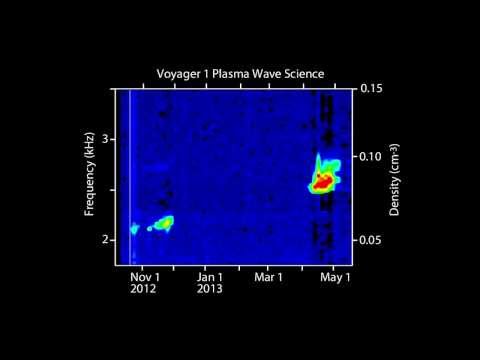
frameborder=”0″ allow=”accelerometer; autoplay; clipboard-write; encrypted-media; gyroscope; picture-in-picture; web-share” referrerpolicy=”strict-origin-when-cross-origin” allowfullscreen>
As it traverses the untamed frontier beyond the heliopause, even after all but two of its 10 science instruments have been shut down, Voyager 1 is continuing to uncover puzzles.
“The two Voyagers are finding that the Sun still influences the interstellar medium beyond the heliopause through shocks related to solar activity such as coronal mass ejections that propagate all the way through the heliosphere,” Kurth said.
“The impulses continue through the interstellar medium for at least 20 astronomical units (3 billion kilometers) beyond that boundary. We are also finding that the plasma density actually increases beyond the heliopause for 10 or more astronomical units.”
There is an important distinction to make about the heliopause. It marks the boundary of the solar wind, but the Sun’s influence extends much farther. The Oort Cloud, extending out to an estimated 1.6 to 3.2 light-years from the Sun, is held in place by its gravity, for example.
That’s the extreme outer limit of the Solar System – but Voyager 1 and Voyager 2 are showing that disturbances triggered by solar eruptions can continue traveling outward through interstellar space, billions of kilometers beyond the heliopause.
Meanwhile, the increasing plasma density suggests that the environment immediately beyond the heliopause is not uniform, but continues to change with distance.
These are discoveries that take time – not just the 24 hours needed for Voyager 1’s signals to reach Earth, but the many years it has taken the spacecraft to travel into the wild unknown.
“Voyager has taught me to be patient,” Kurth said. “While it takes information a day to be transmitted from Voyager 1 to Earth, it has taken the spacecraft decades to get to where they are.”
We don’t know how long Voyager 1 has left. Its nuclear power supply, which converts heat from decaying plutonium into electricity, loses around 4 watts of output every year. Engineers have been painstakingly shutting down equipment and finding ways to conserve energy to keep the spacecraft operating.
NASA has forecast that it could retain enough power to keep one instrument operating into the 2030s – far short of the 300 years it would need to reach the inner boundary of the Oort Cloud, but long enough to continue showing us a never-before-seen corner of the cosmos.
“Voyager’s explorations of the planets, heliosphere and interstellar space have taught us to expect the unexpected,” Spilker said.
“Where does the solar influence end and pristine interstellar space begin? Perhaps Voyager may last long enough to answer that question.”
This article was fact-checked by Fiona MacDonald and edited by Fiona MacDonald. While we pride ourselves on our process, we are only human. If you spot a mistake, please let us know.


