Dark Mode Light Mode
Chemistry, medicine, materials and the technology shaping tomorrow — the best science stories from trusted sources, every day.

Maxwell’s Demon Can Extract Energy From Hidden Memories, Study Finds

Maxwell’s Demon Can Extract Energy From Hidden Memories, Study Finds Maxwell’s Demon Can Extract Energy From Hidden Memories, Study Finds


In 1867, physicist James Clerk Maxwell did something very naughty. 

He proposed an apparent violation of the second law of thermodynamics so diabolically clever that other physicists have been trying to resolve it ever since.

His thought experiment invoked a ‘demon’ – a tiny, intelligent being stationed at a door between two chambers filled with gas, only allowing fast particles into one side and slow particles into the other – with the end result being warmth in one chamber and chill in the other.

The problem is that this decreases entropy – something that, according to the second law of thermodynamics, cannot happen in an isolated system without a compensating increase elsewhere.

Yet Maxwell’s demon apparently achieves this without doing any work. It is the poster child for indolence.

Now, a new team of physicists has exacerbated the problem.

By exploiting information hidden in a physical system’s memory, researchers have shown that the malingering imp can extract more energy than a memoryless system would ever give up.

YouTube Thumbnail

frameborder=”0″ allow=”accelerometer; autoplay; clipboard-write; encrypted-media; gyroscope; picture-in-picture; web-share” referrerpolicy=”strict-origin-when-cross-origin” allowfullscreen>

To be clear, Maxwell’s original paradox has long since been resolved. The demon’s trick is not free after all: Information is physical, and processing it comes with thermodynamic costs that preserve the second law.

But the resolution revealed something fascinating. Information about a physical system can itself be used to extract useful work from that system.

And to demonstrate this idea, physicist Clemens Bechinger of the University of Konstanz in Germany and his colleagues built a real-world version of Maxwell’s demon.

Here’s how it worked. The researchers used a laser to trap a microscopic glass bead in a liquid. Even caught in the laser’s grasp, however, the bead wasn’t completely still. It was constantly jostled by the molecules around it, causing it to jiggle about randomly in a phenomenon known as Brownian motion.

Maxwell's Demon Can Extract 3 Times More Energy by Exploiting Hidden Memories, Physicists Discover
A supplied AI-generated illustration of Maxwell’s demon. (University of Konstanz/AG Bechinger, created using AI)

By monitoring the bead’s position, the researchers could determine when to shift the laser trap to take advantage of its movements, extracting a little energy in the process.

This is the basic principle of an information engine – using knowledge about a system to turn otherwise random motion into useful work.

But there’s a catch. An information engine can only make use of information it has access to. And in the real world, some of that information can be hidden.

And this is where Bechinger’s system starts to extend beyond the bog-standard Maxwell’s demon – because that liquid is not bog-standard water.

It’s packed with spaghetti-like strands of molecules called micelles that form a microscopic network whose movements the researchers couldn’t directly observe.

These structures tangled and rearranged themselves as the bead danced its tiny jig, retaining traces of its past motion that could influence where it moved next.

So, although the researchers couldn’t observe the network directly, they could use the bead’s movements to glean information about it.

Rather than just measuring the bead’s position once, they measured it twice, with a carefully timed interval between observations.

That timing was critical.

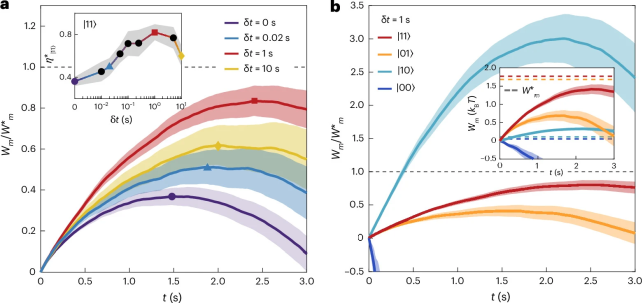
If the measurements were taken too close together, they revealed little about the liquid’s hidden dynamics. If they were too far apart, the network had already begun to forget the bead’s earlier movements. The researchers found a sweet spot at an interval of around one second.

Comparing the results allowed them to infer how the surrounding network had been disturbed – and how it might influence the bead’s next movement.

This allowed them to time their adjustments to the laser trap more effectively, extracting energy that would otherwise have remained inaccessible.

Under certain conditions, this strategy allowed the researchers to extract up to three times as much work as the theoretical limit for an equivalent system without the hidden micellar memory.
Maxwell's Demon Can Extract Energy From Hidden Memories, Study Finds
The timing of measurements affects work extraction (left), which can exceed the theoretical limit for a system without memory (right). (Muruga et al., Nat. Phys., 2026)

If you need a mental picture, imagine a meatball held in place in a vat of invisible spaghetti soup.

The research is like watching the meatball jiggle twice to work out what the spaghetti is doing, and then using that information to move its laser trap in a way that extracts extra energy from the soup’s hidden dynamics.

The next bit you’re probably wondering about is whether there’s any practical use for this, or if it’s all about giving Maxwell’s demon a new physics mischief tool.

Well, for now at least, it’s mostly the latter. The researchers haven’t built a tiny machine that can perform a useful task. Instead, they’ve demonstrated a new way to extract energy from a microscopic system – and in the process advanced our understanding of what information engines can achieve.

That could matter for future technologies operating at microscopic scales, particularly in complex environments such as biological fluids, where the interactions between particles and their surroundings can be difficult to predict.

Rather than treating those interactions as an obstacle, the new research suggests that they could be exploited as an additional source of useful energy.

“Our results establish environmental memory as an experimentally accessible thermodynamic resource,” the researchers write.

The research has been published in Nature Physics.

This article was fact-checked by Rebecca Dyer and edited by Rebecca Dyer. While we pride ourselves on our process, we are only human. If you spot a mistake, please let us know.


Source link

Previous Post
AI surgery is finding value beyond the autonomous robot

AI surgery is finding value beyond the autonomous robot

Next Post
Cloudy With a Chance of Incineration: Predicting Weather on Distant Worlds

Cloudy With a Chance of Incineration: Predicting Weather on Distant Worlds