Dark Mode Light Mode
Join us on a journey where chemistry meets creativity, and the wonders of science unfold. Quench your intellectual thirst with thought-provoking articles that transcend the boundaries of conventional knowledge.

Membrane technologies for crude oil separation could cut refining energy use by up to 90%

Membrane technologies for crude oil separation could cut refining energy use by up to 90% Membrane technologies for crude oil separation could cut refining energy use by up to 90%


Three teams have developed membranes that can efficiently separate hydrocarbons in crude oil. These materials are scalable, can work under industrial conditions and help reduce the energy demand and carbon dioxide emissions, compared with conventional methods. ‘Membrane-based hydrocarbon fractionation is 1783434720 moving from a promising idea toward a more practical technology,’ explains Sheng Guo at Nanjing University in China, who wasn’t involved with any of these projects.

Fractional distillation – which involves heating and siphoning off hydrocarbons based on their boiling points – is the method of choice to separate crude oil. The process accounts for around 1% of the world’s global energy use, with approximately 11% of the energy extracted from oil needed for this process. This method also emits the equivalent of more than 160 million tonnes of carbon dioxide annually.

‘Membranes [however] can separate molecules by size, shape and chemical affinity, not only by boiling point,’ says Guo. Estimates suggest that using membranes to separate hydrocarbons could reduce the energy required by up to 90%.

One international team has now developed ‘locked’ polymer membranes that can selectively separate longer-chain hydrocarbons from shorter ones.1 Equally, Zhiping Lai’s group at King Abdullah University of Science and Technology in Saudia Arabia has synthesised several covalent organic frameworks (COFs) to separate aliphatic and aromatic compounds.2 Both teams were able to scale-up their technologies to make membrane rolls and fabricate industrial-type membrane modules.

Additionally, a third group led by Dong-Yeun Koh at the Korea Advanced Institute of Science and Technology is using polyacrylonitrile – typically used to support other membranes – to separate crude oil.3

Locking in, separating out

Synthesising membranes using porous polymers with rigid backbones allows chemists to design materials with specific pore sizes. However, such materials can swell when exposed to hydrocarbons. ‘As soon as the polymer starts swelling, it loses the ability to discriminate between molecules,’ says Andrew Livingston at Queen Mary University of London in the UK.

Livingston and his team were able to ‘lock in’ the material’s porous structure by reacting diacyl chloride or dialkyl halide crosslinkers with amines on the polymer’s backbone.
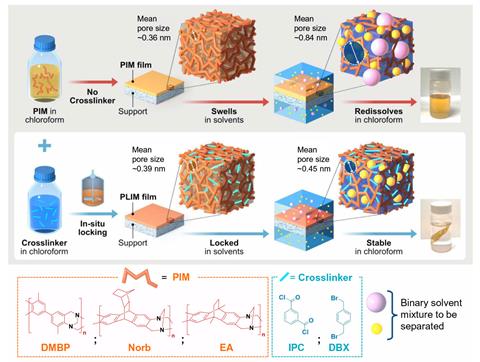
A diagram showing cross-linked polymers one is stable in chloroform and one redissolves

The locked membrane was able to selectively separate hydrocarbons with fewer than 15 carbon atoms – around the cut off for naphtha – as well as remove nearly all (93%) sulfur-containing molecules, which helps reduce sulfur dioxide emissions during combustion.

The team was able to produce membrane rolls several metres long and use these to create membrane modules. Livingston notes that these polymers may also be useful in the petrochemical industry to separate a variety of feedstocks, or to concentrate compounds by removing hydrocarbon solvents, such as toluene.

‘What we’re really keen to do next would be to combine several membranes’ with different molecular weight cut-offs to ‘show that we could sort the molecules in a crude [oil] into different streams’, explains Livingston. The team is also looking for greener alternatives to the chloroform used to fabricate the membranes.

Creating COF membranes

‘[COFs] are particularly attractive for membrane separations because we can precisely tune both the pore size and the pore chemistry to target specific molecules,’ says Lai.

By reacting a triamine with a dialdehyde, Lai’s team was able to synthesise a variety of 2D COF materials that can selectively separate aliphatic hydrocarbons and aromatic compounds. Varying the length of the pendant alkyl groups on the dialdehyde backbone altered the pore’s size and affinity for aliphatic compounds.
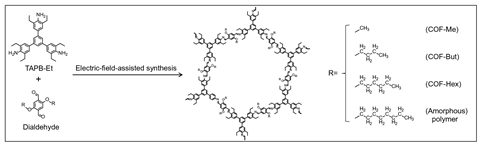
A diagram showing a complex hexagonal polymer being formed via electric-field-assisted synthesis

However, translating powdered COF materials into continuous membranes was a challenge, says Lai. Applying an electric field during synthesis, which caused the COF crystals to settle evenly on to a porous support, helped overcome this issue and allowed the team to create 50m long rolls. Like Livingston’s team, these could also be wound into membrane modules.

Testing such membranes showed that they were able to selectively concentrate aliphatic compounds by over 90%, leaving aromatic molecules in the original crude. ‘This separation is important because it addresses a growing need in the shift from crude oil as fuel to crude oil as a feedstock for chemicals,’ says Lai. He explains that aromatics, such as benzene, toluene and xylene, are valuable building blocks for many chemicals. Equally, aliphatic compounds are useful as steam cracker feedstocks to maximise alkene and alkyne yields.
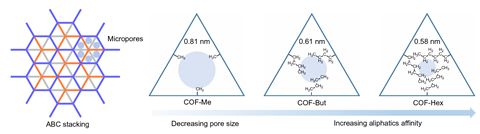
CW-Polymer membrane for hydrocarbon separation-fig1b

For Guo, this work is ‘a materials breakthrough’. ‘Making a crystalline membrane in the lab is one thing. Making it continuously and then testing it in spiral-wound modules with crude oil is much more significant.’ However, he notes that the COF membranes separate ‘broad hydrocarbon classes rather than individual compounds’. While this is useful in many refineries, he would be interested to see how the membrane separates molecules that have a similar chain length, for example.

Guo also notes that ‘industrial hydrocarbon streams are chemically complex and can contain heavy aromatics, sulfur compounds, resins, asphaltenes and other foulants’. Understanding how Livingston’s and Lai’s membranes age, foul and recover under realistic operating conditions will be important going forward, he adds.

‘In the past, many membrane studies used relatively simple model mixtures. Now the field is moving toward real hydrocarbon feeds, module testing, long-term operation and energy analysis,’ says Guo. ‘That is the right direction.’

Repurposing existing materials

While these new membranes offer a way to efficiently separate crude oil, Koh points out that there are existing materials that could do the same job. Polyacrylonitrile (PAN) is one possibility. ‘This material is typically used only as a mechanical support beneath a thin, carefully designed coating that performs the actual separation,’ he says.

However, removing the membrane coating and feeding undiluted crude oil through the PAN polymer allowed the team to still separate out lighter hydrocarbons. ‘As the crude permeates, its heavy hydrocarbons deposit within the pores, narrowing them from about 15nm down to under 2nm, forming a selective channel in situ,’ explains Koh.

‘Livingston and Lai use the same membrane as ours, but as a mechanical support for precise selective layers,’ says Ryan Lively at Georgia Tech in the US. ‘A surprising finding of our work is that this mechanical support transforms into a selective membrane during operation.’

Comparing the membrane to a polymer Koh developed in 2020, along with M G Finn, the team found that the PAN material allowed 23 times more crude oil to flow through per hour. This makes the material more attractive to use in an industrial setting.

‘We [also] found that the membrane could reduce distillation energy by 30%, reduce CO2 emissions by 35% and water usage by 20%,’ says Lively. He explains that adding this membrane to the four large oil refineries in the UK would be equivalent to saving enough energy to power 600,000 homes, remove 500,000 petrol or diesel cars from the road and save the amount of water used by 80,000 people each year.

‘PAN is inexpensive, processable and already familiar to membrane manufacturing,’ says Guo. ‘The broader message is that we should not only chase increasingly complex membrane materials.’ However, Guo stresses that scaling up the membrane from a flat sheet to spiral-wound modules and testing performance over several months is necessary to move the technology forward.

‘I do not think membranes will completely replace distillation in the near future,’ says Guo. ‘But they could become very important in hybrid processes. Even partial enrichment before distillation could reduce energy consumption and make some separations more efficient.’



Source link

Keep Up to Date with the Most Important News

By pressing the Subscribe button, you confirm that you have read and are agreeing to our Privacy Policy and Terms of Use
Add a comment Add a comment

Leave a Reply

Your email address will not be published. Required fields are marked *

Previous Post
These New Smart Glasses From Solos Come With a Privacy Shield for the Cameras

These New Smart Glasses From Solos Come With a Privacy Shield for the Cameras

Next Post
Elestor and Windpark Zeewolde partner on long-duration energy storage

Elestor and Windpark Zeewolde partner on long-duration energy storage

Advertisement