


A compound featuring a uranium–carbon triple bond is the first example of a Fischer carbyne made using an f-element, with experiments showing that this ‘is anything but your regular triple bond’.
Compounds that have a metal–carbon triple bond are known as metal carbynes. There are two types of metal carbynes: Schrock and Fischer, named after Nobel laureates Richard Schrock and Ernst Fischer, who first discovered metal carbenes (compounds with metal–carbon double bonds).
Schrock carbynes form between a carbon atom with a triplet electron configuration and a metal. In contrast, Fischer carbynes have three bonds between a singlet carbon atom and a metal: one σ bond from the carbon to the metal, and two π bonds formed by the metal back-donating electrons to the carbon.
These metal carbynes also tend to have different substituents on the carbon atom. Schrock carbynes favour hydrogen atoms and alkyl and silyl groups, while Fischer carbynes have amines or esters.
In terms of reactivity, Fischer carbynes react more slowly as they are stabilised by the amine or ester groups. Schrock carbynes undergo electrophilic attack at the carbyne carbon atom, while Fischer carbynes react with nucleophiles at the same position. Such compounds are useful to synthesise alkynes and nitriles.
Chemists first synthesised metal carbynes over 50 years ago. Creating such complexes with actinides, rather than transition metals, has since been a goal to better understand how these heavy atoms form bonds.
An international team of researchers has now accomplished that feat by reacting a uranium triamide complex with a diazo phosphorus ylide, eliminating a phosphorus compound in the process.
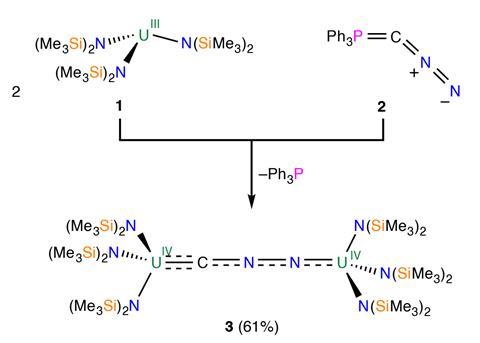
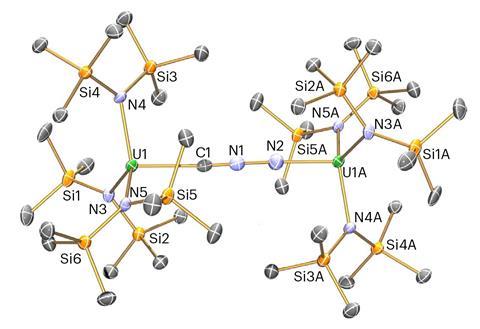
Single crystal x-ray crystallography showed that the complex is linear, with two uranium cations on either end of the diazo compound. The uranium–carbon bond length of 2.38Å is much shorter than in uranium carbenes, for example.
Computational analysis revealed that the carbon atom donates two of its electrons to form a σ bond, while the uranium forms two back π bonds, each with one electron. This is unusual as back bonds typically involve two electrons. Steve Liddle at the University of Manchester, who led the work, says that ‘it is anything but your regular triple bond’. Quantum crystallography experiments, which determine molecular and electronic structure, helped confirm this unusual bonding.
The complex reacted with alkyl, silyl and tin halides by substituting the uranium–carbon triple bond, as well as activating and forming adducts with small molecules. Many of these reactions are typical of Fischer carbynes, but the researchers note that the reaction rates were often ‘sluggish’, due to the stability of the uranium–carbon bond.


