
In the darkest depths of Earth’s oceans, surprises are expected.
For humans, it’s one of the most inhospitable environments our planet has to offer, and we’ve seen very little of what’s down there, and how life survives.
What we don’t always expect is for those surprises to be startlingly familiar – but on a series of dives using a remotely operated vehicle in 2025, familiar was exactly what scientists were confronted with.
At depths of more than 1,120 meters (3,675 feet), in an undersea chasm that had never been explored before, researchers found that our trash had beaten us there.
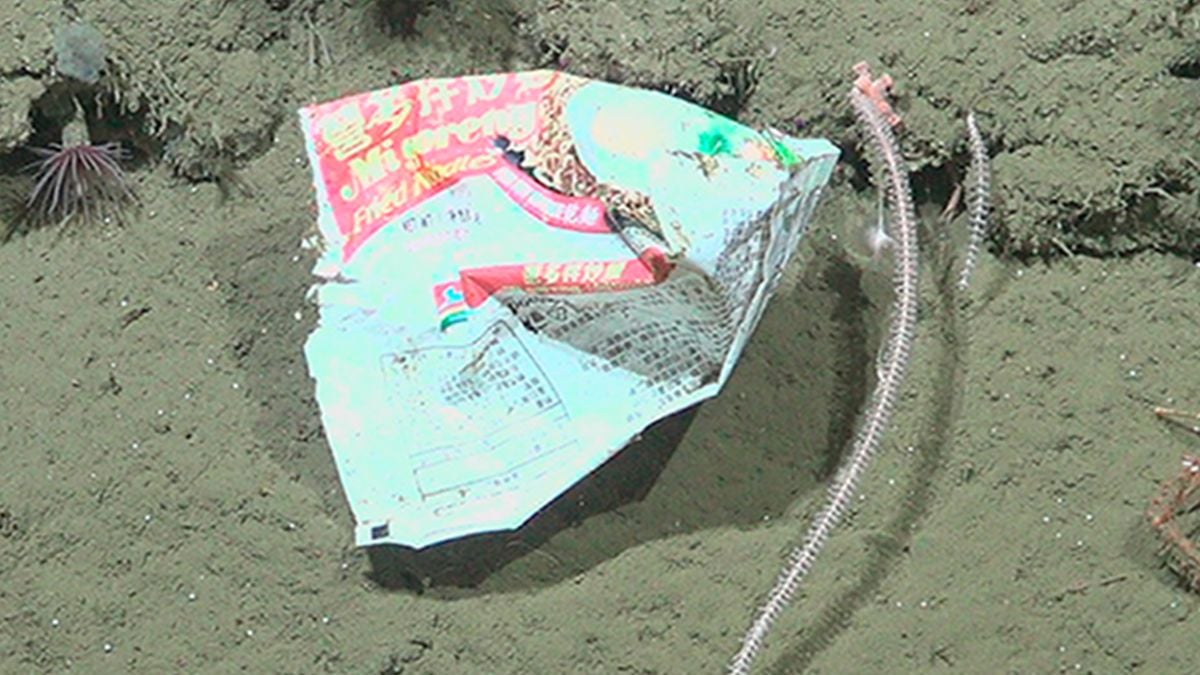
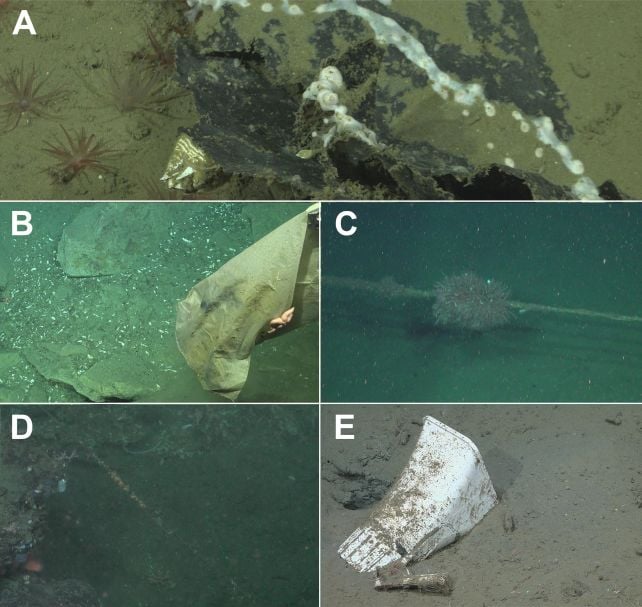
A brightly colored packet that once held Mi Goreng instant noodles lay on the rocky seafloor at a depth of 1,920 meters. Slightly deeper, at 1,949 meters, lay a nylon rope with a hook attached. More food wrappers, a plastic bag, a discarded cup – the more the Schmidt Ocean Institute’s SuBastian looked, the more it found.
Altogether, across 17 dives into Argentina’s Mar del Plata Submarine Canyon, the team documented 29 pieces of human-made litter – 27 of them plastic – at depths ranging from 1,120 to 3,820 meters.
“The main goal of the expedition was to study deep-sea benthic biodiversity,” says marine biologist Diego Urteaga of the Grupo de Estudios del Mar Profundo de Argentina (GEMPA).
“However, the presence of marine litter was so evident that we felt it was important to document it and share our observations with the scientific community.”
Submarine canyons are exactly what they sound like – enormous valleys gouged deep into the seafloor.
They can also become biodiversity hotspots – places where nutrients can naturally accumulate, carried and dropped in by currents and then trapped by the canyon walls.
The Mar del Plata canyon lies off Argentina beneath the meeting place of the warm Brazil Current and the cold Malvinas Current, in a dynamic region where water, sediment and organic material are transported into the deep – a likely place to find thriving, deep-water ecosystems.
But just as normal ocean things can accumulate there, so too – as the researchers were chagrined to discover – can human garbage.
“I hope our findings help raise awareness of the impact we are having on an environment that is both distant and largely unknown to us,” Urteaga says.
“We may already be altering deep-sea communities that we have barely begun to understand.”
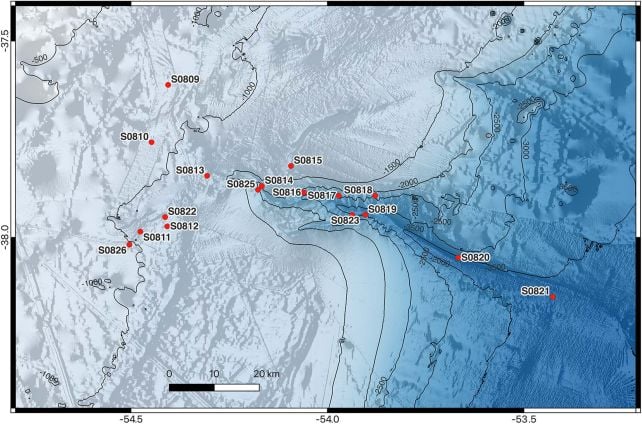
The trash wasn’t evenly scattered throughout the canyon. In July and August of 2025, the researchers deployed SuBastian from the control center aboard the research vessel Falkor(too), conducting 17 dives scattered across the region.
They found garbage during 10 of those dives, clustered in localized spots along the canyon’s walls and down its spine, consistent with the way the landform channels and traps material.
What makes less sense is where it could have come from. Mar del Plata is detached from the continental shelf and lies hundreds of kilometers offshore. That makes garbage washed directly from Argentina’s coastline an unlikely explanation for what the researchers saw.
Obviously, tracing the provenance of each piece of trash was not going to be possible, but the researchers did find some clues indicating how most of them may have ended up there – and those clues were in what the rubbish was.
A tangled rope. A rubber boot. Shelf-stable food packaging.
“The characteristics of the litter we found are more consistent with waste generated by vessels operating offshore, particularly fishing vessels, than with urban sources,” Urteaga says.
“This suggests that human activities at sea may be a major contributor to the litter reaching the Mar del Plata Submarine Canyon.”
Yet, as grim as the discoveries were, there was a small piece of good news. Compared with other submarine canyons around the world, Mar del Plata wasn’t particularly litter-strewn.
“What surprised me the most was the relatively low quantity of litter, luckily,” says marine biologist Daniel Lauretta of GEMPA.
“Before we started the ROV dives, I was expecting a much more polluted area.”
In some submarine canyons connected directly to land, researchers have recorded between 50 and 80 pieces of litter per kilometer. On the one Mar del Plata dive where the researchers calculated litter density, they recorded fewer than three.
But quantity isn’t the only way trash can affect a deep-sea ecosystem.
Some of the garbage the researchers found was already being used by the animals that live there. Arthropods were making themselves comfortable with a black plastic sheet, while sea stars and polychaete worms were making their home on a plastic bag and a length of rope, respectively.
It’s not the first time marine life has been found turning trash into treasure, but it’s not known what the long-term consequences of this creative up-cycling might be.
“The colonization of litter by sessile organisms can turn human debris into an artificial substrate in the deep sea, potentially altering local communities,” Urteaga says.
“It may also provide a means for organisms to be transported beyond their natural distribution, although the ecological consequences of this process are still poorly understood.”

Nor should the 29 items be accepted as a complete inventory of the trash scattered across Mar del Plata. It would have been very easy for SuBastian‘s camera to miss any items too small to pick out, or obscured by sediment.
Related: Deep Sea Scientists Hunting a Shipwreck Accidentally Stumbled Across The Ocean’s Own Backrooms
The researchers plan to expand their surveys into other submarine canyons around Argentina to gain a better understanding of how widespread the litter is, and where Mar del Plata sits in the wider picture.
There is, after all, still so much down there that no human eyes have ever seen.
“The possibility of observing life in waters so deep that sunlight is simply unknown is a frontier of knowledge that I have always dreamed of exploring,” Urteaga says.
“The deep sea encompasses most of our planet, yet it remains largely unknown, making it one of the last great frontiers of exploration and discovery.”
The findings have been published in PLOS One.
This article was fact-checked by Rachel Garner and edited by Rebecca Dyer. While we pride ourselves on our process, we are only human. If you spot a mistake, please let us know.