


Try to think back to the last day you remember that wasn’t packed full of things to do, people to see, and places to go. Was it yesterday? Within the last week? Outside of recent memory?
For a lot of us, modern life can be one hectic day after another.
In a new paper published in Behavioral Sciences, social scientists from institutions in Singapore have examined previous studies and theories to put together an argument: Our rapid progress as a species has left our individual bodies and minds unable to keep up.
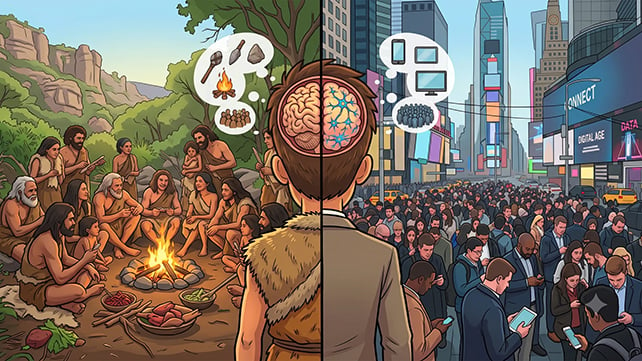
The crux of the proposal is this: Humans evolved to fit small groups of familiar people and to respond to immediate, recognizable threats.
What we live with now are vast communities, constant connection, and a multitude of overlapping pressures that create a heightened sense of competition.
This “evolutionary mismatch” is then leading to significant problems in physical and mental health, the new study suggests, everything from obesity to anxiety.
“Stress, loneliness and anxiety are often treated as personal or lifestyle problems, but they may also reflect a mismatch between the environments people live in and the conditions our minds and bodies evolved to navigate,” says environmental psychologist Sarah Chan, from the Singapore University of Technology and Design (SUTD).
“That means we should think not only about individual resilience, but also about how cities and communities are designed.”
The researchers suggest that our instinctive responses have been fine-tuned by hundreds of thousands of years of evolution, but that they don’t work as well in the modern environment that’s developed over the past couple of centuries.
For example, it was easier to understand our standing in a group before the age of the internet. Now we’re continually comparing ourselves against long lists of friends, relatives, celebrities, and strangers.
“Competition is not new, but modern life can make it feel constant,” says research psychologist Jose Yong, from James Cook University in Singapore.
“An evolutionary perspective may help explain why people respond so strongly to comparison and the fear of falling behind, even when those signals come from strangers or screens rather than a small social group.”
Then we have the compounding effects of issues like climate change, global pandemics, economic instability, and technological disruptions such as the advance of AI – something the researchers describe as a “polycrisis”.

“These incidents – from major global shocks to their psychosocial impacts – are increasingly recognized as connected in a manner that mutually reinforces their occurrence,” write the researchers in their published paper.
“For instance, rising costs of living and widening economic inequality – worsened by financial crises and events like the COVID-19 pandemic – heighten people’s financial and status insecurities, in turn motivating actions that lead to burnout, reduced prosociality, and further insecurities, creating feedback loops that intensify societal competitiveness and contribute to economic stagnation or contraction.”
Past studies have picked up on these ideas too, suggesting that crowded urban living makes our bodies feel like we’re constantly under attack, and that modern culture is in fact trouncing environmental factors when it comes to influencing our species through evolution.
The researchers call their concept the Social Evolutionary Mismatch and Competition Hypothesis (SEMCH), and suggest that a better understanding of it could help in dealing with some of the psychological ills of our times.
There are also implications for the design of cities and urban environments. Places can be engineered to feel less crowded and less overwhelming – with the use of natural spaces and greener surroundings an obvious starting point.
That applies to digital spaces too. The researchers don’t argue that we should roll back digital advancements, but that they should be designed to reduce feelings of competition rather than encourage them.
Related: Human Evolution May Be Undergoing a Major Shift Right in Front of Our Eyes
Next, the researchers want to see some of these ideas tested with further studies: real-world tests of how our environment contributes to our well-being.
“We need to design interventions that work with rather than against our evolved human nature,” says Yong.
The research has been published in Behavioral Sciences.
This article was fact-checked by Clare Watson and edited by Rebecca Dyer. While we pride ourselves on our process, we are only human. If you spot a mistake, please let us know.