



Familiar things can look very strange when viewed under a microscope.
Each week in our newsletter, our team shares a head-scratching microscopic image and asks readers to work out what exactly they’re looking at.
Now, we’ve brought the challenge to the website.
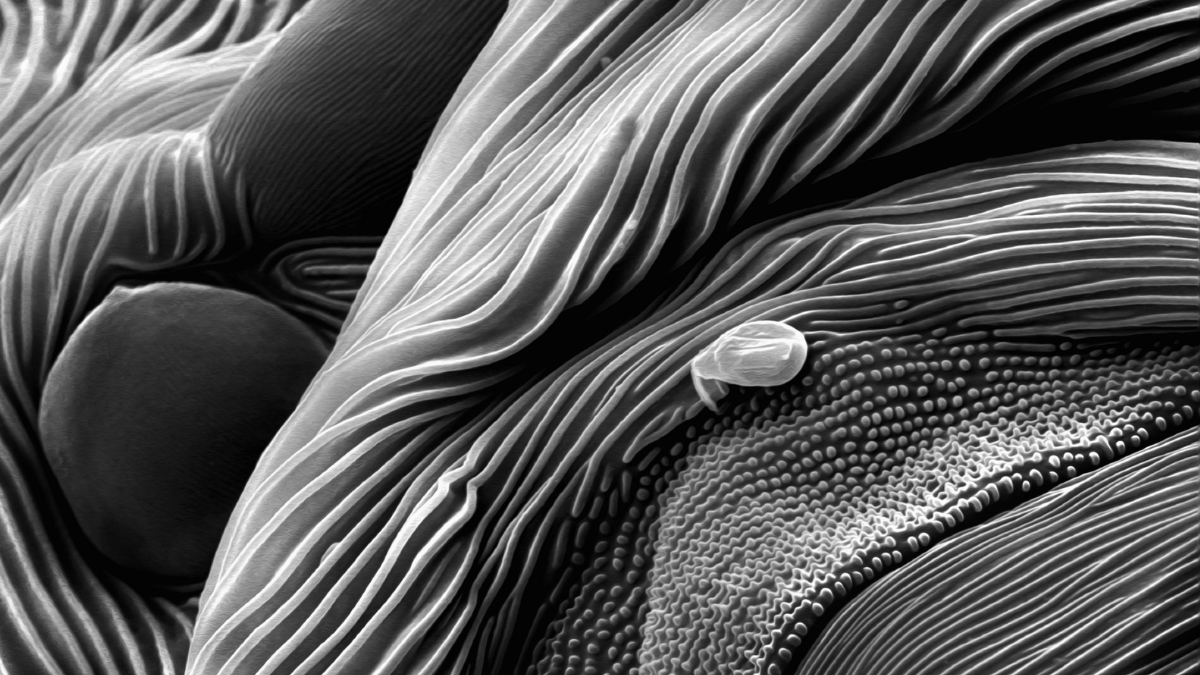
This week’s specimen is incredibly structural and looks a little like a satellite image of sand dunes – with one small, glossy intruder sitting right in the middle of the folds.
What do you think you’re looking at?
There will be spoilers below, you have been warned!
As a visual buffer, we’ve got the one animal that orcas flee from…
 frameborder=”0″ allow=”accelerometer; autoplay; clipboard-write; encrypted-media; gyroscope; picture-in-picture; web-share” referrerpolicy=”strict-origin-when-cross-origin” allowfullscreen>
Okay now we’re getting into it!
Narrow it down
a. Coral
b. Mite eye
c. Dried super glue
d. Fern sporangium
Answer below the image.
Alright, ready for the answer?
Last chance to close the browser if you don’t want a spoiler.
Okay, here we go…
3…
2…
1…
The Answer
The answer is b: the eye of a mite.
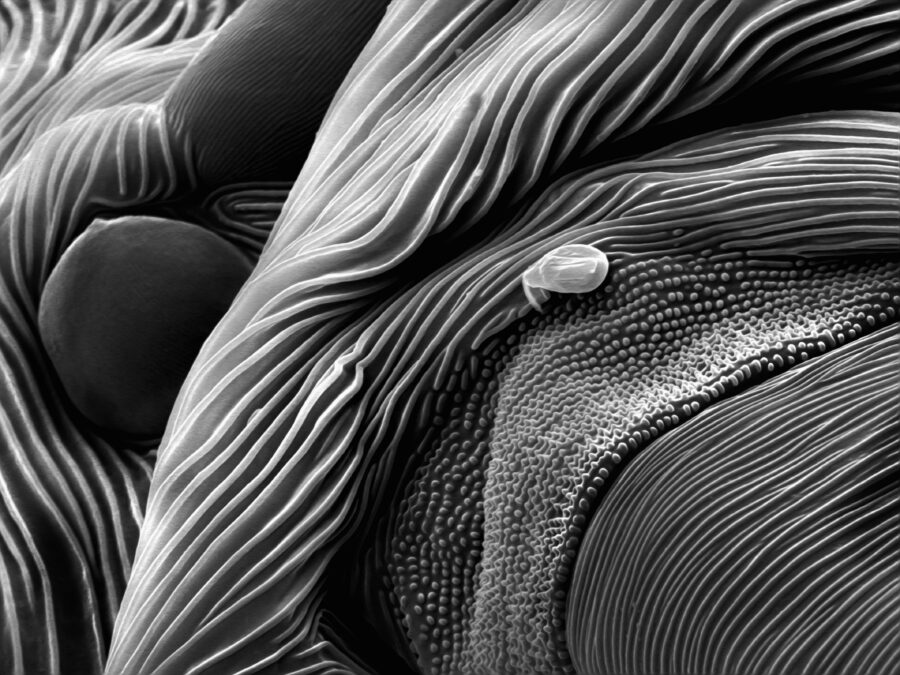
That small, smooth, dome-shaped structure sitting among the ridges is a mite’s eye.
True compound eyes, built from thousands of individual lenses called ommatidia, belong to insects, crustaceans, and some myriapods.
Mites don’t have them. When mites have eyes at all, they’re simple eyes called ocelli – single-lensed structures, usually arranged in one to three pairs.
And plenty of mites don’t bother with eyes. Many species are functionally blind, navigating their world through touch and chemical cues picked up by sensory hairs instead.
When eyes are present, they’re not tucked into a head the way ours are. They sit on the ‘shoulders’ of the body, above the bases of the legs – which is roughly where this one is perched, ringed by the deeply grooved cuticle typical of mite skin.

Those long parallel folds aren’t decorative. They’re striations in the exoskeleton that let a mite’s rigid outer shell flex and stretch as the animal moves, since arthropods can’t rely on the kind of soft, elastic skin vertebrates have.
This image was captured with a scanning electron microscope, which fires a beam of electrons at the sample rather than light, producing a super-detailed black-and-white image.
Mites are among the most numerous and least understood animals on Earth – there are tens of thousands of described species, with estimates of the true number running into the millions.
Most spend their entire lives within a few centimeters of where they hatched, seeing the world, if they see it at all, through a single, unblinking lens on their shoulder.
This article was fact-checked and edited by Michael Irving. While we pride ourselves on our process, we are only human. If you spot a mistake, please let us know.
-Wireless-Earbuds.jpg "Nothing Ear (3a) Wireless Earbuds Review: Style Meets Value")