


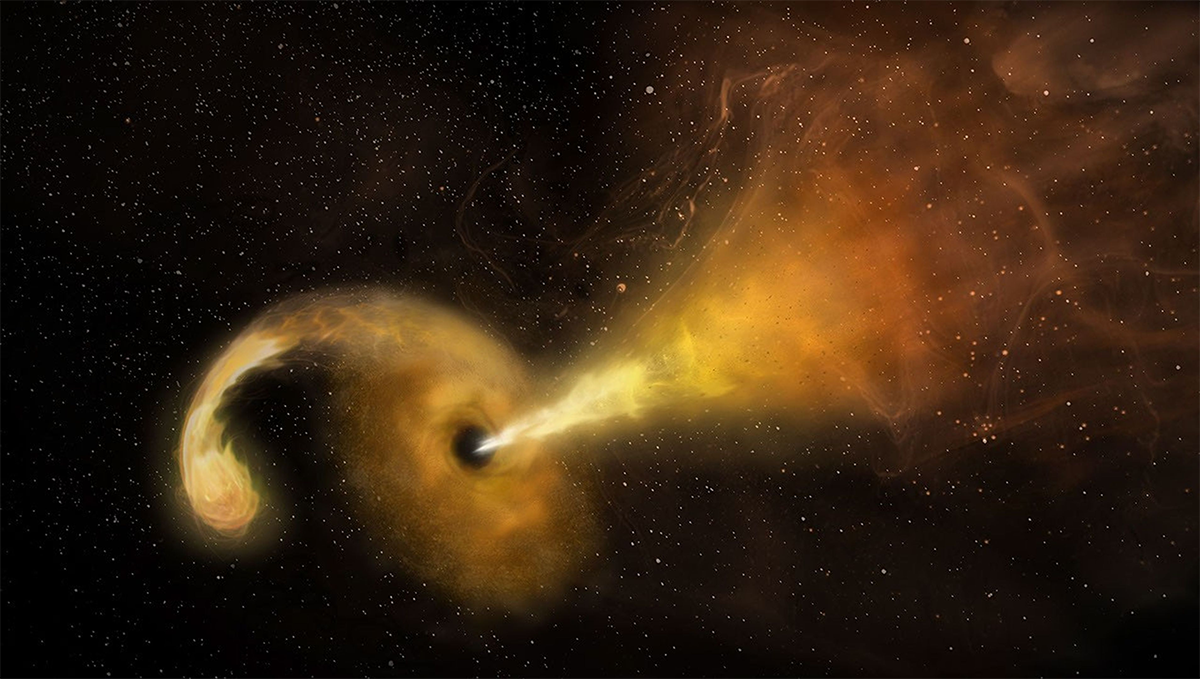
About 750 million light-years away from Earth, a wandering supermassive black hole is sneaking up on stars and eating them.
These “orphan” black holes, detached from their usual positions at the center of their galaxies, are a rare sight. This one—just the second ever spotted by astronomers—is out in a galaxy designated as WISEA J014656.04-152214.7, in the constellation Cetus.
How do researchers even spot such an event?
The black hole’s destruction of a star—technically known as a tidal disruption event—causes fragments of the disintegrating star to glow brightly as they’re heated to temperatures of 54,000 degrees Fahrenheit, creating a detectable light signature.
NASA’s Neil Gehrels Swift Observatory, operating in low Earth orbit, spotted the phenomenon after initial observations from the Palomar Observatory in Southern California and the SOAR (Southern Astrophysical Research) telescope in Chile. The findings were published in The Astrophysical Journal Letters.
The event certainly puts our own solar system into perspective: At its brightest, the star that the black hole consumed radiated with the strength of about 10 billion of our suns, and the black hole is estimated to weigh about 1.2 billion times the mass of our sun.
Read more: “Why It’s Hard for Black Holes to Get Together”
As for how it compares to the first orphan black hole on record, it strayed about 11 to 12 times farther out from the galaxy center. Experts think orphan black holes might be set loose when larger galaxies collide with smaller ones, with the lightest black hole becoming untethered. Alternatively, these galaxies may still be in the process of merging.
“We were looking for these star-shredding events as a way to find otherwise invisible supermassive black holes wandering away from the galactic cores where they usually reside,” research fellow Robert Stein, from NASA’s Goddard Space Flight Center, explained in a statement. “With this discovery, which is one of just a couple that have been confirmed so far, we’ve validated a new technique and can use it to hunt for more.”
Even tidal disruption events involving black holes in their normal position are relatively rare. Once every 100,000 years or so, a star gets too close to a black hole and will be inexorably pulled in, which illuminates the black hole’s otherwise hidden existence and gives astronomers a chance to chart galaxy evolutions and positions.
The Swift Observatory is due an orbit boost in the coming months, after which—together with new telescopes and instruments coming online—it can continue the quest for more wandering black holes.
Enjoying Nautilus? Subscribe to our free newsletter.
Lead image: NRAO / AUI / NSF / NASA