


Just when you thought it was safe to enter the benthic depths of the Indian Ocean, a new eldritch horror emerges from the darkness.
Hundreds of meters below the waves off the coasts of Christmas Island and the Cocos (Keeling) Islands, scientists have found a whole new genus of seafloor-dwelling worms.
They’re known as spaghetti worms, but their resemblance to delicious pasta is more of a nightmare variety – a horrible tangle of spaghetti-like tendrils writhing from a squishy body that spends its life sheltered inside a protective tube.
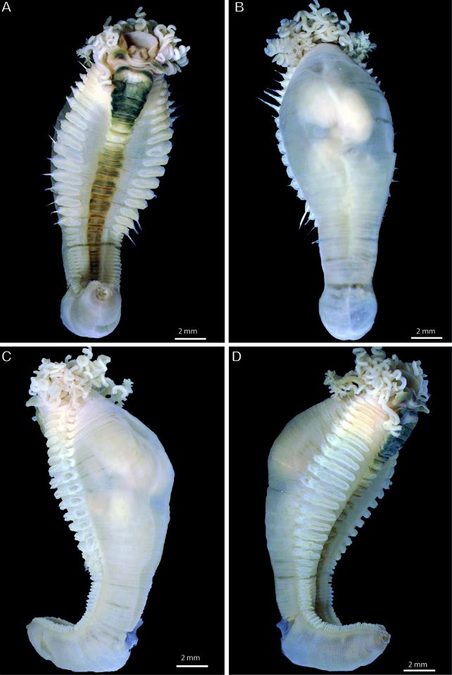
It’s that squishy body that makes the three species assigned to the new genus Terebellosuctoria stand out: On their undersides are modified pads that form strange, sucker-like structures unlike those of any other known genus of spaghetti worm.
While the team of scientists that described the genus in a paper published in Records of the Australian Museum has some clues, the purpose of the suckers is something of a mystery.
They could be for sucking out the souls of drowned sailors, for all we know.
“The sucker-like structure is what makes this new genus so interesting and unique,” says marine zoologist Elena Kupriyanova of the Australian Museum, the paper’s first author.
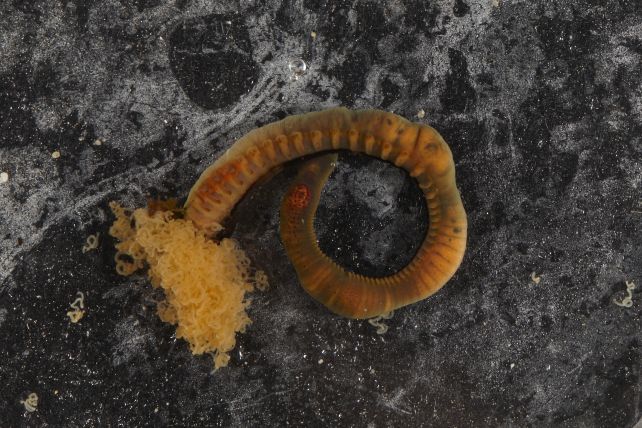
Actually, for all their somewhat alarming appearance outside of their habitat, spaghetti worms are relatively unassuming little creatures. Their family, Terebellidae, is related to earthworms, in fact – although the spaghetti worms’ anatomy is significantly more baroque.
They usually plonk themselves into the seabed, building a tube for protection, and extending their tentacles – the ‘spaghetti’ – to truffle out tasty morsels from the surrounding sediment.
They’re also not exclusive to the deep ocean. Many Terebellid worms live in shallower waters, and almost all Australian species described to date inhabit more sunlit depths.
But our understanding of the life that inhabits deeper waters is significantly more limited than our knowledge of the shallows.
During research voyages in 2021 and 2022, scientists aboard Australia’s research vessel Investigator explored seamounts around Christmas Island and the Cocos (Keeling) Islands, collecting specimens from these little-explored deep-sea ecosystems.
These voyages yielded many species totally new to science. Some have already been described. Others are still awaiting formal description.
But among the hundreds of specimens collected from the seafloor, two kinds of worms in particular stood out as unusual.
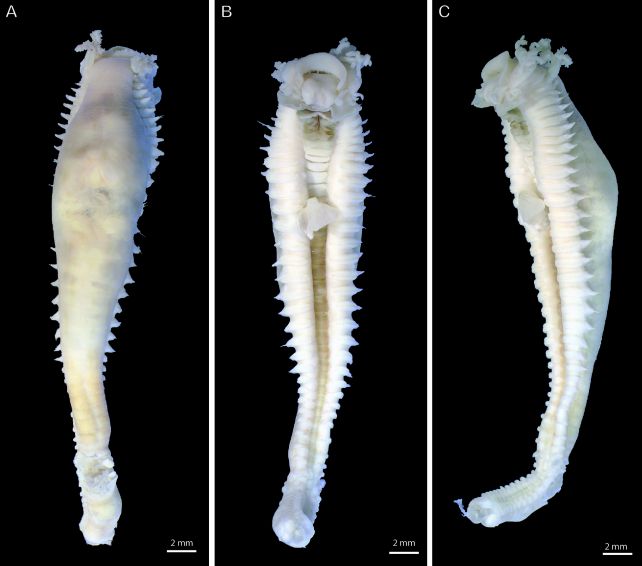
They were collected from seamounts at depths between 467 and 674 meters (1,532 and 2,211 feet), and, when extracted from their protective tubes, revealed sucker-like structures formed from modified pads on the undersides of the front portions of their segmented bodies.
One increasingly common step in describing a new species is to sequence its DNA.
When the researchers analyzed the DNA of their peculiar worms, the evidence – combined with their distinctive anatomy – pointed to something even more exciting than two new species: an entirely new genus.
That genus is Terebellosuctoria, a name that acknowledges their weird sucker-like structures, and the two species are Terebellosuctoria jimii and Terebellosuctoria keelingensis.
Eagle-eyed readers, however, will recall that we mentioned three species of Terebellosuctoria.
The third member of this strange little group had actually been discovered before – thousands of kilometers away, in even deeper waters (843 meters) off the coast of Japan.
It was described in a 2025 paper, and tentatively assigned to the Lanice genus, named Lanice spongicola, but its unusual anatomy left its evolutionary relationships unresolved.
The Japanese researchers had sequenced its DNA, too. Their analysis suggested that the worm was related to members of the Lanice and Loimia genera, but they couldn’t confidently place it in either.
They even suggested that the discovery of other worms with similar sucker-like structures might reveal an entirely new evolutionary lineage.
Well, here we all are.
By comparing the anatomy and DNA of the Australian specimens with the Japanese species, Kupriyanova and her colleagues were able to resolve the mystery. Lanice spongicola has now been reassigned to the new genus as Terebellosuctoria spongicola.
And there’s one more intriguing clue about those mysterious suckers.
The Japanese researchers observed their worm using its sucker-like structure to cling to the inside of its tube, which was attached to a deep-sea glass sponge. They suggested that it might help anchor the animal in a habitat where loose sediment is scarce.
Whether the Australian species use their suckers in the same way remains to be seen.
But that may have to wait for another day. The voyage yielded many potential new discoveries. This particular paper detailed seven new species – the two spaghetti worms and five other annelids.
There are many more to go – and that’s just from a relatively small patch of the deep ocean.
“An expedition may collect hundreds or thousands of specimens, but discovering what they actually are can take years,” Kupriyanova says.
“The specimens become part of museum research collections, where taxonomists can continue studying them long after the voyage has finished. The seven species described in this paper are another step in working through that remarkable archive.”
The research has been published in Records of the Australian Museum.
This article was fact-checked by Peter Dockrill and edited by Peter Dockrill. While we pride ourselves on our process, we are only human. If you spot a mistake, please let us know.


