

Key Insights
- A scientific sleuth suggests that 15 companies are selling thousands of antibodies using questionable validation images.
- The images are used in sales materials for antibody reagents to show researchers the effectiveness of the reagents, which are used in fields such as cancer biology and neuroscience.
- Six of the 15 companies responded to requests for comment, with each of those responding promising to review their catalogs; other scientists express concern and disappointment about the potential consequences of the apparent inconsistencies between the reagents being sold and the validation images.
A new report alleges that at least 15 companies are selling antibodies to researchers using images and validation data that show signs of manipulation. The report has cataloged close to 19,000 authentication images that the author says show signs of tampering or fabrication.
The findings follow a similar report in May that detailed apparent manipulations of antibody validation images in Thermo Fisher Scientific’s sales catalog. This latest investigation shows that the problem extends to at least 17,495 antibody products from 15 companies, including Abcam, Abnova, Antibodies.com, Boster Biological Technology, Bioss, Geno Technology (with the G-Biosciences brand), GeneTex, Huabio, LifeSpan BioSciences (LSBio), MilliporeSigma, Novus Biologicals and R&D Systems, OriGene Technologies, ProteoGenix, Santa Cruz Biotechnology, and Thermo Fisher Scientific.
Adjusting the black and white levels of the original antibody-validation image (left) reveals changes in the background around the cells (right). The report says these patterns are consistent with digital “painting.” Credit:
Reese Richardson
“Scientists should be outraged because they’ve been sold products that are not clearly validated,” says Elisabeth Bik, an independent research-integrity consultant based in the San Francisco Bay area.
Biochemists use antibodies to detect proteins in biological samples. They’re essential reagents in experiments such as Western blots and fluorescence imaging, across different fields ranging from cancer biology to neuroscience. The validation images, typically included in sales materials for the antibodies, are supposed to give researchers confidence that the antibodies they buy are effective and worth the price tag.
Evidence of image manipulation
This looping video cycles through Western blots for different antibodies. The protein band shifts to be near the target for each of the antibodies, yet the background noise remains identical even though it should be unique for each experiment. Credit: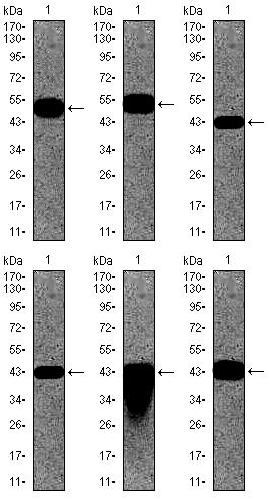
Reese Richardson
“What’s happening here is not right, which is why I have gone to great lengths to ensure that the evidence is documented and publicly available,” says Reese Richardson, a scientific disinformation researcher at Northwestern University and the report’s author. “I want these companies to explain it.”
Richardson—aided by other sleuths who sent him images to investigate—trolled through the companies’ catalogs looking for visual “fingerprints” that ought not to appear in more than one experiment.
Each run of a Western blot, for example, contains random background noise that should be unique. Richardson downloaded validation images from the companies’ websites and increased their contrast to make that background noise easier to see. After doing that, he looked for telltale signs, such as the same fingerprints appearing in blots that were said to come from different antibodies; bands that seemed to have been copied or moved to different positions; repeated blocks of background noise; identical images used by different companies; and areas that looked like they had been digitally painted over.
He found no shortage of such images. In particular, Richardson found large groups of images in which the backdrop was identical but the protein strip appeared to have been shifted up or down the blot to be closer to the product’s target protein.
“The background noise is the exact same, but the band is moving around,” Richardson says.
Damaged trust in antibody suppliers
Each example of an image falling afoul of the above patterns was added to the repository, but this inclusion does not necessarily prove that the antibodies are defective or even that the images were conclusively fabricated. What it does show is that Richardson found 18,943 images that contain patterns that he thinks are inconsistent with genuine and unedited experimental data.
“There’s the underlying quality of the product as well as data manipulation, and those things are not necessarily the same thing,” says Harvinder Virk, a clinical lecturer in the Department of Respiratory Sciences at the University of Leicester and cofounder of Only Good Antibodies, an open science initiative that houses a database showing how commercial antibodies perform in standardized tests.
“These new findings shock me. I have done work with some of these companies, and there are good actors in there. I know at least some of them are actively removing products from the market when we find problems,” Virk says. “It is surprising to see that some of the same organizations might not have processes that are robust enough to stop outright manipulation from making it onto their product pages.”
Of the 17,495 antibodies that showed up in Richardson’s investigation, 54 of them have already been assessed by Only Good Antibodies. Of those 54, “43 of them were not recommended in at least one of their tests,” Richardson says.
It’s also worth noting that Richardson did not do a systematic audit; he deliberately searched in places where he thought he might find problems rather than investigating a random sample of a company’s products. He also excluded images that were too low resolution for him to investigate.
The impact is nevertheless substantial, Bik says. “Scientists have been misled on an enormous scale.”
Alexey Merz, a professor of biochemistry at the University of Washington Seattle who regularly uses antibodies in his research, says that if the antibodies are less effective than the allegedly falsified images suggest, the results from previous experiments could have been affected, and potentially valuable findings may have gone undiscovered.
“My overall reaction is profound disappointment. This does indeed suggest a widespread if not pervasive problem across the industry,” Merz says. “Insufficient validation can lead to years of lost effort and even incorrect and misleading published results.”
Identifying suppliers of fraudulent antibody images
The duplication of the same fingerprints across different antibody vendors suggests that these images could be coming from an independent supplier somewhere along the antibody supply chain. Richardson likens the situation to buying a store-brand product from different supermarkets. The labels and the branding may differ, but the product (and its accompanying verification data) may well have come from the same original manufacturer.
This possibility adds to the number of questions that the 15 companies in Richardson’s analysis need to answer, Bik says: “Where did these images come from? Were they produced internally, or did they come from a third-party supplier? Did that third party also supply the antibodies?” she asks. “Or did you as a company manipulate these photos?” C&EN contacted each of the 15 companies for comment. Six shared responses before the publication deadline: Abcam, Bioss, GeneTex, MilliporeSigma, Novus Biologicals and R&D Systems, and Thermo Fisher Scientific. All of them said they value accuracy and promised to review all of their products that were highlighted in the report.
The uncovering of duplicated images is likely to be just the first step in a longer saga for these 15 companies as they face pressure to establish how the problem became so widespread, Bik says. They will likely also face calls from customers to prove the effectiveness of their antibody products and to make those findings public, something that Bioss has already said it will do. “If the review establishes that a relevant product claim cannot be substantiated or requires material correction, Bioss will identify affected customers and provide appropriate support and remedies, which may include replacement or refund,” Bioss says in its statement to C&EN, noting that it had not yet had a chance to assess Richardson’s report. “Bioss intends to disclose material findings and product level corrections after receiving and reviewing the underlying materials.”
For Richardson, the questions about the images and antibodies highlight the need to bolster and properly fund research-integrity experts. “It is the job of scientists to produce reliable information, and part of that is identifying which information out there is unreliable.”