Humanity needs new materials to help it move away from a ‘digging civilisation’ to a ‘separating civilisation’. That’s the big idea of Susumu Kitagawa at Kyoto University, one of last year’s winners of the Nobel prize in chemistry for his work on metal–organic frameworks (MOFs), who says that we need to focus on ‘mining’ the ‘invisible gold’ all around us – air.
Kitagawa won the 2025 chemistry Nobel prize, alongside Omar Yaghi and Richard Robson, for the creation and development of porous coordination polymers that include MOFs. Kitagawa’s personal contribution, which won him a third of the 2025 chemistry prize, was developing stable MOFs. He then went one step further, developing a third generation of MOFs that were much less rigid than those that preceded them.
MOFs are synthesised by combining a metal with an organic linker. As the framework self-assembles, a metal ion sits at the centre of each unit with several organic linkers connecting it to several other metal ions. This pattern of a metal ion connected to another metal ion by organic linkers repeats many times to make a huge, open, often 3D, crystalline structure. These frameworks are highly porous so can capture other molecules within their structures and there has been great excitement over their potential to capture and store gases. Kitagawa notes that a single gram of a MOF can have the same surface area as a football pitch.
Kitagawa told the audience at the 10th EuChemS Chemistry Congress in Antwerp, Belgium, that while humanity had had scored some successes mastering control of solids and liquids, gases were proving to be more difficult. By making use of porous materials, such as MOFs, human civilisation could extract raw materials from the air, such as carbon, oxygen and hydrogen, to fuel its industries. This approach has the advantage that these materials are freely available to every country, are plentiful and do not threaten scarce resources such as freshwater.
‘Already people use the nitrogen from the air, for instance in the Haber–Bosch method [to produce ammonia for fertilisers],’ Kitagawa notes. ‘But the problem is that the hydrogen comes from underground resources – natural gas and petroleum.’ He believes that in the future, it will be possible to supply hydrogen by breaking down collected water vapour into oxygen and hydrogen. This hydrogen could then be combined with nitrogen to make a range of chemicals including fertilisers. The hydrogen could also be put to work in the Fischer–Tropsch process to produce fuels. This would mean combining hydrogen with captured carbon dioxide through the reverse water–gas shift reaction to produce a mixture of carbon monoxide and water. Drying this mix and adding further hydrogen to the carbon monoxide creates syngas, which can be reacted over metal catalysts to produce a variety of liquid hydrocarbons.
‘So, we can visualise these technologies and science, but the problem is the political issue,’ he adds. ‘Because governments mostly think about the next two to three years.’ Kitagawa says that his vision of ‘mining the invisible gold’ of air is both costly to implement and a project that would take 50 years to come to fruition. ‘So, that is the reason why I accepted this plenary lecture to advertise [this idea] to young people,’ he says.
Kitagawa acknowledges that moving to a ‘dilute molecule economy’ is not straightforward. As carbon dioxide only makes up 0.04% of our atmosphere, capturing it from air is currently energy intensive and costly. He believes that new porous materials could make this process of selectively capturing gases much cheaper.
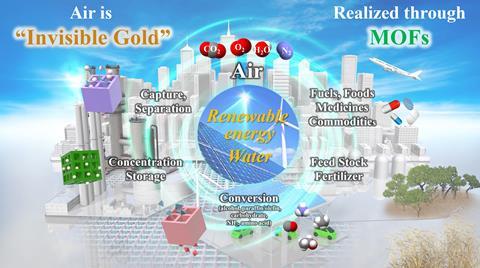
Kitagawa’s group’s contribution to this grand idea is the development of new soft, porous MOFs. They have developed a series of frameworks that range from flexible MOFs – which can double in volume when they accommodate guests – to frameworks that exhibit almost no change in volume during gas binding, so that only the local arrangement of organic ligands within the crystal changes. The former are suited for mechanical functions such as actuators, while the latter are suitable for the selective separation of gases. They are far more robust than their predecessors and can undergo repeated cycles of adsorbing and desorbing their target gas. Another problem the team is looking to solve is that exhaust gases and air contain water vapour, which hinders the selective capture of carbon dioxide. An innovation introduced by Kitagawa’s team is making the pores of these MOFs hydrophobic, thereby enabling the capture of carbon dioxide while at the same time excluding water.
Gill Reid, a past president of the Royal Society of Chemistry and a coordination chemistry researcher at the University of Southampton, UK, describes Kitagawa’s concept as an ‘extraordinary vision’. ‘Hearing him tracing his scientific journey, from his group’s initial discovery of a new family of coordination complexes that contain molecular “holes” to his appreciation of how these flexible dynamic structures can be rationally designed and exploited for the highly selective adsorption and release of molecules such as methane and carbon dioxide from complex mixtures with remarkable control was deeply inspiring,’ she adds.