





Per- and polyfluoroalkyl substances (PFAS) are often informally referred to as ‘forever chemicals’ because they’ve soaked so deeply into the environment and take such a long time to break down.
There are thousands of these PFAS in circulation, used extensively in manufacturing and product materials, and scientists are busy continuing to assess what exactly the health risks of all of them are – and to what extent we’re exposed to them every day.
In a new study in Cell Reports Sustainability, researchers from the US estimate that levels of PFAS in the drinking water of Americans could be twice as high as standard reporting suggests.
The reason for the discrepancy is a matter of rounding. When the numbers have been crunched previously, there’s usually a threshold below which PFAS levels are rounded down – and that’s not what the study authors did here.
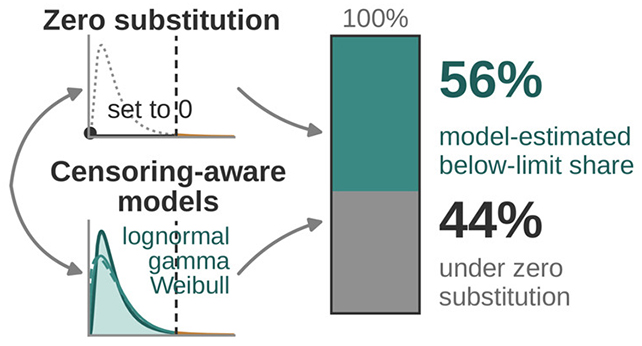
“When the levels of these chemicals are below our reporting limit, it’s often treated as zero when we calculate how widespread they are,” says environmental scientist Gehendra Kharel, from Texas Christian University.
“We set out to understand how treating those results as zero changes the picture of PFAS occurrence in drinking water.”
The researchers analyzed 1.86 million drinking water data points supplied by the Environmental Protection Agency (EPA) in the US. They found 98 percent of the readings were below the minimum reporting level (MRL).
That means the traces of PFAS aren’t high enough to be measured reliably by a lab, the study team says – but it doesn’t mean there aren’t any of the chemicals there, or that the water is guaranteed to be safe.

frameborder=”0″ allow=”accelerometer; autoplay; clipboard-write; encrypted-media; gyroscope; picture-in-picture; web-share” referrerpolicy=”strict-origin-when-cross-origin” allowfullscreen>
Computer models were then used to predict what the values below the MRL might be, based on the figures that had been registered in the drinking water for 25 different PFAS.
Using the statistics produced by the models, the researchers suggest standard reports may be giving an average level of these chemicals that’s 56 percent lower than the models estimate.
For the six PFAS that the EPA specifically sets legal limits for in drinking water, the researchers came up with an average of 5.2 nanograms per liter, compared to 2.6 nanograms per liter when below-limit results are counted as zero.
Overall, these hidden chemical levels pushed only a few dozen extra sampling locations over the EPA’s benchmarks for PFOA and PFOS, but the researchers stress they’re essential to getting a full picture of the problem.
“Our study only examines how PFAS measurements are summarized,” says Kharel. “It does not establish that every below-limit result poses a health risk.”
The researchers would like to see more sensitive testing measures introduced, to remove the need to round down, as well as more extensive water system monitoring. They’re also making the PFAS Censoring-Aware Screening Tool (PFAS-CAST) used here available for other teams and agencies to use.
“Future work combining this framework and PFAS-CAST with improved laboratory sensitivity, treatment engineering, exposure science, public health, and equity research could strengthen contaminant monitoring and help direct limited resources to places where better evidence would have the greatest benefit,” write the researchers in their published paper.
As for how dangerous these PFAS actually are, we’re still not entirely sure. They’ve been linked to faster aging, the spread of cancer, weaker bones, and multiple sclerosis in the past, though it’s difficult to prove direct cause and effect.
Unfortunately, by the time their potential health complications started to come to light – not thanks to the businesses making them – PFAS were already well established.
There’s growing momentum behind greater regulation for forever chemicals, but a lot of the damage may have already been done.
A significant step towards a better understanding of PFAS exposure levels and health risks is knowing precisely just how much of these chemicals are out there, including in our drinking water – and the difference between ‘zero’ and ‘less than MRL’ is important.
“Our method gives water agencies and utilities a way to account for that difference, so they can see where more testing would help and be clearer about what they do and do not know,” says Kharel.
The research has been published in Cell Reports Sustainability.
This article was fact-checked by Rebecca Dyer and edited by Rebecca Dyer. While we pride ourselves on our process, we are only human. If you spot a mistake, please let us know.


