


There are many things about modern life we take for granted – perhaps none more so than the vast electrical grids that power so much of it.
But for many years, these grids have been doing something strange.
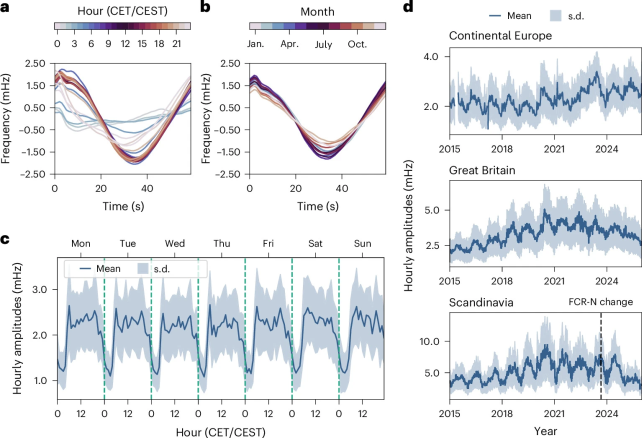
Every 60 seconds, they pulse – a tiny change in the frequency that subsides only to recur 60 seconds later.
And it’s not just one power grid. Around the world, multiple power grids – physically isolated from each other – have been found doing the same thing.
It’s precise, and it has persisted, year after year, for more than a decade. This precision suggests that it’s not an accident, but it has remained a curiously enduring puzzle.
Now, scientists think they have found the answer – and it’s surprisingly mundane.
Every minute, some uninterruptible power supplies – the backup systems used in places like hospitals, data centers, and research facilities – perform routine battery checks, creating small but measurable surges in electricity demand. And it’s like clockwork.
“Even benign control routines can become systemically relevant when many devices act coherently,” writes a team led by physicist Dirk Witthaut of the University of Cologne, Germany, in a paper published in Nature Energy.
“Unintended synchronization can generate recurrent and potentially amplified oscillatory behavior in large-scale cyber-physical energy systems.”
An electrical grid is always performing a delicate balancing act. At any given moment, the amount of electrical power being produced has to closely match the amount being consumed.
In Britain, there’s a name for one of the most glorious examples of the challenge this presents: TV pickup.
It describes the surge in power demand when large numbers of people collectively turn on their electric kettles to make a cup of tea during commercial breaks in TV programs.
It’s become less of a problem as grid operators have learned to anticipate it and streaming has gained popularity, but it can still generate massive demand during nationally popular programs such as royal what-have-yous and football matches.
These fluctuations affect the frequency of the alternating current flowing through the grid – typically 50 or 60 hertz, depending on where in the world you live. When demand exceeds supply, the frequency dips; when supply exceeds demand, it rises.
Usually, these fluctuations are small and irregular, and grid operators work constantly to keep them under control.
But a fluctuation that repeats with extraordinary precision every 60 seconds? Across electrical grids on five continents that aren’t even connected to one another?
Well, that’s a whole new kettle of fish.
Hints of the phenomenon date back to at least 2014, when researchers in Scandinavia documented unusual minute-scale fluctuations in grid frequency.
Such oscillations had been linked to hydropower systems, but similar patterns could also be found in electrical grids elsewhere – including continental Europe, Britain, Australia, and the United States.
The fluctuations were small, but remarkably persistent, recurring with extraordinary precision across grids of vastly different sizes and configurations, including systems physically isolated from one another.
Whatever was causing the mysterious pulse, hydropower alone couldn’t explain it.
To figure it out, Witthaut and his colleagues analyzed high-resolution electricity measurements from buildings at the Forschungszentrum Jülich research campus in Germany.
And this is where the kettle started to heat up – because the 60-second pattern appeared in four buildings, all of which contained uninterruptible power supplies. None of the buildings they measured without these systems showed the same pattern.
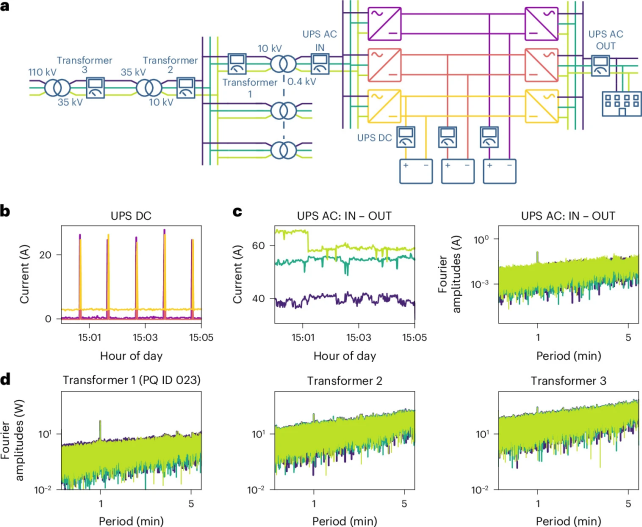
Following the electrical signals more closely, the researchers detected tiny bursts of current from the batteries at precisely one-minute intervals. They were able to trace the resulting fluctuations through one building’s electrical system, all the way to the connection with the public high-voltage grid.
The manufacturer subsequently confirmed the culprit’s identity – routine battery self-tests, conducted automatically by the systems’ management software.
But why would equipment in different buildings, let alone different countries, be doing this at the same time?
The answer appears to lie in the clocks. Digital devices can synchronize their internal clocks using external time signals, meaning that independently operating systems can end up performing their scheduled tasks together.
Individually, these small checks are insignificant. But when enough devices act in synchrony, their combined electricity demand can produce a measurable effect across an entire power grid.
This explanation will need to be tested in other locations to confirm that the same mechanism is at work, but it’s still a rather satisfying solution to a very weird puzzle – and one that could help engineers design more resilient power grids.
At the moment, the fluctuations pose no immediate threat to grid stability; according to the researchers, they are relatively minor, typically measuring just a few millihertz in amplitude.
But as electricity networks become increasingly dependent on digitally controlled equipment, Witthaut and his colleagues warn that the problem could grow.
Battery storage systems, data centers, and internet-connected devices are proliferating, potentially adding more synchronized electrical demands to the grid.
And although the fluctuations are small, they can be amplified by the grid’s own dynamics, contributing to wear and tear on equipment such as hydropower turbines.
Fortunately, the solution may be relatively straightforward, at least for big batteries and backup systems. Rather than having thousands of devices perform the same task at the same moment, manufacturers could introduce small variations into their software schedules, preventing the minutely pile-up.
“Our results indicate that coherent cyber-physical oscillations can be mitigated directly at their source through improved control design,” the researchers write.
Indeed, they have already contacted the manufacturer of one of the systems they identified, and the company issued a software update that relaxed the strict periodicity of its system checks.
So there we are – mystery solved. Now we can all relax and have a nice cup of tea. Let’s just take turns boiling the kettles.
The research has been published in Nature Energy.
This article was fact-checked by Rebecca Dyer and edited by Rebecca Dyer. While we pride ourselves on our process, we are only human. If you spot a mistake, please let us know.


