Dark Mode Light Mode
How Many Steps a Day Does It Take to Sharpen Your Attention? A 14-Year Study Hints at The Range
Probiotics May Protect From Signs of Early Cognitive Decline, Clinical Trial Finds
Chemistry, medicine, materials and the technology shaping tomorrow — the best science stories from trusted sources, every day.

Probiotics May Protect From Signs of Early Cognitive Decline, Clinical Trial Finds

Probiotics May Protect From Signs of Early Cognitive Decline, Clinical Trial Finds Probiotics May Protect From Signs of Early Cognitive Decline, Clinical Trial Finds


Food for the gut may possibly feed the brain as well.

A rigorous new clinical trial has now found evidence that certain probiotic mixes may protect from some initial signs of cognitive decline.

Among older adults with early cognitive impairment, taking a multistrain probiotic supplement daily for roughly six months resulted in a number of benefits.

Most notably, probiotic use compared to a placebo was associated with better scores on several cognitive tests, and it also led to a significant reduction in plasma levels of pTau181.

This is a blood-based biomarker of Alzheimer’s disease that measures levels of a phosphorylated form of tau protein in the blood, which can reflect Alzheimer’s-related changes in the brain.

In cases of dementia, tau proteins can fold abnormally, leading to tangles that can clog up brain cells.

Prior to the onset of dementia symptoms, pTau181 often increases in the blood.

These new findings, published in the Journal of Alzheimer’s Disease, are exciting but still preliminary.

To be clear, they do not show that probiotics can directly reduce tau tangles in the brain.

However, they do join growing evidence that suggests the gut microbiome is closely linked to brain health, and that it may be a useful target for future dementia treatments.

“Collectively,” the trial authors conclude, “these findings indicate that maintaining or restoring the gut microbial balance through probiotic supplementation may represent a promising strategy to mitigate early Alzheimer’s disease-related pathological processes during the prodromal stage of Alzheimer’s.”
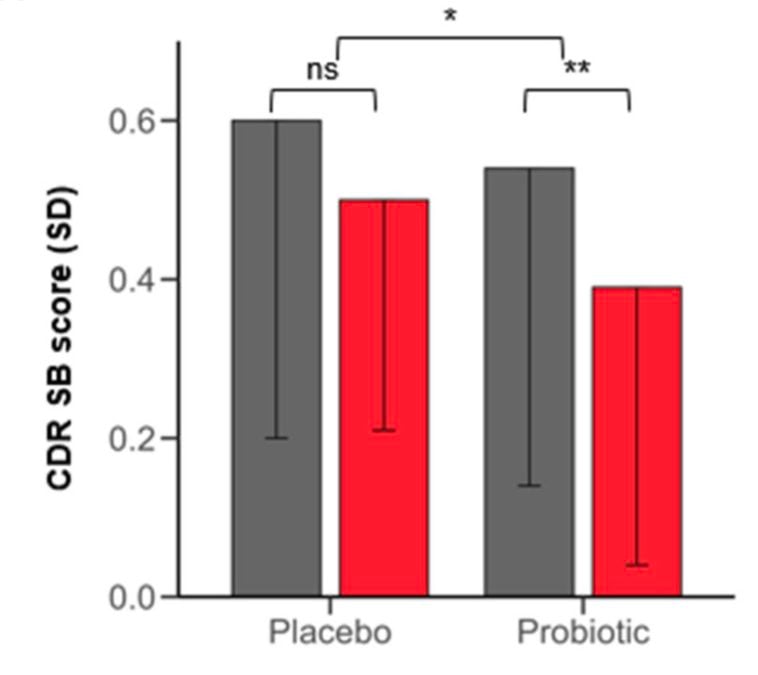
New Clinical Trial Finds Probiotics May Protect From Signs of Early Cognitive Decline
Changes in cognitive impairment scores among older adults who took a daily probiotic supplement or placebo for 24 weeks. Grey bars show scores before treatment, while red bars show scores after treatment. Lower scores indicate less impairment. Only the probiotic group showed a statistically significant improvement.
(Seo et al., Journal of Alzheimer’s Disease, 2026)

The trial took place among 87 participants within a larger, longitudinal study on cognitive decline in South Korea, called the Gwangju Alzheimer’s Disease and Related Dementias (GARD) cohort.

Of the 100 participants originally randomized, 40 completed the 24-week probiotic intervention, while another 47 completed the placebo treatment.

Neither the participants nor the researchers knew who was taking what.

The probiotic given to participants has the code name KL-P301, and it consists of three bacterial strains, including subspecies of Bifidobacterium animalis, Limosilactobacillus fermentum, and Levilactobacillus brevis.

Participants could choose to consume the powder alone or dissolved in water.

Compared to those given a placebo, those who were given a daily probiotic supplement showed a significant reduction in plasma pTau181 by the end of the trial.
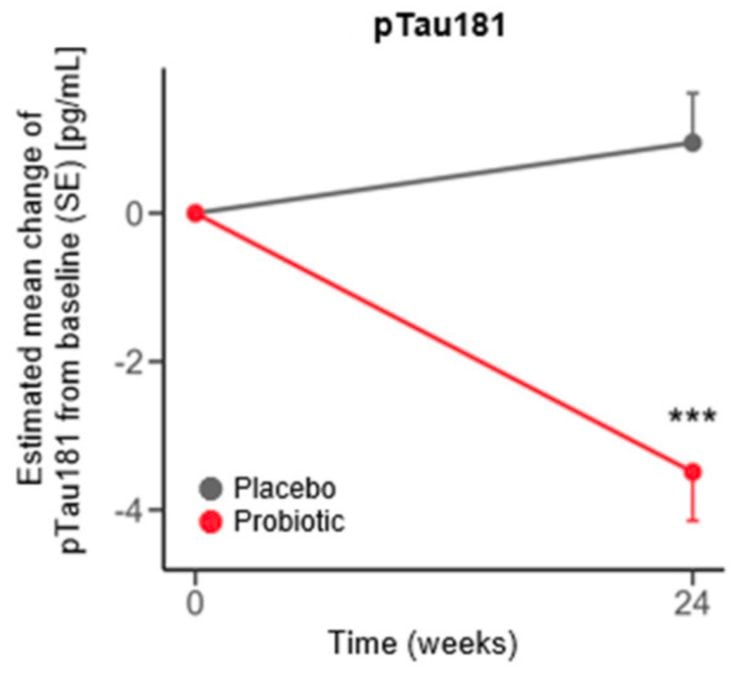
New Clinical Trial Finds Probiotics May Protect From Signs of Early Cognitive Decline
Changes in blood levels of phosphorylated tau 181 (pTau181), a form of tau protein associated with Alzheimer’s disease, among older adults who took a daily probiotic supplement or placebo for 24 weeks. Levels fell significantly in the probiotic group (red), while remaining relatively stable in the placebo group (grey). (Seo et al., Journal of Alzheimer’s Disease, 2026)

After just 24 weeks, they also showed significantly better scores on a Clinical Dementia Rating system.

In fact, their performance on tasks that tested their ability to interpret visual information, understand spatial organization, and draw complex shapes improved significantly, although not all comparisons with the placebo group were statistically significant.

“The parallel reduction in plasma pTau181 and the preservation of visuospatial construction and visual memory provide converging evidence supporting the potential involvement of microbiota–immune–brain interactions in early neurodegenerative processes,” the trial authors conclude, led by neurologists Kang-Ho Choi and Kun Ho Lee from the Republic of Korea.

Previously, some clinical trials on probiotics have found similar results but with key differences.

For instance, in patients with clinically diagnosed Alzheimer’s disease, multistrain probiotic supplements that include both Bifidobacterium and Lactobacillus were associated with improved brain-derived markers in the blood.

They were also linked to lower circulating inflammatory and oxidative stress markers.

But this new trial takes an important step forward. It examines blood markers associated with tau pathology alongside cognitive function, with inflammation potentially playing a role.

After 24 weeks, changes to most inflammatory markers were generally modest.
But one marker in particular, called IL-1β, declined to a greater extent in the probiotic group than the placebo group.

“This finding may suggest a selective anti-inflammatory effect of the multistrain probiotic on specific cytokine pathways,” the authors suggest.

In other words, probiotics may improve gut health, and reduce some signals of systemic inflammation that may reach the brain. This, in turn, may somehow reduce tau markers in the blood.

Poor gut health, for instance, may activate immune responses that could weaken the blood–brain barrier or contribute to neuroinflammation and damage to neurons.

But whether or not probiotics can restore gut health is still under investigation and poorly understood.

Figuring out how these supplements might impact the brain via the gut is a whole other step.

Animal studies have shown positive results, but these don’t always translate to humans. Larger clinical trials are now needed.

“While preliminary, these findings warrant larger and longer trials incorporating tau/amyloid-β PET imaging to assess their durability, clinical relevance, and the utility of visuospatial cognition as a potential endpoint,” the study authors conclude.

“Overall, these results support further investigation of this multistrain probiotic formulation as a potential non- pharmacological approach in early stage of Alzheimer’s disease.”

The research has been published in Journal of Alzheimer’s Disease.

This article was fact-checked by Peter Dockrill and edited by Peter Dockrill. While we pride ourselves on our process, we are only human. If you spot a mistake, please let us know.


Source link

Previous Post
How Many Steps a Day Does It Take to Sharpen Your Attention? A 14-Year Study Hints at The Range

How Many Steps a Day Does It Take to Sharpen Your Attention? A 14-Year Study Hints at The Range